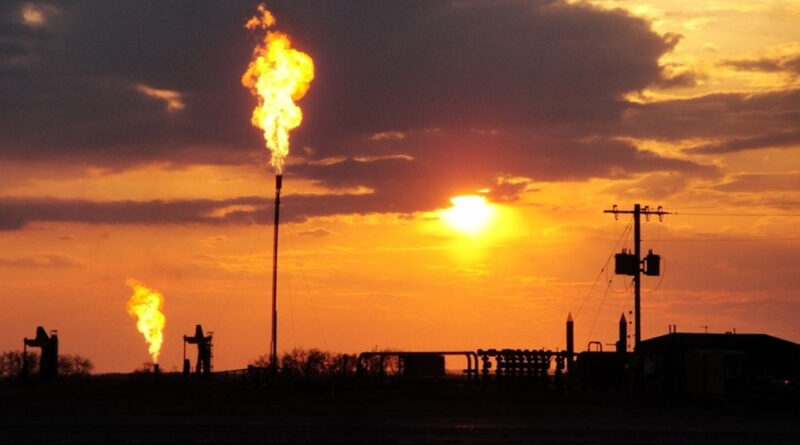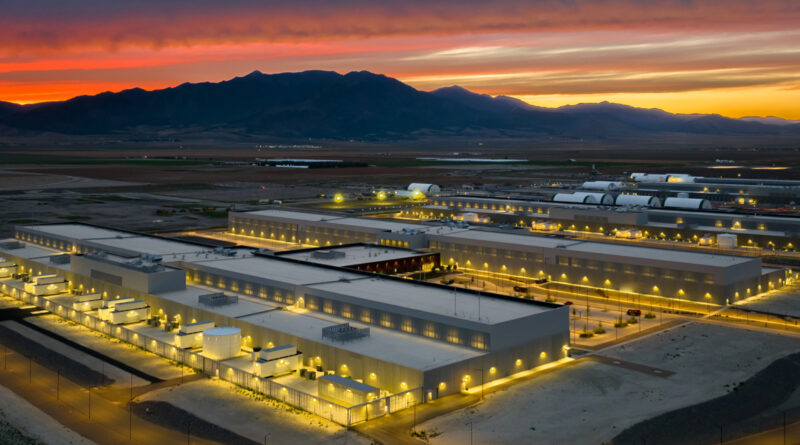
Supported By Big Oil, Data Center Boom Faces Growing Local Opposition
Fossil fuel companies like Exxon see powering data centers as an important new revenue source and are making promises they can’t keep.

Fossil fuel companies like Exxon see powering data centers as an important new revenue source and are making promises they can’t keep.
Unlawful Delay Ignores Health Risks, Energy Waste, Widespread Opposition Contact Sierra Club — Shannon Van Hoesen, shannon.vanhoesen@sierraclub.org Environmental Defense Fund — Sharyn Stein, sstein@edf.org Clean Air Task Force — Samantha Sadowski, ssadowski@catf.us Center for Biological Diversity — Jason Rylander, jrylander@biologicaldiversity.org Earthjustice — Alexandria Trimble, atrimble@earthjustice.org Environmental Law & Policy Center … [continued]
New Zealand is backpedaling furiously on its commitment to lower methane emissions from livestock by 2050.
Assessing the new Low-Carbon Fuels Delegated Act and the case for prioritising RFNBO hydrogen Following the recent adoption of the Delegated Act (DA) on low-carbon fuels, the EU has completed the regulatory framework for both renewable (RFNBO) and low-carbon hydrogen production. The worst case scenario has been avoided. The default … [continued]
 "GOC Tring 133: Cattle" by Peter O'Connor, aka anemoneprojectors, via Flickr (CC BY-SA 2.0 license).
Dr. Serber will advance the biotechnology enabling ArkeaBio’s first-of-its-kind solution to deliver a practical, cost-effective way for farmers and producers to reduce emissions and enhance livestock productivity. Dr. Serber’s appointment comes as ArkeaBio accelerates toward product validation and commercial deployment. BOSTON, MA, USA — ArkeaBio, a global agricultural bioscience company … [continued]
 An electron microscope image of single-celled methanogens, members of the archaea domain. They are ubiquitous in oxygen-free environments, turning simple foods into methane, a potent greenhouse gas.
Alienor Baskevitch/UC Berkeley
An electron microscope image of single-celled methanogens, members of the archaea domain. They are ubiquitous in oxygen-free environments, turning simple foods into methane, a potent greenhouse gas.
Alienor Baskevitch/UC Berkeley
UC Berkeley researchers tweaked a key enzyme involved in microbial methane production to understand the unique fingerprints of different environments on Earth that generate the greenhouse gas. By Robert Sanders Roughly two-thirds of all emissions of atmospheric methane — a highly potent greenhouse gas that is warming planet Earth — come … [continued]
We spend a lot of time here at CleanTechnica spreading the good news about renewable energy and how it will allow us to electrify everything in accordance with the vision of such notables as Mark Z. Jacobson of Stanford University. Perhaps that focus blinds us to some aspects of life … [continued]
 ChatGPT generated panoramic aerial image of a traditional RoPax ferry disturbing shallow coastal sediments, illustrating wake turbulence and potential methane release pathways
I was recently asked if reducing ship speeds is the only available solution to the methane emissions documented in a recent study from the journal Communications Earth & Environment. The research, focused on ship traffic in Neva Bay, Russia, revealed that vessels traveling faster than 12 knots with hull drafts … [continued]
During an especially cold spell in late January last year, Lynne from Santa Monica started to feel unwell. “I was just feeling really sick, and I thought it had something to do with the medication I was taking,” she recalls. “I had headaches, nausea, and dizziness — it was pretty … [continued]
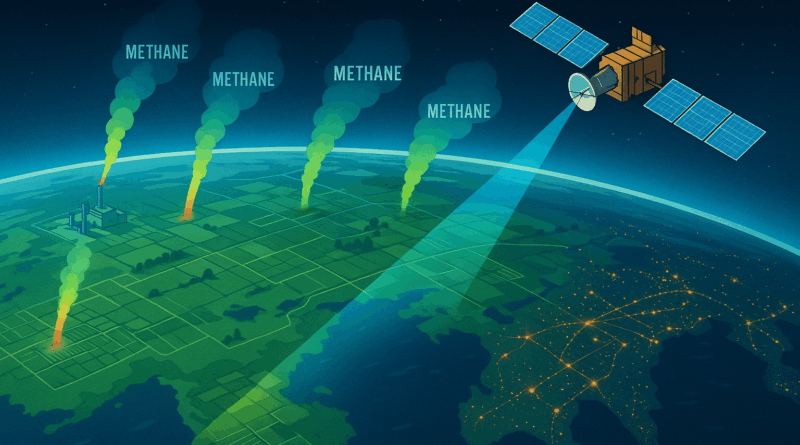 ChatGPT generated this panoramic illustration showing methane emissions detected from space, with plumes rising from industrial and agricultural regions tracked by satellite
The recent failure of MethaneSAT, the widely publicized methane-monitoring satellite developed by the Environmental Defense Fund, attracted global attention. The satellite lost communication with ground control in June 2025, just 15 months after its launch, and was officially declared irrecoverable in July. This event disappointed climate scientists, environmentalists, and policymakers … [continued]