US Navy Prowls For E-Fuels From The Seven Seas
The US Navy is eyeing e-fuels made from green hydrogen and captured carbon dioxide to sustain seagoing and land-based operations.

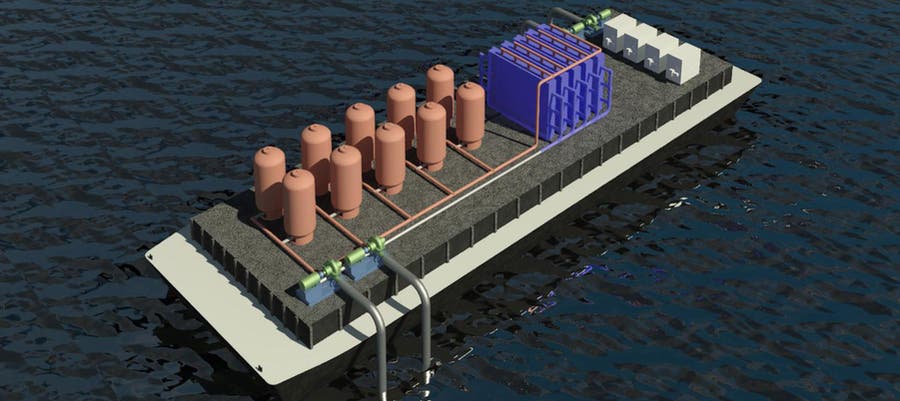 The US Navy is eyeing e-fuels made from green hydrogen and captured carbon dioxide to sustain seagoing and land-based operations (image via MIT News).
The US Navy is eyeing e-fuels made from green hydrogen and captured carbon dioxide to sustain seagoing and land-based operations.
Scientists at PNNL say they have created a new carbon capture process that is effective and economical for flue gas sequestration.
Scientists claim the way to offset the curse of fossil fuel pollution is to make the producers responsible for cleaning up their waste products.
NET Power is developing a new process for capturing carbon emissions from a natural gas generating station.
With the ongoing climate emergency and nations’ commitments to meet net-zero goals by 2050, there’s a heightened need to significantly reduce greenhouse gas emissions through whatever means possible. Carbon capture and storage (CCS) or carbon capture, utilization, and sequestration (CCUS) are included in the mitigation pathways set out by the … [continued]
Algae biofuel could have another moment in the sun, now that more federal dollars are pouring into carbon capture-and-recycling technology.
When did you create Terraform, and what’s the story behind it? What was your initial inspiration? Terraform Industries was founded in late 2021, as a vehicle to bring gigascale atmospheric hydrocarbon synthesis to the world. Regardless of technical approach, ever-cheapening renewable power means that, in any given market, it’s only … [continued]
Carbon dioxide is an important molecule necessary for life on Earth. Trees need CO2 for photosynthesis, crops produce higher yields in its presence, and some bacteria can transform it into food. The molecule is even an important part of human health, driving us to take in big breaths of oxygen. However, … [continued]
The manager for strategic partnerships at Climeworks, Barbara Truyers, has stated that the cost of Direct Air Capture technology is set to drop as low as $250-$300/mtCO2e by the end of 2030 while hoping to reach multi-megaton capacity. Climeworks has recently announced Carbon Dioxide Removal (CDR) purchases by well known … [continued]
As the Russian Baltic Fleet rattles its sword, renewable energy stakeholders in Sweden and elsewhere are eyeballing Baltic Sea offshore wind for a foothold in the new electrofuel market.