Octopus Project Combines Direct Air Capture With Water Recovery
A new direct air capture system deploys salty wastewater to transform airborne carbon into solid carbonates and produce fresh water, too.

A new direct air capture system deploys salty wastewater to transform airborne carbon into solid carbonates and produce fresh water, too.
Captured carbon can yield carbon nanofibers and green hydrogen, too, which could be a better solution than simply pushing it underground.
 ChatGPT & DALL-E generated panoramic image illustrating the metaphor of pH balance scales in a marine setting.
Geoengineering raised its misshapen head today. Someone tagged me on a post on LinkedIn related to a firm that wants to put a common antacid into the oceans to bond with carbon dioxide they’ve absorbed. I nerded out and am deeply skeptical about the entire thing. That’s a pity, as … [continued]
Elephants in Africa are emerging as expert carbon capture and sequestration engineers, without pipelines or pricey infrastructure.
The US Department of Energy bets $2 million on a new carbon capture strategy that transforms ordinary buildings into CO2-devouring demons.
The Department of Energy is providing $1.1 billion to fund two direct air capture sites, one in Texas and one in Louisiana.
The UK government wants to ramp up oil and gas production in the North Sea and offset new emissions with carbon capture technology.
E-fuels, renewable natural gas, carbon capture — fossil fuel companies will stop at nothing to protect their business model.
Restoring forests marks one of six approaches PNNL researchers are exploring as they seek to understand which carbon dioxide removal methods can limit global warming to 1.5 degrees Celsius over pre-industrial levels by the end of the century.
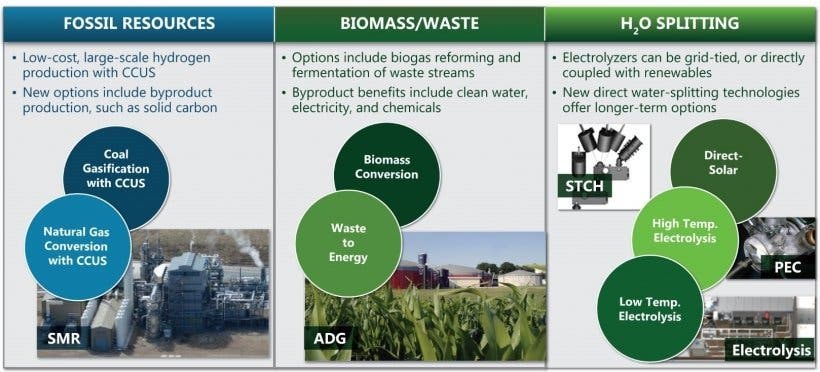 Shell continues its green hydrogen journey while ExxonMobil clings to natural gas with carbon capture (image courtesy of US Department of Energy).
Shell takes another step on its green hydrogen journey, while ExxonMobil doubles down on natural gas with carbon capture.