Trump Must Absolutely Love Solar Panels, Because They Help Farmers
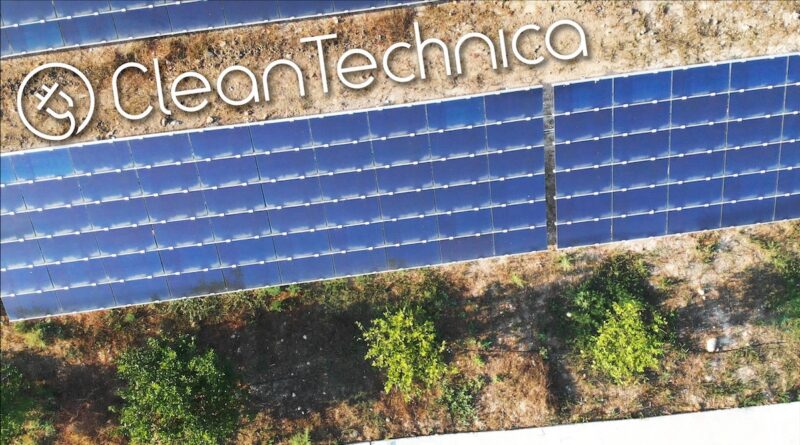
The agrivoltaic movement combines solar panels with agriculture, providing farmers with new opportunities to improve their financial situation at a time of skyrocketing fuel costs.

 The agrivoltaic movement combines solar panels with agriculture, providing farmers with new opportunities to improve their financial situation at a time of skyrocketing fuel costs (cropped, courtesy of Doral Renewables).
The agrivoltaic movement combines solar panels with agriculture, providing farmers with new opportunities to improve their financial situation at a time of skyrocketing fuel costs.
The ZOTA Would Open No Greater Than 1% of Fayette County Land to Agrivoltaic Solar Projects LEXINGTON, Kentucky — On Friday (9/18), Lexington Mayor Linda Gorton announced her decision to veto a zoning ordinance text amendment (ZOTA) previously passed by the Lexington-Fayette Urban County Council. The ZOTA, which passed with … [continued]
The Amendment Will Open No Greater Than 1% of the County to Agrivoltaic Solar Projects LEXINGTON, Kentucky — On Thursday, the Lexington-Fayette Urban County Council voted to pass a zoning ordinance text amendment (ZOTA) opening up no greater than one percent of Fayette County, including agriculturally zoned land, for large-scale solar … [continued]
Lexington, Kentucky — On Thursday, the Lexington-Fayette Urban County Council will hear a zoning ordinance text amendment (ZOTA) that would open up no greater than one percent of Fayette County, including agriculturally zoned land, for large-scale solar development. The ZOTA would require that any such solar projects be “agrivoltaic,” enabling the … [continued]
16 agrivoltaic projects in the state of New Jersey have just gotten approval to move forward by the New Jersey Board of Public Utilities (NJBPU). Together, the projects aren’t huge, but they do total 52.06 more megawatts of clean, renewable energy, produced on land productively being used for agricultural purposes. … [continued]
 Agrivoltaics works where panels provide useful farm functions such as shade, crop protection or water resilience, not merely where crops survive beside solar.
Agrivoltaics is appealing because it seems to solve two land-use problems at once. Put solar panels and farming on the same land, and the conflict between food and electricity appears to soften. The farm keeps producing, the panels produce power, and the project can be described as more sophisticated than … [continued]
One of the biggest criticisms of utility-scale solar is that it competes with agriculture for land. As countries race to add more renewable energy, that debate has become increasingly relevant in the Philippines, where arable land is both limited and economically important. Agrivoltaics offers a different approach. Instead of converting … [continued]
As farmers choose solar to support operations and boost income, suburban sprawl uses 6x more farmland and golf courses nearly 3x more than solar. WASHINGTON D.C. — The Solar Energy Industries Association (SEIA) today launched an interactive map showing how solar development and agriculture thrive side-by-side while creating shared value … [continued]
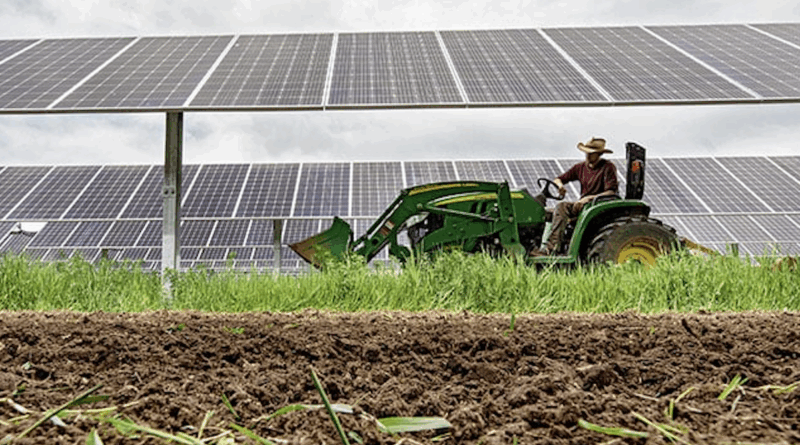 New Jersey is among the US states pursuing dual-use solar power (aka agrivoltaics) to help farmers keep farming while adding a reliable new source of revenue to their property (courtesy of NREL).
For farmers, renewable energy can be the difference between making a living and selling land that has been in the family for generations.
America’s family farmers are facing mounting challenges. Input costs like fertilizer and diesel are going up while international markets recede and commodity prices crater. Despite these challenges, American farmers are resilient and resourceful. They make decisions every day that balance risk, reward, and long-term stewardship. They adapt to volatile commodity … [continued]