
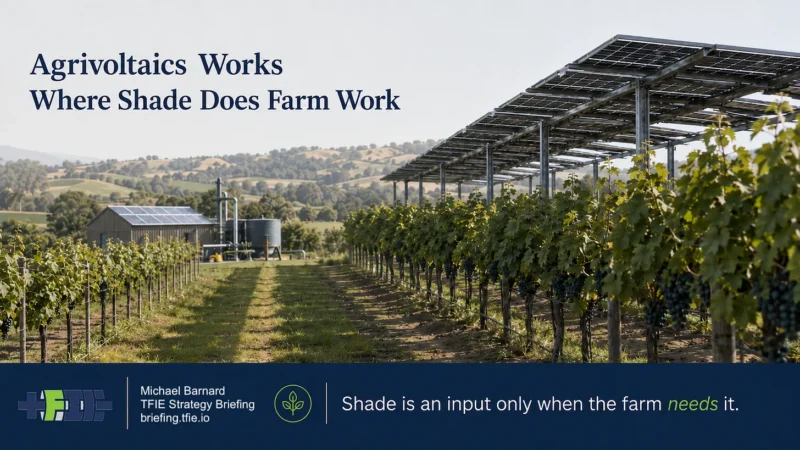
Agrivoltaics Works When Solar Panels Do Farm Work
Support CleanTechnica's work through a Substack subscription, on Patreon, or on Stripe. Help us produce all of the high-quality, original content we publish week after week despite the challenges of content-scraping AI, antisocial media, inflation, and other hurdles.
Agrivoltaics is appealing because it seems to solve two land-use problems at once. Put solar panels and farming on the same land, and the conflict between food and electricity appears to soften. The farm keeps producing, the panels produce power, and the project can be described as more sophisticated than either conventional solar or conventional agriculture. That is the attractive public story, but it is not enough for a serious decision.
The better test is whether the solar structure performs farm work. Shade is valuable when it relieves a real agricultural constraint, protects a crop, supports livestock, preserves water, improves quality, replaces infrastructure or creates farmer revenue without making farming a stage prop. Shade is costly when it mainly exists because the electricity project needed a land-use narrative. Agrivoltaics becomes useful when the farm function is explicit enough to survive comparison with simpler alternatives.
That distinction matters because agrivoltaics is often discussed as if it were a single pathway. It is not. Sheep grazing under ordinary solar arrays, semi-transparent structures above berries, photovoltaic protection over vineyards, vertical bifacial rows between crops and tall steel above broadacre fields are materially different systems. They differ in capital cost, crop risk, machinery access, electricity yield, water effects, farm management and the likelihood that a farmer would repeat the design after living with it for several seasons.
The strongest cases start where the solar structure either stays cheap or does something the farm already needs. Grazing beneath ordinary arrays is the cleanest scaling case because the panels do not have to become agricultural architecture. Sheep can fit beneath many standard systems, vegetation management has value, mowing and fuel use can fall, and graziers can earn income where contracts are designed sensibly. It is less photogenic than a vineyard under dynamic glass, but it has the virtue of asking less from both the technology and the spreadsheet.
Higher-value protected crops are interesting for the opposite reason. Orchards, vineyards, berries, hops and some horticultural systems already live with sunburn, hail, rain damage, trellising, shade cloth, irrigation, crop-quality risk and protection infrastructure. If photovoltaic structures replace or supplement something the farm already buys, the economics become more plausible. In those cases the electricity is not merely an add-on to the field; it is part of a farm-protection system that also produces power.
Hot and water-stressed horticulture has a third logic. Full sun is not always beneficial when heat, radiation and atmospheric dryness are already limiting production. Partial shade can sometimes reduce plant stress, alter evapotranspiration and preserve marketable output, especially where irrigation, cooling, pumping or packing loads give the farm a useful daytime electricity demand. The mechanism is not that panels make crops better in some generic sense. The mechanism is that, in the wrong climate at the wrong hour, full sun can become too much sun.
The caution zone is tall overhead structures above broadacre annual crops. These systems are technically feasible, and demonstration projects have shown that machinery access and electricity production can be combined. The problem is the business case. Commodity crops often have lower value per hectare, many need high light, and large machinery pushes structures higher and more expensive. Climate stress may improve the argument in some regions, but it does not make steel cheap or convert every field crop into a protected horticultural system.
The common denominator error is Land Equivalent Ratio, or LER. LER can be a useful way to measure combined land productivity because it asks how much land would be needed to produce the same crop and electricity separately. However, it does not answer the crop-yield question by itself. A project can show a strong combined land-use result while still reducing crop output materially. That may be acceptable where the electricity gain, water effect, crop protection value and farm economics are clear, but those ledgers need to stay visible.
The comparator also needs discipline. Agrivoltaics should not be compared only with a diesel-dependent farm without solar. The realistic comparator is an electrifying farm with access to roofs, sheds, yards, ordinary ground-mounted PV, grid electricity, batteries where they already make sense and existing crop-protection infrastructure. If the same electricity can be produced more cheaply from a barn roof or a normal field-edge solar array, the agrivoltaic system only earns credit for the extra agricultural value it creates.
Farm electrification makes the question more important, not easier. Pumps, irrigation controls, refrigeration, packhouses, drones, light vehicles and eventually more equipment charging all increase the value of electricity on farms. That strengthens the case for farm solar in general and may strengthen the case for agrivoltaics in selected settings. It does not automatically pay for raising solar above crops. The electricity value, agricultural service and any battery buffering all have to be costed separately, or a weak project can be made to look strong by blending the accounts.
This is where much of the public enthusiasm needs to mature. Agrivoltaics does not need another decade proving that plants and panels can be near each other. That question has been answered. The useful evidence now is crop-specific, climate-specific and configuration-specific: measured crop output, crop quality, water use, electricity production, structure cost, operating cost, farmer economics and repeat adoption after real operating experience. A small trial can be interesting without becoming policy for an entire crop category.
The weak cases have a common pattern. The agricultural evidence is thin, the electricity value is doing most of the economic work, and the farming story is being asked to carry more credibility than the operating data supports. Ornamental planting around a power project, one-year drought results treated as normal performance, evaporation reductions converted into assumed water savings, announcements presented as outcomes, and token crop rows beneath panels all point to the same problem: the farmer’s authority, revenue and durable reason to keep farming that way have not been demonstrated.
The useful conclusion is bounded but positive. Agrivoltaics deserves to scale where the structure provides farm value that simpler solar cannot provide as well. Grazing under ordinary solar is already the practical end of the market. Protected crops and hot horticulture are moving forward where shade, protection and quality have real economic meaning. Tall overhead broadacre systems remain niche unless the farm service is unusually strong.
That is a better story than the inflated one. Agrivoltaics is not a universal answer to land-use conflict and it is not a magic crop-yield technology. It is a set of configurations, some of which are becoming clearer as practical farm-and-power systems. The best projects will be the ones farmers want to repeat because the panels do more than cast shade.
This is a brief summary of a TFIE Strategy Briefing pathway review. Read the full analysis: Agrivoltaics Works Where Shade Does Farm Work.
Sign up for CleanTechnica's Weekly Substack for Zach and Scott's in-depth analyses and high level summaries, sign up for our daily newsletter, and follow us on Google News!
Have a tip for CleanTechnica? Want to advertise? Want to suggest a guest for our CleanTech Talk podcast? Contact us here.
Sign up for our daily newsletter for 15 new cleantech stories a day. Or sign up for our weekly one on top stories of the week if daily is too frequent.


CleanTechnica uses affiliate links. See our policy here.
CleanTechnica's Comment Policy

