Investment

Compressed-Gas Storage Demonstrators Got Bigger. The Economics Didn’t Get Better.

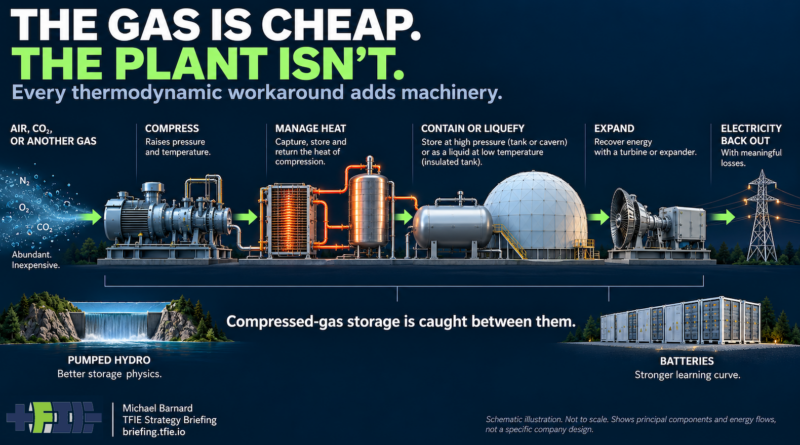
Two years ago I called compressed-gas electricity-storage claims mostly hot air. Since then the sector has produced exactly the sort of evidence that should force a reassessment rather than a repetition of the old argument. China has commissioned the 600 MW / 2.4 GWh Huai’an compressed-air demonstration, Hydrostor has pushed … [continued]

AI Is Climate Tech’s Newest Hype Layer — The Commercial Problems Are Older

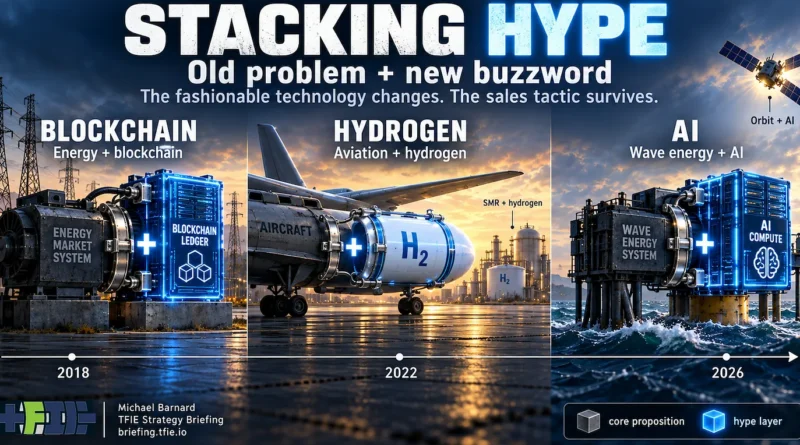
Panthalassa raised $140 million this year to build autonomous ocean platforms that would generate electricity from waves and use it directly for AI inference computing at sea. The proposition removes one genuine problem for wave energy: instead of transmitting electricity back to shore through subsea cables and grid connections, put … [continued]

ARES’ Nevada Demonstrator Shows Why Rail Gravity Storage Is A Train Wreck

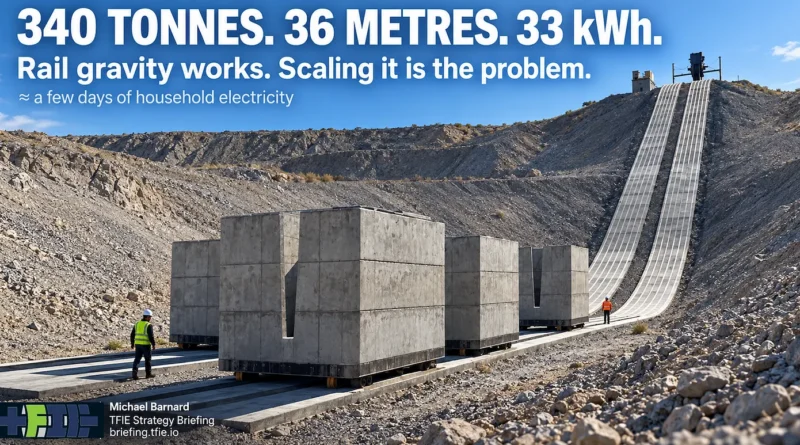
ARES North America has now operated enough of its GravityLine system at Gamebird Pit in Nevada to make clear its deep limitations to people who didn’t simply do the grade 7 math and science calculations. Sandia National Laboratories documents a pair of mass cars weighing roughly 340 tonnes climbing a … [continued]

Dense-Fluid Pumped Hydro Works. Scaling It Is The Problem.

RheEnergise deserves credit for something a lot of energy-storage startups never accomplish: it built the thing. At Cornwood in Devon, the company constructed upper and lower reservoirs, installed pumps, pipes and generating equipment, manufactured hundreds of cubic metres of its proprietary high-density fluid, pumped that fluid uphill and ran it … [continued]

Energy Vault Scaled Gravity Storage. The Battery Benchmark Is Brutal.

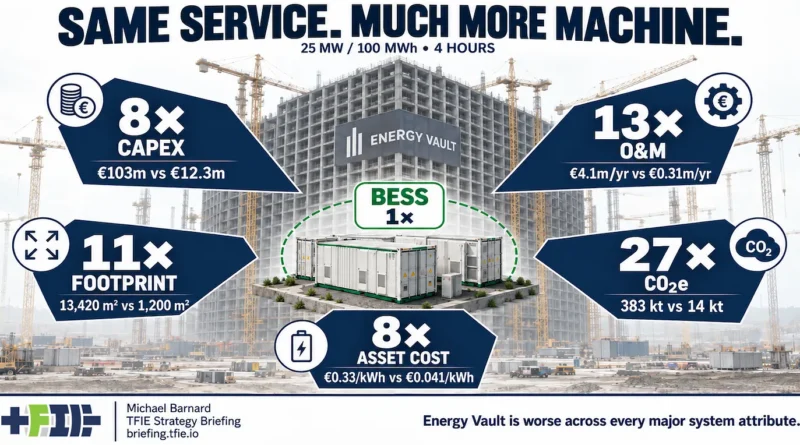
Energy Vault’s Rudong gravity-storage project is a particularly useful technology test because it removes many of the excuses that can surround a first-of-kind energy project. It was built in China, with deep domestic supply chains for concrete, steel, motors, power electronics and industrial construction. It had government support, grid coordination … [continued]

Vertical Aerospace’s eVTOL Can Fly. The Passenger Business Is Still Unproven

Vertical Aerospace’s July appearance at the Farnborough International Airshow was a real engineering milestone. The company publicly demonstrated piloted transition between vertical and wingborne flight, something a powered-lift aircraft has to do safely and repeatedly before certification can advance. Vertical then flew on successive days in front of a large … [continued]

US Lobby’s $1.1 Trillion Freight Rail Electrification Study Intentionally Asked The Wrong Question

Direct electric freight rail is not speculative technology. It already operates across enormous railway systems, moves very heavy freight and works in difficult climates. The interesting North American question is therefore not whether electric freight rail can work, but where catenary should go first, where batteries or dual-mode locomotives make … [continued]

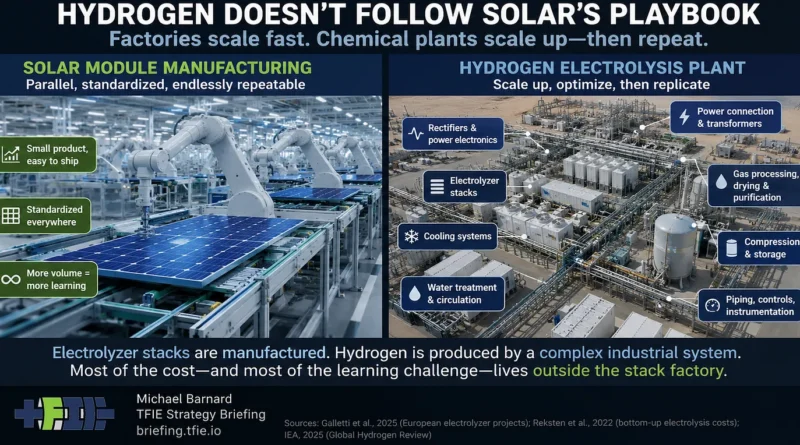
Hydrogen Learning Curves Are Counting The Wrong Doublings

Hydrogen cost forecasts often borrow one of the clean-energy transition’s most useful empirical tools: the experience curve. If a technology has historically fallen by a given percentage in cost every time cumulative deployment doubles, analysts can estimate how many doublings lie ahead and compound the learning rate into a future … [continued]