
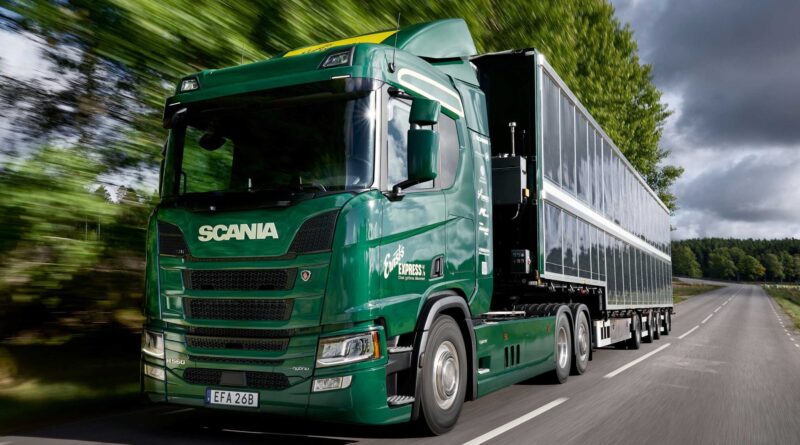
Scania Tests Its First Solar-Powered Trucks, Sees The Technology To Grow
Support CleanTechnica's work through a Substack subscription or on Stripe.
SCANIA recently began tests on a solar-powered truck, a 560-horsepower plug-in hybrid truck with 100 square meters of solar panels wrapping a trailer. This unique setup now being tested on public roads in Sweden is a result of a two-year research collaboration between Scania and industry and academic partners.
The project aligns seamlessly with the company’s mission to reduce carbon emissions and redefine the future of transportation in Europe. Scania’s move towards electrification has resulted in regional electrification of cargo transport industry in Europe, developing more BEV powertrains, and even allowing customers to determine how their electric trucks should be built. As early as 2020, Scania and other European truck makers have agreed to end diesel engine production by 2040.
The collaboration involves Uppsala University, trailer engineering expert Eksjö Maskin & Truck, Swedish solar energy company Midsummer, logistics company Ernsts Express, and energy company Dalakraft.
“Scania’s purpose is to drive the shift towards a sustainable transport system. Never before have solar panels been used to generate energy to a truck’s powertrain like we do in this collaboration. This natural energy source can significantly decrease emissions in the transport sector. It is great to be at the forefront in the development of the next generation’s trucks,” Stas Krupenia, Head of the Research Office at Scania, said in a press statement.
The practical applications of solar power integration are far-reaching and transformative.
Aside from the panels providing supplementary charging for the hybrid system, they decrease operational costs significantly because of the truck’s self-produced energy. While not enough for full battery charging, this augmentation translates into additional kilometers powered by solar energy.
Erik Johansson, Project Manager and Professor of Physical Chemistry at Uppsala University, underscores the magnitude of this endeavor, highlighting its potential to mitigate climate impacts stemming from truck transports: “This is an exciting project where academia and industry together try to decrease the climate impact from truck transports. The results from this unique truck will be very interesting.”

The truck is used in a research project to examine the generated solar energy, and how much carbon emissions decrease via the solar panels. The researchers developed new, efficient, and lightweight solar panels for trucks. They also studied how trucks can interact with the power grid, and they brought forward new models for what will happen if several trucks like this one are connected to the power grid.
The solar-powered system can also power auxiliary systems like trailer refrigeration. This directly reduces the need for the primary engine to run during idle periods, resulting in decreased fuel consumption and emissions.
The truck’s 60-foot (18-meter) trailer is almost completely covered in thin-film solar panels supplied by Midsummer. The solar array is almost equivalent to a house equipped with similarly powerful panels. The solar energy gives the hybrid truck a prolonged driving range of up to 5,000 kilometers annually in Sweden. In countries like Spain, with more sun hours, the vehicle can double the amount of solar energy.
“Our research towards efficient and light solar cells will be truly important, especially when it comes to applying them in future trucks,” Johansson continues. “Thin film panels excellent for commercial vehicles.”
“Our solar panels are excellent for applications that make commercial vehicles sustainable. … This ground-breaking project enables us to be a partner that can be counted on,” Erik Olsson, Head of Corporate Development at Midsummer, explained highlighting the system’s maximum efficiency of 13.2 kWp (kilowatt peak) and ability to deliver 8,000 kilowatt-hours (kWh) annually when operated in Sweden. The batteries have a total capacity of 300 kWh, with 100 kWh on the truck and 200 kWh on the trailer.
The solar-powered prototype truck is now taking to public roads, led by haulage company Ernsts Express AB.
Sign up for CleanTechnica's Weekly Substack for Zach and Scott's in-depth analyses and high level summaries, sign up for our daily newsletter, and follow us on Google News!
Have a tip for CleanTechnica? Want to advertise? Want to suggest a guest for our CleanTech Talk podcast? Contact us here.
Sign up for our daily newsletter for 15 new cleantech stories a day. Or sign up for our weekly one on top stories of the week if daily is too frequent.
CleanTechnica uses affiliate links. See our policy here.
CleanTechnica's Comment Policy

