With New EV Charging Stations, Norway’s Excellent EV Adventure Is About To Get More Excellent
An EV charging station startup aims to keep EV sales humming along, with an energy storage solution for DC fast charging.

An EV charging station startup aims to keep EV sales humming along, with an energy storage solution for DC fast charging.
There is more to the energy transition in Norway than meets the eye, with startups and legacy firms alike pushing the decarbonization envelope.
The April auto market saw plugin EVs take 97.4% share in Norway, up from 91.0% year on year. BEVs alone accounted for 97.0% of all new car registrations, with diesels taking half of the remainder (and 3x the number PHEVs). Total new passenger vehicle registrations for the month reached 11,286 … [continued]
 ChatGPT generated panoramic image of dozens of trucks hauling CO₂ from Ørsted’s Avedøre plant to Asnæs, trailing euro signs like exhaust fumes
Northern Lights, Europe’s flagship cross-border carbon capture and storage project, is now ready to receive carbon dioxide for sequestration, with the first ships in the water and expected to start delivering waste gas from customers this year. It’s being celebrated as a triumph of climate leadership and engineering. But when … [continued]
 ChatGPT generated panoramic image of cross-section showing: LCO₂ ship → Øygarden tanks → high-pressure pumps → subsea pipeline → Johansen reservoir
The Northern Lights carbon capture and storage project is often described as a logistics system, but at its core, it is a storage facility. The Øygarden terminal, its connecting offshore pipeline, and the Johansen Formation are the infrastructure that turns cross-border CO₂ shipments into permanent geological sequestration. Phase 1 is … [continued]
 ChatGPT generated stylized aerial view of Øygarden Northern Lights terminal with multiple ships queuing and tanks labeled by volume
Northern Lights is Europe’s most ambitious carbon capture and storage project, and possibly the most operationally serious one in the world. It deserves credit for getting past the pilot stage, for designing an end-to-end storage system with real injection capacity, and for contracting with emitters in four different countries. But … [continued]
 ChatGPT generated create a panoramic Stylized infographic-style panorama showing the full CO₂ journey: capture, liquefaction, shipping, injection
When BASF quietly backed away from signing a transport and storage agreement with Northern Lights for its Kairos@C project in Antwerp recently, it signaled more than just a missed customer for the high-profile Norwegian CCS initiative. It revealed the delicate balancing act at the heart of Europe’s carbon management ambitions: … [continued]
March saw plugin EVs take 93.2% share in Norway, up from 91.5% year-on-year. PHEVs saw a large pull forward ahead of an April 1st tax tightening, and thus temporarily took share from BEVs. Overall auto volume was 13,304 units, up some 36% YoY, though from a low base. The new … [continued]
 ChatGPT generated image of a Norwegian hydrogen facility with the flag at half mast and a permanently closed sign
In 2020, Norway jumped into hydrogen like it was the next North Sea oil rush. The government released a national hydrogen strategy full of ambitions and buzzwords, envisioning a country where blue and green hydrogen would decarbonize ships, factories, maybe even homes. In 2021, they doubled down with a hydrogen … [continued]
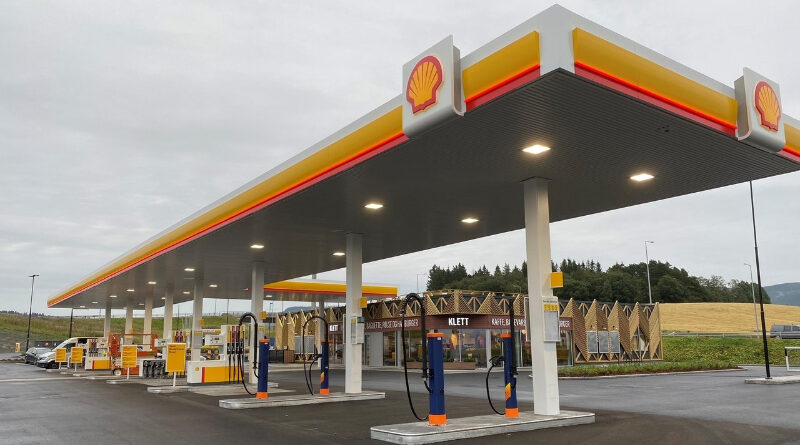
Many service center operators are installing EV chargers in place of gas pumps, especially in Norway were electric cars are dominant.