Spring Forward, Fall Back. Are Time Changes Bad For Your Health?
Heath professionals say changing to daylight savings time comes with health risks. British Columbia thinks it has the answer.


Heath professionals say changing to daylight savings time comes with health risks. British Columbia thinks it has the answer.

In the past week I had the opportunity to deliver the same presentation on the global acceleration to clean technologies and decarbonized solutions to two different audiences, one from a stage keynoting the 2026 Clean Energy Summit in the Vancouver Metropolitan area, and one virtually. Both were Canadian audiences. The … [continued]

Canada has just shifted its electric vehicle policy architecture. Instead of relying on an explicit EV sales mandate, the federal government has moved toward tightening fleet average emissions standards combined with credit trading and trade policy adjustments. On the surface, this looks like a procedural change. In practice, it changes … [continued]

Eight thousand new EV chargers will be installed in Canada at a cost of $84 million. At the moment, Canada has about 35,000 public EV chargers. Canada also supports the transition to zero-emissions vehicles with EV incentives and the country has huge sustainable transition goals, as stated here: “To help … [continued]

Will the Chinese use Canada as their North American beachhead? This story has been updated with additional details and recalculation of the forecasts. As Chinese electric vehicle manufacturers look beyond Europe and Southeast Asia, Canada is quietly emerging as the most realistic entry point into North America. It combines stringent … [continued]
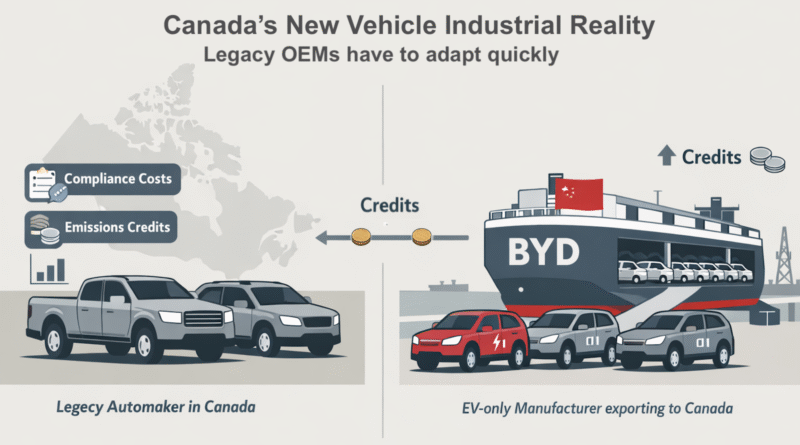
Canada has quietly shifted into a new phase of EV focused industrial policy, not by announcing a dramatic ban or a sweeping mandate, but by changing the arithmetic that governs the automotive market. The federal government has moved away from explicit EV sales quotas and toward steadily tightening fleet average … [continued]

Ontario is moving forward with planning for an entirely new nuclear generation site in Port Hope, 100 km east of Toronto, at a moment when its electricity system is already one of the most nuclear-heavy in the world. Nuclear power today provides roughly 55% of Ontario’s electricity, with hydro adding … [continued]

Recently I took part in a discussion in Ottawa as part of CAFES Network’s work to raise local energy literacy, hosted by Invest Ottawa and attended by a mixed audience of residents, municipal and provincial policy observers, students, and people already working in energy and climate. Angela Keller-Herzog, founding executive … [continued]

Ontario Power Generation (OPG) has asked the Ontario Energy Board to approve a sharp increase in regulated nuclear payment amounts, including a year over year jump of more than 40% in 2027. The weighted average regulated payment amount rises from about $78/MWh in 2026 to roughly $110/MWh in 2027, driven … [continued]

Canada and South Korea are working toward a new trade deal that would bring more auto manufacturing to that country.
