Manufacturing

Why Tugboats Fit Batteries Better Than Their Power Ratings Suggest

Tugboats do not initially look like good candidates for battery propulsion. A harbour tug has to shove, pull and control ships weighing tens or hundreds of thousands of tonnes, sometimes in wind, current and confined channels where losing thrust is not an acceptable outcome. Modern ship-assist tugs consequently carry propulsion … [continued]

Hydrogen Learning Curves Are Counting The Wrong Doublings

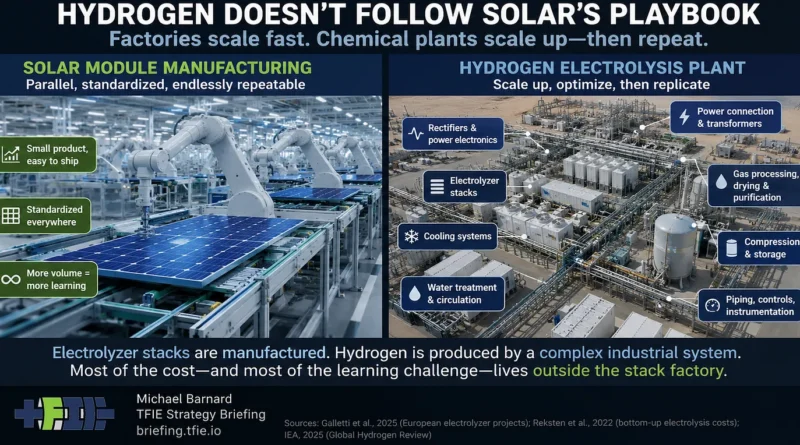
Hydrogen cost forecasts often borrow one of the clean-energy transition’s most useful empirical tools: the experience curve. If a technology has historically fallen by a given percentage in cost every time cumulative deployment doubles, analysts can estimate how many doublings lie ahead and compound the learning rate into a future … [continued]

Poland Created Hydrogen Bus Demand. Polenergia Still Walked Away From Supply.

Poland did something hydrogen advocates have spent years saying governments need to do: it created real demand. Public subsidies helped put hydrogen buses into Polish cities, refueling infrastructure received support, and renewable-hydrogen projects were offered public money as well. By April 2026, Poland had 153 hydrogen buses registered, 140 already … [continued]

China Is Making More Aluminum. Its Emissions May Still Be Peaking.

Earlier this year I argued that China’s aluminum-sector carbon emissions had probably peaked around 2024. Since then, the output data have weakened one important part of that case. China produced 45.02 million tonnes of primary aluminum in 2025, 2.4% more than the year before, and another 23.19 million tonnes in … [continued]