Author: Michael Barnard

Farm Electrification Should Start With The Work, Not The Tractor

Ask whether agriculture can electrify and the conversation usually arrives at the same machine within minutes: the tractor. More specifically, the large diesel tractor working hard through planting, harvest or another narrow seasonal window. It is a legitimate engineering challenge, but it is a poor organizing principle for farm electrification. … [continued]
AI Is Climate Tech’s Newest Hype Layer — The Commercial Problems Are Older

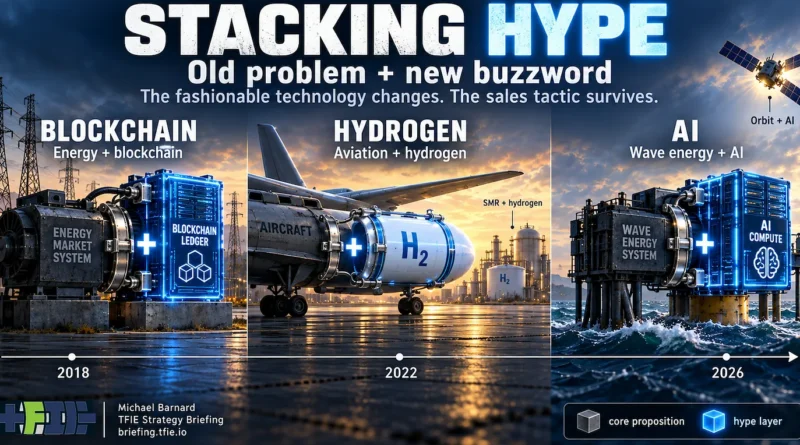
Panthalassa raised $140 million this year to build autonomous ocean platforms that would generate electricity from waves and use it directly for AI inference computing at sea. The proposition removes one genuine problem for wave energy: instead of transmitting electricity back to shore through subsea cables and grid connections, put … [continued]

UK Trying to Advance Hydrogen Aviation. Likelihood by 2050 is still under 1%

The UK Civil Aviation Authority announced its latest Hydrogen Challenge in the same week as I published my updated assessment of hydrogen passenger aviation. The regulator is examining hydrogen-aircraft turnarounds at London City Airport, cryogenic hydrogen storage and airside supply, while its broader hydrogen aviation roadmap targets scaled operations for … [continued]

ARES’ Nevada Demonstrator Shows Why Rail Gravity Storage Is A Train Wreck

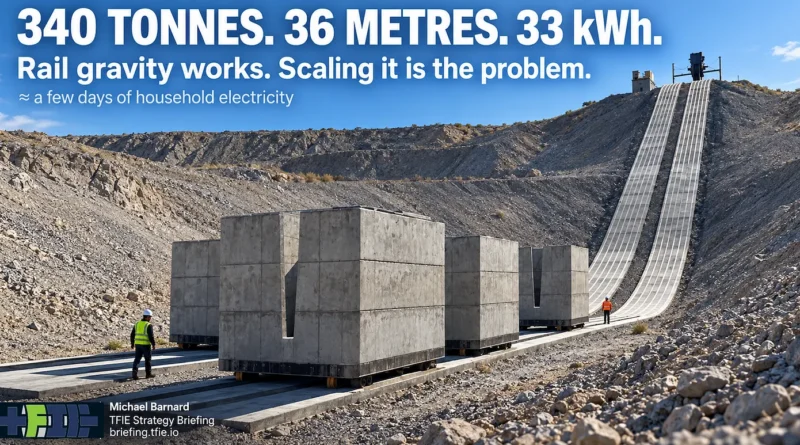
ARES North America has now operated enough of its GravityLine system at Gamebird Pit in Nevada to make clear its deep limitations to people who didn’t simply do the grade 7 math and science calculations. Sandia National Laboratories documents a pair of mass cars weighing roughly 340 tonnes climbing a … [continued]

Dense-Fluid Pumped Hydro Works. Scaling It Is The Problem.

RheEnergise deserves credit for something a lot of energy-storage startups never accomplish: it built the thing. At Cornwood in Devon, the company constructed upper and lower reservoirs, installed pumps, pipes and generating equipment, manufactured hundreds of cubic metres of its proprietary high-density fluid, pumped that fluid uphill and ran it … [continued]

Aberdeen Paid £556k Per Hydrogen Bus. Five Years Later, First Bus Is Paying £30k

Aberdeen’s hydrogen double-deckers have finally produced a useful market price, and it is more revealing than another theoretical argument about fuel-cell efficiency, hydrogen costs or refuelling infrastructure. First Bus is set to buy 23 Wrightbus StreetDeck Hydroliners for £30,000 each. Aberdeen City Council originally spent about £13.9 million on the … [continued]

Energy Vault Scaled Gravity Storage. The Battery Benchmark Is Brutal.

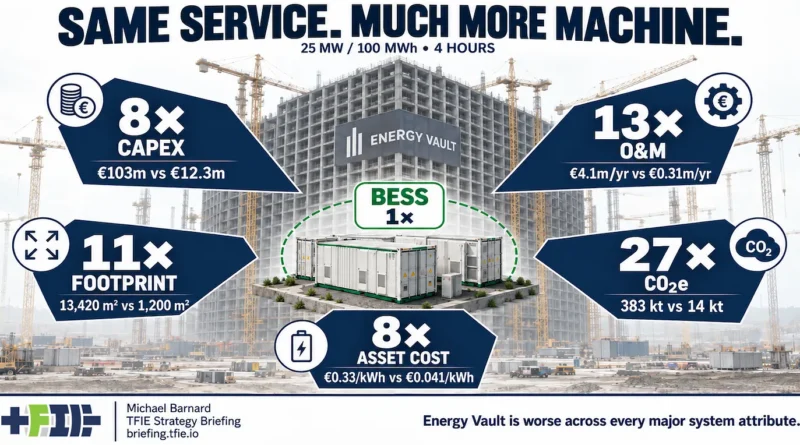
Energy Vault’s Rudong gravity-storage project is a particularly useful technology test because it removes many of the excuses that can surround a first-of-kind energy project. It was built in China, with deep domestic supply chains for concrete, steel, motors, power electronics and industrial construction. It had government support, grid coordination … [continued]

Vertical Aerospace’s eVTOL Can Fly. The Passenger Business Is Still Unproven

Vertical Aerospace’s July appearance at the Farnborough International Airshow was a real engineering milestone. The company publicly demonstrated piloted transition between vertical and wingborne flight, something a powered-lift aircraft has to do safely and repeatedly before certification can advance. Vertical then flew on successive days in front of a large … [continued]

A Productivity Strategy For Europe Starts With Cheap Electricity

Europe is running out of workers while still debating how long to preserve machines that burn imported fuel. That is an odd starting point for a competitiveness strategy. Europe’s central economic problem is not electricity prices alone. Mario Draghi’s competitiveness diagnosis is broader: weak productivity, fragmented markets, difficulty turning research … [continued]

US Lobby’s $1.1 Trillion Freight Rail Electrification Study Intentionally Asked The Wrong Question

Direct electric freight rail is not speculative technology. It already operates across enormous railway systems, moves very heavy freight and works in difficult climates. The interesting North American question is therefore not whether electric freight rail can work, but where catenary should go first, where batteries or dual-mode locomotives make … [continued]