Author: Michael Barnard

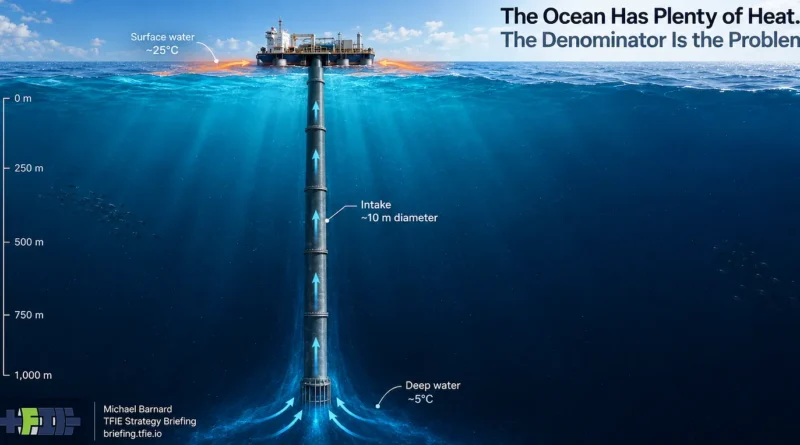
OTEC Works. The Seawater Flow Is The Problem.

Ocean thermal energy conversion has an appealing proposition. Tropical oceans can have surface water around 25°C while water roughly a kilometre down is near 4°C to 5°C. Put a heat engine between the two reservoirs, use the warm water to vaporize a working fluid, run it through a turbine, condense … [continued]

Reach Stackers Look Like A Hydrogen Use Case. Ports Are Buying Batteries.

A reach stacker looks like exactly the sort of machine batteries should struggle with. Large models can weigh more than 70 tonnes before picking anything up, then lift loaded shipping containers weighing another 40 tonnes or more several rows deep and several containers high. They work in busy freight terminals … [continued]

Norway Found A Real Bus Cyber Risk. It Didn’t Show It Was Chinese.

When Norwegian transit authority Ruter put a Chinese Yutong electric bus through cybersecurity testing inside an isolated mine, the investigation started with two very different concerns. One was geopolitical: could the bus act as a visual-surveillance platform near sensitive facilities such as Lutvann, home to Norway’s intelligence service? The other … [continued]

Nate Hagens Keeps The Doom And Moves The Bottleneck

Nate Hagens has spent most of his intellectual career inside a forecasting tradition that expected physical resource constraints to force industrial societies into contraction. He was a major contributor to The Oil Drum and eventually its managing editor, while the nonprofit that now produces The Great Simplification grew directly from … [continued]

Leipzig’s Hydrogen Garbage Trucks Fail The Tuesday Test

Garbage collection is not a technology demonstration. Municipalities need trucks that leave the depot every working morning, finish predictable routes, operate compactors through hundreds of stops and come back ready to do it again. That is why refuse collection has become such a useful test of competing zero-emission drivetrains. Battery-electric … [continued]

Ports Need More Capital As Their Bulk Cargo Base Shrinks

Ports are being asked to make infrastructure decisions that will last thirty, forty or fifty years while several of the assumptions that paid for their existing infrastructure are changing at the same time. Ships are getting larger, requiring deeper channels, larger cranes and more capable tug fleets. Climate disruption is … [continued]

OceanX Made Downwind Floating Wind Worth Another Look

OceanX gave me two immediate reasons to be skeptical. It puts two turbines on one floating platform, and it puts the rotors downwind of their supports rather than in front of them. I had looked at both ideas years ago and found good reasons why the wind industry had largely … [continued]

Green Lightning’s Fertilizer Claim Doesn’t Add Up

Green Lightning really does make nitrogen fertilizer from air and electricity, but it makes very little of it compared with what its marketing says it can replace. Nitrogen is not merely something that encourages a plant to grow. Nitrogen atoms become part of the plant itself, incorporated into proteins, chlorophyll, … [continued]

Netherlands Cuts 2040 Hydrogen Forecast By Almost 60%

Three years is a long time in hydrogen strategy. The Netherlands’ 2023 National Energy System Plan projected roughly 460 petajoules of gaseous hydrogen demand in 2040. Its 2026 National Energy System Plan update cuts that central estimate to about 200 PJ, a reduction of roughly 57%. This is especially interesting … [continued]

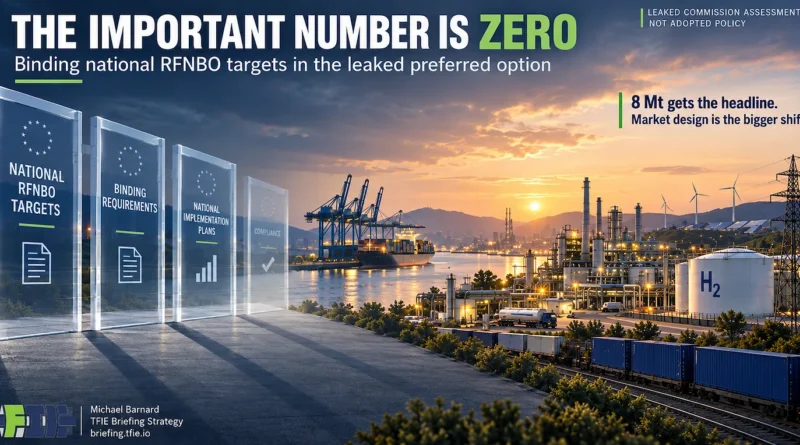
Leaked EU Hydrogen Draft Moves From Quotas To Credits

Europe’s current Renewable Energy Directive requires renewable fuels of non-biological origin, or RFNBOs, to account for at least 42% of relevant industrial hydrogen use by 2030 and 60% by 2035, subject to exclusions and flexibilities. Those provisions do more than subsidize hydrogen production. They create a specified market for a … [continued]