

VinFast’s Electric Buses Headed for the US Began Journey in Brussels
Support CleanTechnica's work through a Substack subscription, on Patreon, or on Stripe. Help us produce all of the high-quality, original content we publish week after week despite the challenges of content-scraping AI, antisocial media, inflation, and other hurdles.
WHEN VinFast brought its electric buses to Busworld Europe 2025, the Vietnamese automaker was making its first major international move in the electric bus market.
The company displayed the EB 8 and EB 12 in Brussels in October 2025 as it looked beyond Vietnam for new markets. North America was already part of that strategy. During VinFast’s second-quarter 2025 earnings call, Chairwoman Le Thi Thu Thuy said the company had appointed an executive to lead its e-bus business in North America. That executive was Brian Finnerty, CEO of VinFast North America.
VinFast announced in October 2026 that it would bring its electric bus platform to the United States through NexMove Certified, a joint venture between Transportation Management Services and Zeem Solutions. The first certified buses are targeted to enter service in the first quarter of 2028.
“Bringing VinFast electric buses to the United States marks an important next step in our long-term commitment to this market. As demand grows for cleaner, smarter urban transportation, we are doubling down on our investment in the U.S. and working with partners such as NexMove to help cities, transit operators and businesses accelerate the transition to sustainable mobility,” Finnerty said.
The EB 12 shown in Brussels is a 12.11-meter low-floor city bus with twin 125-kilowatt wheel-hub motors producing 250 kW combined. Its 422-kWh battery is rated for more than 400 kilometers under SORT 2 conditions, while DC charging is supported at up to 140 kW. It can carry as many as 90 passengers.
The 8.61-meter EB 8 uses a 359-kWh battery with a stated range of more than 290 kilometers under SORT 1 conditions. Its 200-kW central electric motor gives it a maximum speed of 80 kph, while charging is rated at up to 120 kW. Capacity is up to 60 passengers.
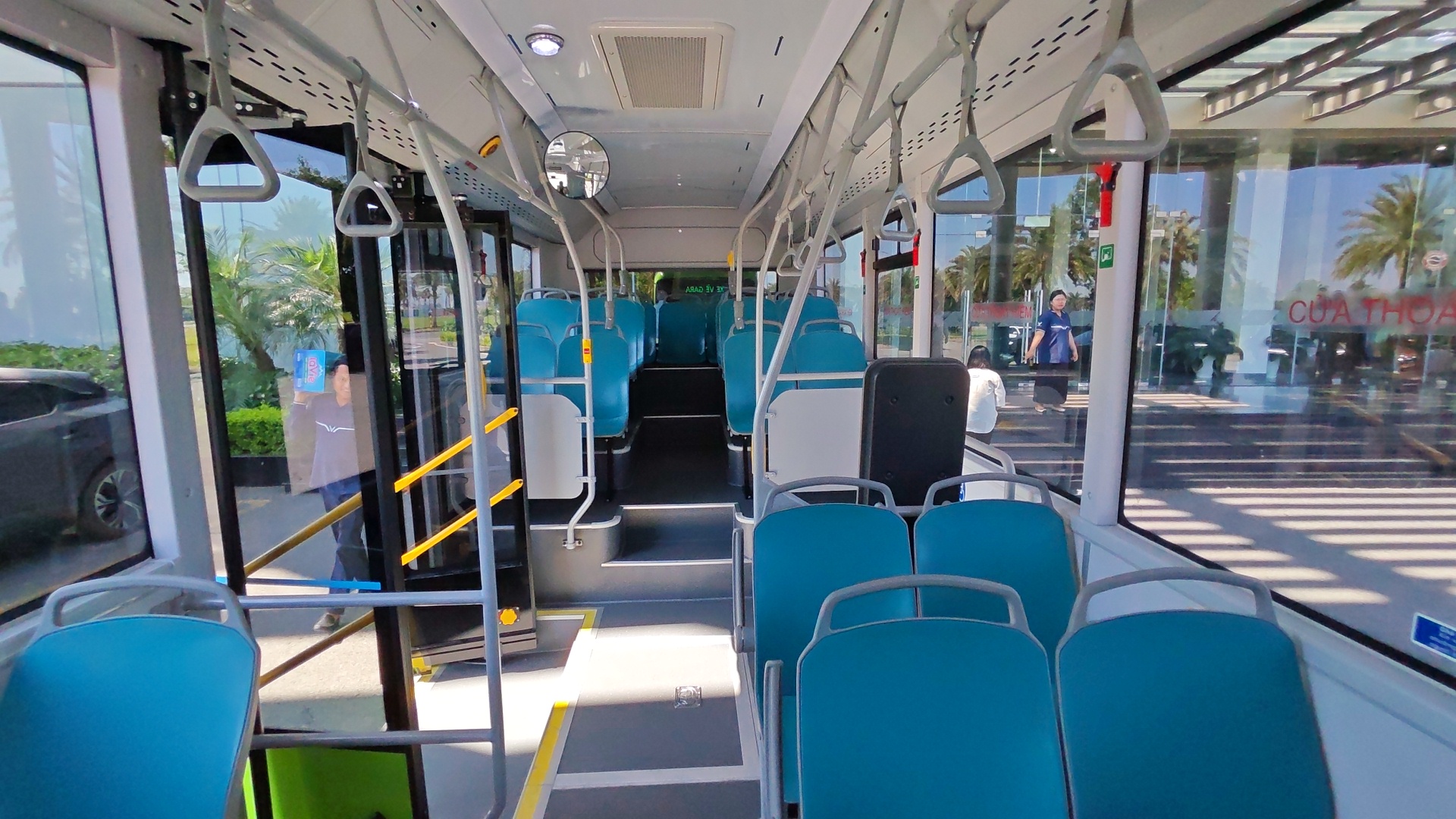
Not the US spec
The EB 12 had met UNECE and CE requirements and was available for order, while the EB 8 was still being prepared for the European market. The EB 8 also showed how requirements can differ between markets. Its battery arrangement, with packs positioned partly on the roof and partly in the floor, resulted in an entry height that prevented European homologation in the configuration displayed at Busworld. VinFast said the model remained available for other markets.
For the U.S., VinFast has not disclosed the final vehicle specification. The program will have to address American accessibility and safety requirements as well as federal transit procurement rules and domestic-content requirements.
The next move
NexMove’s plans to package the vehicles with charging infrastructure, maintenance and operational support rather than treat the transaction as a conventional bus sale. It is targeting 97 percent uptime, while customers would provide drivers and insurance.
Paul Gioupis, founder and CEO of Zeem Solutions and co-founder of NexMove, said his team visited VinFast’s manufacturing operations in July and saw buses operating in daily service.
“This is a proven product with real operating history behind it,” Gioupis said. “We look forward to working with VinFast toward U.S. manufacturing that meets Federal Transit Administration requirements, so public transit agencies can put these buses to work.”
Before the certified vehicles arrive, demonstration buses are expected to be placed at Zeem’s electric vehicle charging depots. They will be available for evaluation by transit agencies and fleet operators but will not be approved for passenger service.
Made in the USA
U.S. manufacturing could become a central part of the program. VinFast has not announced where the buses would be built, but it is separately preparing to restart construction of its North Carolina manufacturing facility, with production planned for 2028.
VinFast says its electric buses have been running there for four years and that it has developed manufacturing, deployment and maintenance capabilities around the vehicles. Its bus manufacturing facility has annual capacity of 1,500 to 2,000 vehicles, while more than 2,000 VinFast electric buses are reported to be operating in Vietnam.
The first certified buses are expected in 2028. Whether they are versions of the EB 8 or EB 12, or vehicles developed specifically for the American market, will depend on the certification and manufacturing work between now and then.
Sign up for CleanTechnica's Weekly Substack for Zach and Scott's in-depth analyses and high level summaries, sign up for our daily newsletter, and follow us on Google News!
Have a tip for CleanTechnica? Want to advertise? Want to suggest a guest for our CleanTech Talk podcast? Contact us here.
Sign up for our daily newsletter for 10–15 new cleantech stories a day. Or sign up for our weekly one on top stories of the week if daily is too frequent.


CleanTechnica uses affiliate links. See our policy here.
CleanTechnica's Comment Policy

