
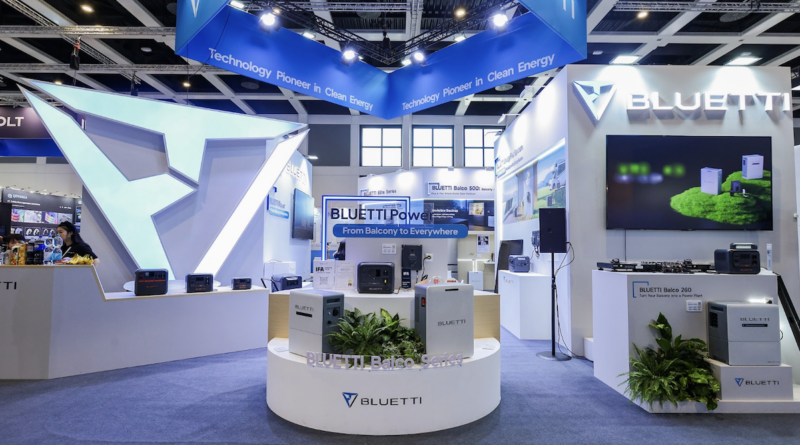
BLUETTI Launches New Energy Solutions for Work, Home, & Life on the Move at IFA 2026
Support CleanTechnica's work through a Substack subscription, on Patreon, or on Stripe. Help us produce all of the high-quality, original content we publish week after week despite the challenges of content-scraping AI, antisocial media, inflation, and other hurdles.
BLUETTI* used IFA 2026 to stretch the idea of power stations in several directions. The BLUETTI IFA 2026 lineup covered balcony solar, home energy management, compact batteries, and a 5,000W jobsite E-Generator, with products for apartments, road trips, outages, and worksites. More interestingly, the company is trying to solve a problem: portable power stations are useful when you need them, but many spend long stretches doing nothing. This year’s announcements focus on expanding power station applications, whether they’re plugged into a home, packed into a car, or rolled onto a worksite.

Pioneer 5000 E-Generator: A Battery-powered Generator for Job Sites
Construction sites across the EU answer to Stage V emissions standards phased in from 2019, while sites in London have faced the Non-Road Mobile Machinery Low Emission Zone since 2015, and BLUETTI enters that landscape with an E-Generator category built around the Pioneer 5000.
Across the pond, construction sites across the US are moving toward cleaner equipment, with California accelerating zero-emission construction through new programs and incentives, while reliable off-grid power remains a growing challenge, positioning BLUETTI’s Pioneer 5000 E-Generator for the next generation of jobsite power.
That combination suits noise‑sensitive sites and intermittent tool use — the system’s 5.12 kWh battery (expandable to 35 kWh) powers short‑burst tools and lighting, with load‑dependent runtime, and features IP65, IK10, and a -20°C to 55°C environmental tolerance.
Charging follows the same practical logic, since 5 to 80 percent takes around 60 minutes at up to 5 kW of AC input and combined AC-solar charging can reach 6.2 kW, while BLUETTI rates noise at no more than 50 decibels, a level that could appeal to operators working in noise-sensitive locations.
Remote oversight comes through the BLUETTI App and an optional 4G module, which combine location tracking, fault alerts, remote diagnostics, and over-the-air updates to cut routine site visits for fleet managers.

What gets more interesting is what happens when the battery isn’t enough. The Pioneer 5000 can work with a compatible fuel generator, telling it to start when the battery runs low and shut down after reaching a preset charge level. On a remote worksite, farm, or emergency deployment, that is a more believable path away from constant generator use than pretending fuel has disappeared overnight.
Balco 500: Balcony Solar Without the Rooftop Commitment
The Balco 500 is built around the European “Balkonkraftwerk” idea, a compact, plug & play solar setup that can feed energy into a home without committing the owner to a full rooftop installation. That opens the door to apartments, condos, rentals, and smaller homes where rooftop solar isn’t realistic.
The Balco 500 is less a balcony gadget and more serious home-energy hardware. It has a 5,024 Wh battery, and accepts up to 4,600 W of solar input. Grid output ranges from 800 W to 3,680 W, depending on the installation. At about 139 pounds, this one isn’t going camping unless somebody has lost a bet. It is IP65-rated, typically stays below 40 dB, carries a 10-year warranty, and is rated for 8,000 battery cycles before reaching 70% remaining capacity.
American readers should note that BLUETTI’s documentation centers on 230-volt European systems. These aren’t products meant to pair with a spare US wall outlet.

EnergyFlex System: Gives Idle Power Stations Something to Do
EnergyFlex is the piece that makes BLUETTI’s broader strategy easier to understand. A compatible portable power station connects to the Balco Transfer Hub, with optional solar panels, a smart meter, and a smart plug turning that power station into part of a home energy system. When you need it elsewhere, you disconnect it and take it with you.
At home, EnergyFlex can store solar power or lower-cost grid electricity for later use. Its scheduling can consider electricity tariffs, weather, solar generation, and household demand, and it works with the BLUETTI app, Home Assistant, Amazon Alexa, Google Home, and Shelly. The Transfer Hub provides up to 800 W of grid-tied output, subject to local rules and configuration, while off-grid output depends on the connected power station and can exceed 2.6 kW.
The updated Transfer Hub accepts up to 850 VA from a connected power station, supports up to 2,300 W of bypass charging, weighs 8.8 pounds, carries an IP54 rating, and has a two-year warranty.
Germany registered around 430,000 new plug-in balcony solar systems in 2025, so the market is already there. EnergyFlex aims to make the portable power station behind that kind of setup useful after sunset, during an outage, and on the weekend when you’d rather have it in the car.

Elite mini Series: Smaller, Lighter, More Portable
Rounding out the announcements, BLUETTI previewed the Elite mini Series — three compact power stations for shorter trips and quick top-ups.
The Elite 100 mini is the standout. It packs 1 kWh into a vertical body about 9.3″ × 8.5″ × 11.5″ and weighs 23.6 lb — roughly 45% smaller by volume and one-third lighter than the AC180. It retains the 1 kWh capacity and 6,000+ cycle LFP battery, making it easier to carry and stow.
Outputs include three AC outlets, 140 W, and 65 W USB-C, USB-A, a 12V car outlet, and two DC5521 ports. It also serves as a UPS, switching to battery in 10 ms during an outage.
In addition, the Elite 30 mini (288 Wh, 300 W) and Elite 200 mini (2,010 Wh, 1,500 W) round out the line for lighter and heavier use cases, respectively.

As for availability, the Balco 500 and Elite 100 Mini are scheduled to launch in November 2026, followed by the Elite 30 Mini and Elite 200 Mini in January 2027. The Pioneer 5000 E-Generator is expected to go on sale in Q1 2027.
*This article was kindly sponsored by BLUETTI.
Sign up for CleanTechnica's Weekly Substack for Zach and Scott's in-depth analyses and high level summaries, sign up for our daily newsletter, and follow us on Google News!
Have a tip for CleanTechnica? Want to advertise? Want to suggest a guest for our CleanTech Talk podcast? Contact us here.
Sign up for our daily newsletter for 10–15 new cleantech stories a day. Or sign up for our weekly one on top stories of the week if daily is too frequent.


CleanTechnica uses affiliate links. See our policy here.
CleanTechnica's Comment Policy

