

Suzuki Unveils It BEV Kei Car For Release This Autumn
Support CleanTechnica's work through a Substack subscription, on Patreon, or on Stripe. Help us produce all of the high-quality, original content we publish week after week despite the challenges of content-scraping AI, antisocial media, inflation, and other hurdles.
Suzuki has unveiled the e SKY, its first battery-electric passenger kei car, with a reference driving range of 310 kilometers as the Japanese automaker prepares to enter one of the country’s most competitive small-car segments.
Suzuki released preliminary information on August 24 and plans to launch the e SKY in Japan in autumn 2026. The company has not yet announced pricing or final production specifications.
The e SKY is the production evolution of the Vision e-Sky concept that Suzuki unveiled at the Japan Mobility Show 2025 in Tokyo. The concept was presented as a light passenger battery-electric vehicle designed specifically around the needs of kei-car users, with Suzuki targeting commercialization during fiscal 2026.
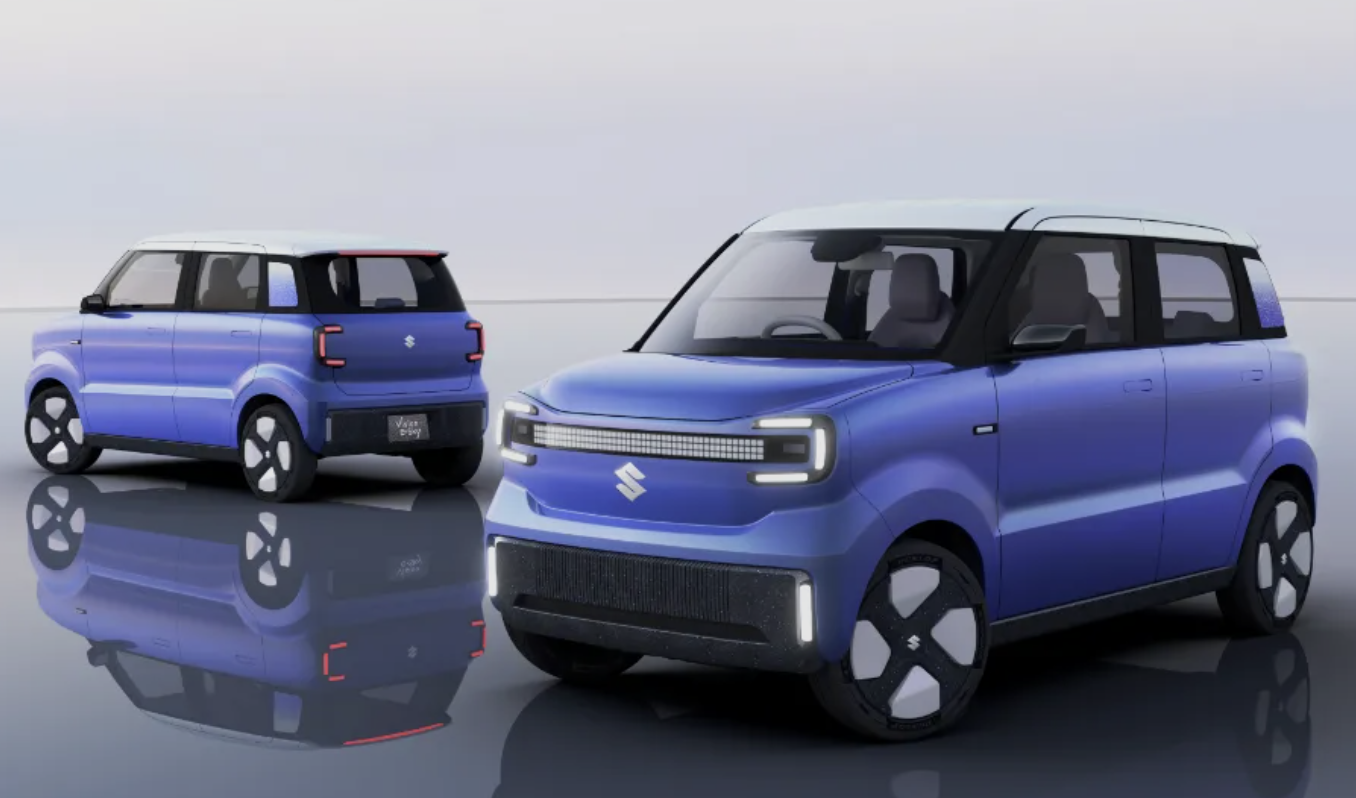
Concept car
At the 2025 show, Suzuki gave the Vision e-Sky a projected driving range of more than 270 km. The concept measured 3,395 millimeters long, 1,475 mm wide and 1,625 mm high. Those basic dimensions have been retained for the e SKY, while the reference range has increased to 310 km.
That development provides a useful indication of Suzuki’s engineering priorities. Rather than expanding the vehicle to accommodate a larger battery, the company has sought to improve the amount of distance it can extract from the same compact kei-car package.
The e SKY is being developed under Suzuki’s “Easy to Switch” concept, which is intended to make the move from a gasoline-powered kei car to an EV familiar to existing users. Suzuki identifies commuting, school trips, shopping and family transportation as the vehicle’s primary uses.
The prototype measures 3,395 millimeters long, 1,475 mm wide and 1,625 mm high, with a 2,460-mm wheelbase. Its curb weight is about 1,030 kilograms.
The vehicle uses a 26-kilowatt-hour lithium iron phosphate battery and has a reference energy-consumption figure of 97 watt-hours per kilometer. Suzuki’s 310-km range is also a reference figure and has not yet been certified under Japan’s WLTC testing cycle.
The figures put the e SKY firmly in the small-battery end of the EV market. The engineering challenge is made more demanding by Japan’s kei-car regulations, which limit vehicle dimensions and power output. Suzuki cannot simply enlarge the body to accommodate more battery capacity.
Instead, the company has developed the e SKY around its HEARTECT-e electric vehicle architecture. The drivetrain uses an integrated e-Axle combining the motor, inverter and reduction gears, while the battery is installed beneath the floor.

Aerodynamics
Suzuki has also worked on the vehicle’s aerodynamics, including its underbody, while retaining the tall, compact proportions characteristic of kei cars. The result is a vehicle that uses almost the full permitted kei-car footprint without growing into the dimensions of a conventional small hatchback.
The low vehicle mass is central to the specification. At about 1,030 kg, the e SKY weighs substantially less than many contemporary battery-electric passenger cars. That reduces the amount of energy required for acceleration and helps limit the battery capacity needed for the vehicle’s intended operating range.
The 26-kWh battery also uses lithium iron phosphate chemistry, which has become increasingly common in lower-cost EVs because of its thermal stability, durability and reduced reliance on nickel and cobalt compared with some other lithium-ion chemistries.
Quick hops only
Suzuki has not positioned the e SKY as a long-distance vehicle. Its intended environment is Japan’s urban and suburban road network, where a relatively modest battery can cover daily travel and be recharged while the vehicle is parked.
The charging system reflects that use case. Suzuki says the prototype can accept up to 50 kW of DC fast charging, reaching 80% in about 25 minutes. With AC charging, the company cites approximately 4.5 hours using a 6-kW connection and about eight hours at 3 kW. The vehicle can also supply electricity externally through a 100-volt, 1,500-watt outlet. A heat-pump climate-control system is used to reduce the electrical load associated with cabin heating and cooling. That makes energy consumption a more important design variable. At 97 Wh/km, Suzuki’s stated prototype figure would give the e SKY an energy requirement of roughly 9.7 kWh for every 100 km traveled.
The e SKY will enter a market that already has several electric kei cars. Nissan and Mitsubishi have offered the Sakura and eK X EV, respectively, while Honda has introduced the N-ONE e:. BYD has also entered Japan’s kei segment with the Racco.

For the daily commute
The e SKY represents an approach to EV development that starts with the vehicle’s intended use rather than with a target battery capacity. A kei car used primarily for daily urban travel does not need to carry the same energy reserve as an electric SUV designed for long highway journeys.
That also affects the material requirements of the vehicle. A smaller battery requires fewer cells and less battery material, while the lower vehicle mass reduces the energy needed throughout the vehicle’s operation.
The approach has limits. A 310-km reference range and a 26-kWh battery may be well suited to the e SKY’s intended market, but the same formula would not necessarily work for vehicles expected to carry heavy loads, travel long distances at highway speeds or operate for extended periods without charging.
Suzuki is consequently not proposing the e SKY as a universal EV formula. It is applying electric propulsion to a vehicle category whose operating requirements are already tightly defined.
That makes the model significant beyond its size. As automakers face pressure to reduce EV costs, battery material demand and energy consumption, Suzuki is demonstrating what can be achieved by reducing the energy requirement of the vehicle before increasing the amount of energy stored onboard.
The e SKY is an example of that approach: a 1,030-kg kei car, a 26-kWh battery and a targeted 310-km range, with efficiency doing much of the work that a larger battery would otherwise have to do.
Suzuki expects to disclose final specifications and pricing closer to the autumn launch.
The model’s development from the Vision e-Sky concept also shows that the company has been working toward this formula for at least a year. In October 2025, Suzuki presented a kei EV with essentially the same exterior dimensions and a projected range above 270 km. By August 2026, the production-bound e SKY had pushed the reference figure to 310 km without increasing its length or width.
The progression is significant because it shows where Suzuki has found additional efficiency during development. The company has not simply scaled up the vehicle. It has refined the electric drivetrain, battery integration, aerodynamics and other systems while preserving the dimensions required of a kei car.

Sign up for CleanTechnica's Weekly Substack for Zach and Scott's in-depth analyses and high level summaries, sign up for our daily newsletter, and follow us on Google News!
Have a tip for CleanTechnica? Want to advertise? Want to suggest a guest for our CleanTech Talk podcast? Contact us here.
Sign up for our daily newsletter for 10–15 new cleantech stories a day. Or sign up for our weekly one on top stories of the week if daily is too frequent.


CleanTechnica uses affiliate links. See our policy here.
CleanTechnica's Comment Policy

