

A Vacation Farmhouse In Vermont Inspires A Renewable Energy Travelogue
Support CleanTechnica's work through a Substack subscription, on Patreon, or on Stripe. Help us produce all of the high-quality, original content we publish week after week despite the challenges of content-scraping AI, antisocial media, inflation, and other hurdles.
This week, as part of our summer travels around New England, hubby and I have reserved a Vermont farmhouse. The rolling hills are lush and verdant. Generations of farmers have planted creamy hydrangea and purple phlox. Native columbine, wild grapes, and milkweed feed pollinators are among the thousands of plants that surround us. Crab apple, willow, maple, elm: deciduous trees stand guard beside the barns. Huge mounds of yellow day lilies. Oh! The long rows of vegetables — tomatoes, cukes, zucchini, carrots still producing. Pole beans, lettuces, asparagus gone to seed. All emit slightly sweet aromas.
To vacation in Vermont in August means slow days and mindfulness. It means going light on the beach and leaning more toward immersion in museums and north country architecture. It means studying the rising mist and breathing in familiar and hard-to-identify fragrances.
With touchless check-in, one of my first activities was to familiarize myself with the property and home. As my regular readers know, I’ve been attempting to convert my summer home to all-electric. At our host farmhouse, interestingly, there’s a surprising lack of one smell: burning fossil fuels. I was a little caught off-guard by the multiple ways that our hosts have made a slow and steady conversion toward an all-electric lifestyle.
Our vacation farmhouse is run primarily by electricity.
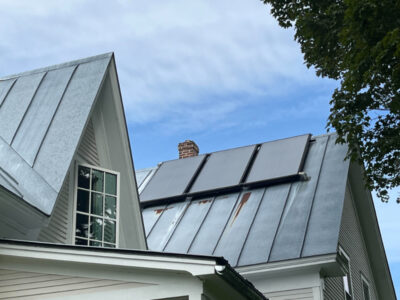
Solar water heaters: Gravity, thermodynamics (heat transfer), and water flow all come into play on a roof. Solar water heaters are high-efficiency appliances that use dedicated solar collectors on a rooftop to draw power from the sun. The solar energy collected is then used to heat the water in the farmhouse. They don’t use energy from the grid to heat water.

Rooftop solar: The barn is topped with 16 solar panels. Hubby found a log inside that chronicles the first records of kWhs produced, starting in 2014 — a time when rooftop solar was much more expensive than today. The entries indicate that about 50,000 kWh were produced cumulatively in the solar system’s first decade. According to the US Energy Information Administration (EIA), the average US home used 10,791 kWh of electricity in 2022. So the farm family is producing about half their annual needed electricity with the solar panels. It’s substantial, if not everything.
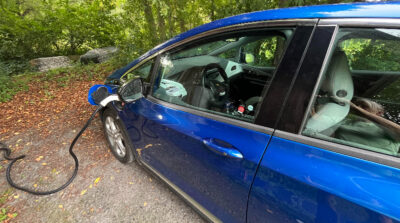
EV charging: We were delighted to be able to plug in our summer vehicle, a 2017 Chevy Bolt, at our rural farmhouse destination. Driving an EV long distances has definitely become easier over the last couple of years with more access to public chargers. Then again, there’s nothing quite like the convenience of plugging in at home and going about regular daily activities while the electrons accumulate.
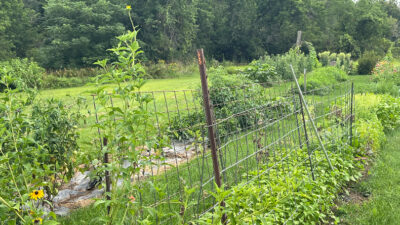

Sustainable practices help, too: A huge vegetable garden provided amazing complements to our meals while we were in farmhouse residence. Our hosts requested that we compost — which we always do — and a pile at the bottom of a rolling hill popped with pumpkins.
Is it Feasible for a Farm to be All-Electric in 2026?
The short answer to that question is “No.” A 10-acre farm is complex, and, while our hosts have made strides toward net zero energy usage and far exceed any of their neighbors in those goals, the transition to an all-electric lifestyle is a process for us all.
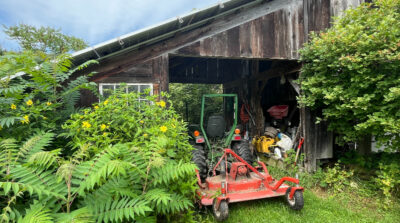
Mowing the fields: While many of the fields are dedicated to haying, the acreage around the farmhouse must also be mowed. A brush hog on site is a necessity, even if it takes diesel to run it. Yes, commercialized, zero-emission, off-road equipment is on its way. In fact, the Vermont Department of Environmental Conservation (DEC) has announced $5,909,575 in funding to reduce diesel emissions by supporting the replacement of medium- and heavy-duty vehicles and certain non-road equipment with electric options. Who knows? Maybe our host family will be a recipient of such funding and make their field equipment all-electric in years to come.
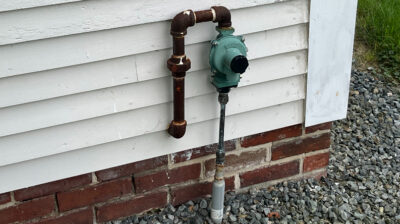
Propane backup: We noticed that our hosts do have an access point for propane to enter the home, and there are baseboard heaters in a couple of the rooms. While two wood stoves offer carbon neutral heating, it must be necessary to have another option during periods of travel, for example.
Is Affordability the Driving Force for a Farm Family to Convert to Renewables?
“There’s no question that the average consumer is feeling pressure from rising fuel costs,” Home Depot CFO Richard McPhail said in May.
More recently, and with greater persuasion, Senator Bernie Sanders (I-VT) wrote an editorial for Common Dreams. In it, he condemned any softening of the Trump administration’s approach to climate change. He also affirmed that progressives are ready to vote for candidates who aren’t afraid to stand up for our planet.
“The last 11 years have been the hottest 11 years on record and the last three years have been the hottest three years on record. This past year the United States and countries throughout the world have seen major heatwaves, flash floods, increased drought and horrific forest fires – and scientists tell us the worst is yet to come. Progressives believe that we must forcefully take on the greed of the fossil fuel industry. The truth is that we can create millions of good-paying union jobs by transforming our energy systems away from fossil fuels and into energy efficiency and sustainable energy. For the sake of our kids, future generations and the habitability of the planet that is what we must do.”
Although I’ve never met them, I suspect our VT farmhouse hosts are progressives. They’re moving toward a sustainable lifestyle, even if the Trump administration denies the imperative to stop climate change at every turn. I also suspect that our hosts, like us, will be voting in the November midterms for like-minded candidates who will push to enact policies and programs that help everyone to live cleaner, more sustainable, and more affordable lives. In the meantime, we’re making renewable energy inroads in small but important steps.
Sign up for CleanTechnica's Weekly Substack for Zach and Scott's in-depth analyses and high level summaries, sign up for our daily newsletter, and follow us on Google News!
Have a tip for CleanTechnica? Want to advertise? Want to suggest a guest for our CleanTech Talk podcast? Contact us here.
Sign up for our daily newsletter for 10–15 new cleantech stories a day. Or sign up for our weekly one on top stories of the week if daily is too frequent.


CleanTechnica uses affiliate links. See our policy here.
CleanTechnica's Comment Policy

