
EU Parliament Biofuels Blunder Could Expose EU To Over $5.6 Billion A Year In Sanctions
Support CleanTechnica's work through a Substack subscription, on Patreon, or on Stripe. Help us produce all of the high-quality, original content we publish week after week despite the challenges of content-scraping AI, antisocial media, inflation, and other hurdles.
MEPs have voted to reject an EU regulation that would have seen soy biofuels no longer count as a renewable fuel by 2030.
Members of the European Parliament have voted to reject an EU regulation that would have seen soy biofuels no longer count as a renewable fuel by 2030. Soy bean cultivation is one of the world’s leading causes of deforestation and land clearance, says T&E.
The decision to reverse the regulation could now see the EU liable for over $5.6 billion a year in retaliation penalties from Indonesia and Malaysia for failing to meet a legal obligation to update its laws regarding deforestation-risk biofuels, according to a letter sent to MEPs from Energy Commissioner Dan Jorgensen.
The EU previously won a WTO trade dispute against Indonesia and Malaysia that allowed the EU to keep a phase out of palm oil biofuels – of which Indonesia and Malaysia are the world’s biggest producers – provided it took a scientific and consistent approach to what it considers high deforestation risk feedstocks. This condition will now not be met as a result of today’s vote, leaving the EU open to litigative action from these palm oil powerhouses.
Cian Delaney, biofuels campaigner at T&E, said: “This decision comes after relentless, targeted lobbying from the bioenergy and agriculture industries, so they can continue to use deforestation-driving soy to make biofuels. Soy is one of the world’s leading causes of deforestation and land clearance. Considering it as a sustainable alternative to fossil fuel is a gross underestimation of the impact its cultivation has on the environment, climate and food security.”

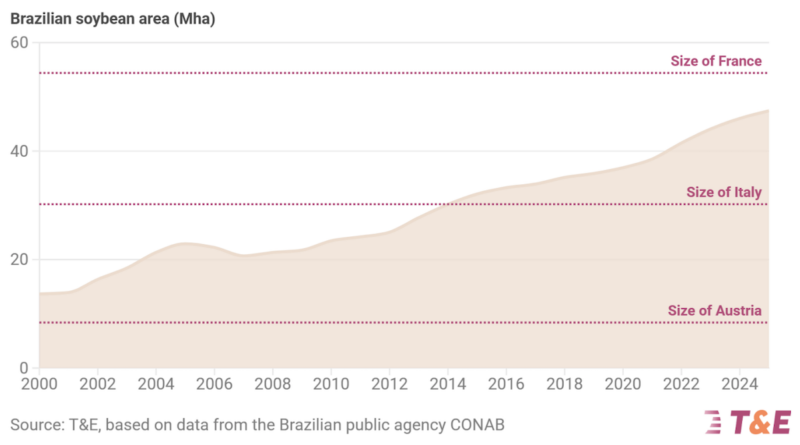
According to T&E research, land dedicated to soy cultivation in Brazil now exceeds most European countries, which has devastating effects on the Amazon rainforest and the Cerrado savannah.

T&E calls on national governments to prioritise science by preemptively phasing out soy from national targets, as is already the case in France, the Netherlands, Denmark, and Belgium.
Article from T&E.
Sign up for CleanTechnica's Weekly Substack for Zach and Scott's in-depth analyses and high level summaries, sign up for our daily newsletter, and follow us on Google News!
Have a tip for CleanTechnica? Want to advertise? Want to suggest a guest for our CleanTech Talk podcast? Contact us here.
Sign up for our daily newsletter for 10–15 new cleantech stories a day. Or sign up for our weekly one on top stories of the week if daily is too frequent.


CleanTechnica uses affiliate links. See our policy here.
CleanTechnica's Comment Policy

