
The US Army Is Launching A Next-Gen Abrams Tank, And It’s Just What You’d Expect
Support CleanTechnica's work through a Substack subscription, on Patreon, or on Stripe. Help us produce all of the high-quality, original content we publish week after week despite the challenges of content-scraping AI, antisocial media, inflation, and other hurdles.
If you guessed that the US Army’s long awaited, next-generation M1E3 Abrams tank is a hybrid electric vehicle, run right out and buy yourself a cigar. Yes, it is. The Army has been taking a long, slow, roundabout journey to the all-electric fleet of the future, but it has been nothing if not persistent despite last year’s sharp U-turn in federal EV policy.
The Abrams Tank Lumbers Into An EV Future
The Army’s interest in EVs, or at least hybrid EVs, has grown apace with the considerable amount of electronic gear layering onto combat operations. For tactical vehicles that spend most of their time sitting still in idle mode, running a conventional engine to power that equipment creates a fat, juicy heat signature for targeting by whatever enemy happens to be in the area. The noise factor also adds another element to exposure risks.
Some early hints about electrifying parts of the venerable Abrams series began to surface on the CleanTechnica radar back in 2010, with hydrogen fuel cells among the technologies in the running. The idea of diverting the vehicle’s copious waste heat into thermoelectric generating systems also made an appearance.
“GM has been working on a thermoelectric system for capturing waste heat from car exhaust, so it’s no surprise that the company is a partner in the Abrams tank project along with General Dynamics, Creare, Inc. (a heat transfer expert), and the international research group Research Triangle Institute,” CleanTechnica observed in 2012.
Waste heat and fuel cells aside, new energy storage technology provides an opportunity to accomplish the same thing. In recent months, for example, the Army has begun to install “anti-idling kits” on some vehicles, in the form of extra battery packs that can power the onboard electronic equipment while the engine is switched off. Next steps reportedly include diverting electricity to power off-board equipment and microgrids.
Here Comes The Hybrid EV Of The Future, Tank Edition
The potential for pushing the Abrams tank into a more EV-aware future began to take shape in 2022, when CleanTechnica’s Jennifer Sensiba took note of a fresh round of activity in the hybrid electric space.
“General Dynamics Land Systems recently announced some important upgrades for the next generation of Abrams and Stryker vehicles,” Sensiba wrote. “By using hybrid powerplants, not only are problems solved, but the vehicles get exciting new capabilities.”
“While the big motivation for reducing fuel consumption is to get better range and lower logistical challenges, the Pentagon does also have climate goals,” Sensiba added.
The climate goals evaporated from federal energy policy after US President Donald Trump took office for the second time last year. However, with drone-centered combat emerging in force, the need to shed 20th-century energy technologies is more urgent than ever.
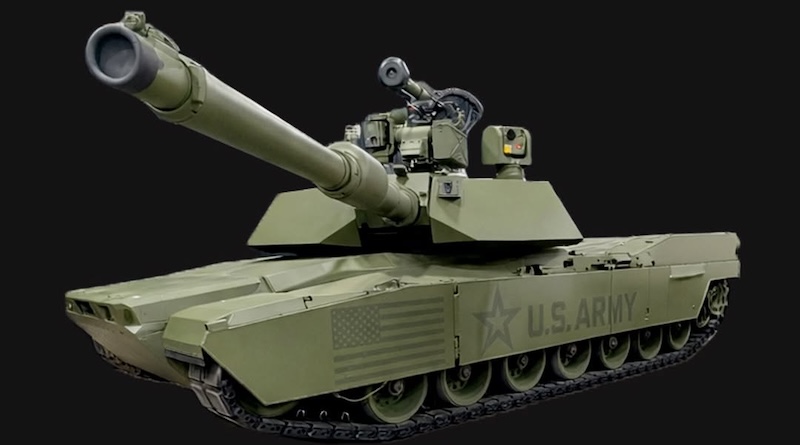
Accordingly, in January the Army displayed its new M1E3 Abrams early prototype at the North American International Auto Show in Detroit, accompanied by an Army press statement that is rather thin on detail except to note that the new tank-sized hybrid EV combines “advanced protection, reduced weight, and a smaller logistical footprint to meet the challenges of tomorrow’s battlefield.”
Confirmed: Hybrid Electric Powertrain In The Planning Stage
More details were forthcoming from the defense trade news organization Army Recognition in May. Calling the M1E3 a “lighter, more technologically advanced successor to the M1A2 SEPv3,” Army Recognition Chief Editor Alain Servaes confirmed that the new tank includes plans for a hybrid diesel-electric powertrain.
“A central feature of the M1E3 program is the planned adoption of a hybrid diesel-electric propulsion system combined with a high-efficiency transmission. The hybrid architecture is expected to reduce fuel consumption, extend operational range, lower thermal and acoustic signatures, and provide additional onboard electrical power for future sensors, protection systems, directed-energy technologies, and electronic warfare capabilities,” Servais elaborated.
“By combining reduced weight with advanced automation and improved fuel efficiency, the Army aims to create a tank better suited for rapid deployment, extended operations, and future warfare against increasingly sophisticated anti-armor threats,” he emphasized, listing loitering munitions, FPV (First Person View) attack drones, long-range precision fires, and persistent aerial surveillance among those threats.
What About Light Tactical Vehicles?
Yes, what about them? While propulsion is not in the cards for electrifying a full sized tank (at least, not yet), lighter tactical vehicles have the potential to take full advantage of hybrid technology.
Back in 2022 there was much rejoicing in the EV world when the US Army and US Marine Corps dropped some hints about the potential for electrifying their forthcoming JLTV (Joint Light Tactical Vehicle), with the US defense contractor Oshkosh Defense amon3g those pursuing the hybrid EV angle. In January of 2022 the firm unveiled its new “eJLTV,” highlighting the vehicle’s silent running capability.
“The eJLTV offers the U.S. Army and U.S. Marine Corps the same level of performance and protection as the base JLTV with the addition of silent drive, extended silent watch, enhanced fuel economy, and increased exportable power that enables it to be used in combat and reconnaissance scenarios,” Oshkosh enthused, covering all the benefits bases of EV technology.
Writing for Military Times last week, reporter Jared Keller noted that “the ultimate fate of the JLTV remains uncertain,” while also drawing attention to other hybrid electric solutions in the tactical vehicle space.
That includes the ISV-H from the Defense branch of General Motors, which Keller describes as a “mobile power plant that happens to carry soldiers.
The underlying challenge is the need for an onboard power system that can provide the sharp bursts of energy required of laser weaponry. “The proposed solution to this problem is a hybrid architecture: a generator sized for average load paired with a high-voltage battery system capable of delivering instantaneous surges on demand,” Keller explains.
“The battery handles the spike, the generator recharges the battery between shots and the overall system is smaller, quieter and more tactically versatile than alternatives,” he adds.
“A vehicle with the right hybrid architecture becomes more than just a maneuver capability, but a node in a distributed battlefield power grid capable of charging drone batteries, running C2 and sensor networks and powering electronic warfare equipment — and, when the moment requires it, feeding a laser weapon the juice it needs to fry a target,” he adds again for good measure.
In its data sheet for the ISV-H, GM Defense emphasizes that the vehicle uses “the existing fuel supply system,” referring to JP8 and fuel infrastructure (JP8 is a kerosene-based multipurpose fuel). That provides some clarity on whether or not an EV charging station is needed, and the answer is no.
Still, the hybrid angle illustrates how modern warfare is exposing the limitations of fossil energy resources. On the plus side for the ISV-H hybrid, GM Defense cites “providing energy on demand” while replacing existing generators, alongside an overall savings on fuel. Among other advantages, the company also lists fewer moving parts and subsystems needed for propulsion, leading to reduced downtime and costs for maintenance.
For those of you keeping score at home, the ISV-H hybrid is based off GM’s ZR2 variant of the Chevy Silverado HD 3500, not to be confused with the company’s ZH2 hybrid fuel cell EV. The fuel cell version popped up back in 2018. Whether or not it surfaces again remains to be seen…
Photo: Hybrid EV technology has made its way into the US Army’s plans for the forthcoming next-generation M1E3 Abrams tank, aimed at deploying 21st century electrification technology to fight the drone-centered wars of today (cropped, courtesy of US Army via Facebook).
Sign up for CleanTechnica's Weekly Substack for Zach and Scott's in-depth analyses and high level summaries, sign up for our daily newsletter, and follow us on Google News!
Have a tip for CleanTechnica? Want to advertise? Want to suggest a guest for our CleanTech Talk podcast? Contact us here.
Sign up for our daily newsletter for 15 new cleantech stories a day. Or sign up for our weekly one on top stories of the week if daily is too frequent.


CleanTechnica uses affiliate links. See our policy here.
CleanTechnica's Comment Policy

