

As Kenya’s Electric Motorcycle Ecosystem Grows, Local Firms Are Starting to Specialise and Forge Interesting Partnerships With Large Global Firms
Support CleanTechnica's work through a Substack subscription or on Stripe.
Kenya’s electric motorcycle sector is starting to blossom now as several firms move from initial commercialisation of their products to full commercialisation, and scaling up their operations. In the beginning, several startups moved to validate their models using electric motorcycles built with off-the-shelf battery cells, BMS, controllers, motors, and other components all bundled into a package housed into a frame of old internal combustion engine motorcycles that had the ICE components stripped out. During this early pilot phase, the startups worked on the ground with motorcycle taxi riders to gather insights on the critical requirements to build electric motorcycles that are best fit for local conditions.
Armed with real-world data, they raised grant funding, debt, as well as equity investment to build essentially the first generation of their own motorcycles with proprietary BMS from their own designs guided by local findings. These motorcycles were then deployed on the ground in volumes of tens, and eventually low hundreds, leading to more iterations of the motorcycles themselves as well as the battery charging/swapping infrastructure. At this stage, all companies were involved across the whole value chain. That meant developing the electric motorcycles as well as the enabling infrastructure for charging batteries at their battery swapping hubs and other related services. This stage helped prove the unit economics, the demand for electric motorcycles, backed by the large addressable market in Kenya, a market that has over 2 million internal combustion engine motorcycles.
This led to more funding rounds enabling them to raise tens of millions of dollars, helping them to deploy the next iterations of their electric motorcycles in volumes in the order of thousands now and also hundreds of accompanying battery charging and swapping centers. There are now close to 50,000 electric motorcycles on Kenya’s roads along with over 1,000 battery swapping centres, and it looks like we are starting to see the next phase of evolution in Kenya’s electric motorcycle sector.
Since the Kenyan startups had to work on everything from scratch to build the sector, such as designing and building the motorcycle and the energy infrastructure, they in the process of all this developed the necessary hardware, software, and supporting infrastructure for the charging and swapping infrastructure. That means they are now at a stage where they could scale this infrastructure and unlock value by offering Energy-as-a-Service (EaaS) or Battery-as-a-Service (Baas) as a business on its own with capability to support any international motorcycle companies that want to enter the Kenyan and African market. That means international OEMs can focus on developing their motorcycles knowing that the problem of charging/swapping infrastructure has been solved and they can just leverage these Kenyan companies and ride on their charging/swapping networks.
We are starting to see some indication of this. ARC Ride initially developed its own motorcycles and still does, but is now pivoting to become more and more of a leading battery-as-a-service (BaaS) infrastructure provider. ARC Ride wants to drive affordable, reliable, and clean e-mobility solutions for electric vehicles across rapidly developing cities. In an exciting development, ARC Ride and Yadea announced the launch of Kifa, a 2-wheeler electric vehicle, at the EV Expo Kenya 2026 at Carnivore Exhibition Grounds, Nairobi, Kenya. Yadea’s Kifa model is powered by ARC Ride batteries as part of a larger interoperability partnership. Yadea is one of the world’s leading electric two-wheeler brands. Yadea has ranked global No.1 in annual sales for the last 8 consecutive years, with the product ranges mainly covering high-performance electric motorcycles, electric mopeds, electric bicycles, and electric kick scooters. ARC Ride CEO, Joseph Hurst Croft, says their vision is to be a multibrand battery as a service business and Yadea has now become the first of many partners to come in the future. ARC Ride will continue to develop and sell its range of electric motorcycles, led by its flagship Panther electric motorcycle. ARC Ride has set up assembly plants in several countries on the African continent.


The Kifa electric motorcycle from Yadea is the first 3rd party motorcycle where ARC Ride is the BaaS partner. ARC Ride wants to get to the point where their BaaS supports multiple brands of motorcycles, three-wheelers, and light four wheeled vehicles. ARC Ride wants to be the leading BaaS partner for micromobility on the continent’s rapidly growing cities
“Our goal as ARC Ride is to be the leading interoperable battery as a service infrastructure provider across Africa. This partnership enables Yadea to introduce their EVs like Kifa to the African market while relying on our established battery as a service network across all our markets. Kifa demonstrates our capacity to achieve interoperability reliably across different EV models so more people can ride electric,” said Joseph Hurst-Croft, CEO of ARC Ride.
“We are excited to launch our EVs in Africa and to have ARC Ride as a reliable BaaS partner. Our interoperability partnership has enabled us to provide an innovative new product that goes the distance while still being affordable to many eager and keen African riders,” said John Zhang, Market Supervisor of Yadea.
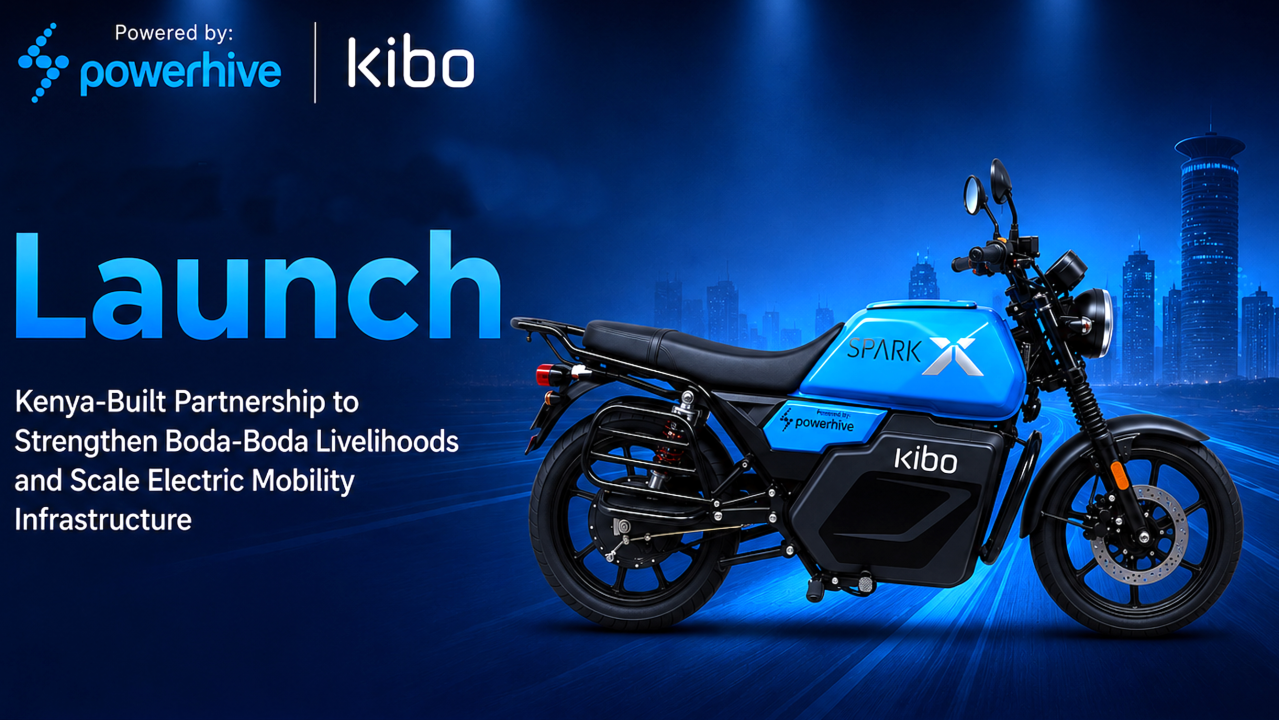
In another exciting development also following a similar strategy, Powerhive and Kibo Motorcycles have officially partnered to bring the Kibo Spark powered by Powerhive to market, combining two companies with deep experience building solutions for Kenya’s transport and energy sectors. The partnership brings together Kibo’s decade of motorcycle manufacturing, assembly, distribution, and aftersales expertise with Powerhive’s battery-swapping infrastructure, energy platform, rider technology, and mobility services. The two companies believe that while electric motorcycles are becoming increasingly common across Kenya, widespread adoption depends on more than the vehicle itself. Riders need reliable support, accessible service, predictable operating costs, and energy infrastructure that works every day. That is the challenge this partnership was designed to solve.
Powerhive and Kibo say that for riders, the value is straightforward: access to a locally supported electric motorcycle backed by a growing national swap network, a flat-rate energy model, insurance benefits, and digital tools designed to improve daily operations. Powerhive says it is targeting the expansion of its battery-swapping network from approximately 130 locations in the initial phase to more than 630 locations by 2029, supporting a projected rider base of more than 10,000 active users. Powerhive adds that the combined economic impact projections estimate a contribution of approximately US$74.7 million to Kenya’s economy between 2026 and 2029.
Late last year, Ampersand announced a partnership to run the Wylex electric motorcycle on its batteries and existing swap network across East Africa. This marked a major step forward for Ampersand, one of the pioneers of electric transport in Africa, and for Wylex Mobility, a leading electric motorcycle manufacturer. The partnership made Ampersand Energy the first electric transport company in Africa to open its batteries and swap network to third-party vehicle manufacturers. Ampersand says it is actually an electric vehicle energy tech company, not just a motorcycle company, and has been positioning its branding to reflect this.
So it’s interesting to see this model seems to be gaining traction in Kenya and Rwanda. It could be what is needed to get the sector from tens of thousands of motorcycles on the road a year to the hundreds of thousands per year to displace the internal combustion engine motorcycles. Already, electric motorcycles now make up 15% of brand new motorcycles sales in Kenya and the sector looks like it will grow at an accelerated pace in the coming years. A lot more funding in the order of hundreds of millions and billions of dollars across the African continent will be needed in the medium term to get there.
Sign up for CleanTechnica's Weekly Substack for Zach and Scott's in-depth analyses and high level summaries, sign up for our daily newsletter, and follow us on Google News!
Have a tip for CleanTechnica? Want to advertise? Want to suggest a guest for our CleanTech Talk podcast? Contact us here.
Sign up for our daily newsletter for 15 new cleantech stories a day. Or sign up for our weekly one on top stories of the week if daily is too frequent.


CleanTechnica uses affiliate links. See our policy here.
CleanTechnica's Comment Policy

