
Solar With Firming Now Beating Gas In Asia, & EVs Could Save Region $350 Billion A Year
Support CleanTechnica's work through a Substack subscription, on Patreon, or on Stripe. Help us produce all of the high-quality, original content we publish week after week despite the challenges of content-scraping AI, antisocial media, inflation, and other hurdles.
While the solar industry really got its jumpstart in the US, and then grew to a significant level in Germany, it’s China that completely exploded the industry while driving costs down to unbeatable levels. The same thing basically happened with electric vehicles as well.
However, there’s still much more that can be done in China, as well as Asia more broadly of course. A new report from Ember highlights that in some eye-popping ways.
Saving $350 Billion A Year
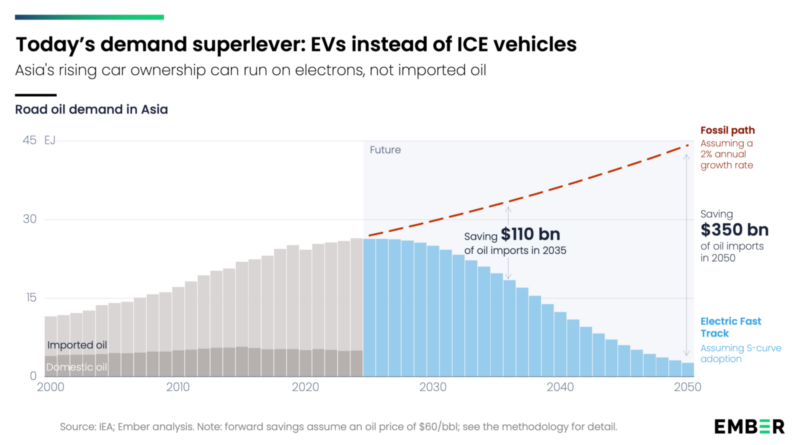
One big headline figure is that the organization estimates Asia could eventually save $350 billion a year on oil imports if it electrified its fleets. $350 billion. Every year.

As you can see in the chart above, the projection shows $110 billion a year in savings by 2035 and $350 billion a year in savings by 2050.
“Electric vehicles are a strategic necessity,” says Daan Walter, Principal at Ember and the lead author of the report. “Road transport is the single largest source of Asia’s fossil imports, costing over $300 billion a year. Asia could electrify its fleet within twenty years and halve its oil imports. No single lever does more for the region’s balance of payments and energy security.”
Of course, China has been electrifying its new vehicle sales very quickly, quicker than almost any other country in the world on a market share basis. It is by far the biggest EV market in the world. Last month, 63% of new vehicle sales were plugin vehicle sales. And it just makes a ton of sense for the country. “Around 80% of the oil Asia uses in road transport is imported, and with electric cars now at purchase price parity with petrol and vehicle ownership across the region set to surge, the report highlights that switching to electric transport will reduce one of Asia’s largest and fastest-growing sources of import dependence,” Ember writes. Indeed.
Electrify transport. Keep money in your own country. It just makes sense. It’s one of the most obvious national priorities imaginable — or should be.
It gets even more obvious for Asia. Check out these stats: “Asia has just 4% of the world’s oil and gas, but accounts for 75% of electrotech production, although largely from China.” No-brainer. Cut oil and gas use. Switch to electric vehicles and renewable energy.
Solar with Firming Boots Gas from Asia Power Plans
Aside from using electricity in vehicles instead of gas/petrol/diesel, the other side of the fossilized coin is electricity generation. Solar and wind power have came into town with scorchingly low prices, but there has always been that whole “the sun doesn’t always shine and the wind doesn’t always blow” argument. That’s where batteries come in, and because battery prices as well as solar panel prices have come down so much, the solar plus battery combo is starting to shake up the power market in Asia.
“Firmed solar can now undercut most of the new gas power capacity Asia is planning to build,” Ember writes. “[S]olar plus batteries can already beat LNG on price at three-quarters of the sites across Asia where new gas capacity is currently planned.” Wow!
A new report from Ember comes to the following conclusion: “round-the-clock solar-plus-battery power now costs less than $100/megawatt-hour (MWh) in most of Asia.” That’s pretty much a breakthrough level. Fossil fuels can’t compete. The organization thinks that this cleantech option will outcompete LNG across 100% of Asia by 2030 — within just 3½ years.
“Solar plus batteries are much better suited to deliver bulk power now in Asia than LNG, and they will only get cheaper,” says Aditya Lolla, Interim Managing Director at Ember and a co-author of the report. “With strong domestic manufacturing capacity and low electricity prices, the countries in the region are well-positioned to supply their own clean, electrified future.” Indeed.
Solar and batteries are winning, and they are only going to win more and more. Electric vehicles are winning, and they are going to win more and more. The Asian continent is turning into a continent of electrostates, and there couldn’t be an easier decision for these countries. Instead of being at the whim of aggressive nations like the US, Russia, and some in the Middle East, having to suffer price spikes and economic uncertainty — not to mention much more pollution and health problems — Asian countries can keep hundreds of billions of dollars a year within their own economies and stop sending money abroad for oil and gas. It’s a no-brainer if there ever has been one.

“Electrotech is fast, modular and consumer-led,” notes Daan Walter, Principal at Ember and the lead author of the report. “Faced with a crisis, policymakers can deploy electrotech rapidly, and households can climb the energy ladder one step at a time at low incremental cost. Witness what happened in Pakistan. Households and businesses have installed distributed solar at a pace that has outrun centralised planning entirely. Governments need to keep up.”
Sign up for CleanTechnica's Weekly Substack for Zach and Scott's in-depth analyses and high level summaries, sign up for our daily newsletter, and follow us on Google News!
Have a tip for CleanTechnica? Want to advertise? Want to suggest a guest for our CleanTech Talk podcast? Contact us here.
Sign up for our daily newsletter for 15 new cleantech stories a day. Or sign up for our weekly one on top stories of the week if daily is too frequent.


CleanTechnica uses affiliate links. See our policy here.
CleanTechnica's Comment Policy

