
Why Have F1 Drivers Given The Ferrari Luce The Thumbs-Up But The Tifosi Won’t?
Support CleanTechnica's work through a Substack subscription, on Patreon, or on Stripe. Help us produce all of the high-quality, original content we publish week after week despite the challenges of content-scraping AI, antisocial media, inflation, and other hurdles.
The newly unveiled Ferrari Luce, the company’s first fully electric car, hasn’t quite captured the love of the tifosi.
The $640,000 five-seater, designed by former Apple guru Jony Ive and the industrial stylist Marc Newson, has “the high degree of system integration to ensure performance typical of the brand,” the company insists. Capable of hitting close to 200 miles per hour, it is a sports car developed to take turns at high speeds, even with its heavy battery cells.
“I thought there were four engines in it,” seven-time F1 World Champion Lewis Hamilton mentioned after giving it a test drive, “but there are twelve.”
“Yes, three per wheel,” his Formula One Ferrari SF-26 teammate, Charles LeClerc, helped.
“One controlling the torque. One controlling the suspension. And the other one,” Hamilton paused. “Oh, yeah, the steer… which is pretty incredible.”
The new Ferrari Luce is good enough for Hamilton. Where’s the disconnect between a Formula One World Champion and the Ferrari fan base?
Ferrari’s introduction of the Luce (pronounced LOO-chay, or “light” in Italian) into the marketplace seems to symbolize an effort to broaden the company’s product portfolio. Can the 80-year-old brand transcend the Luce’s criticism and come out on the other side flourishing?
To assuage some anticipated complaints, Ferrari added in sound — it’s picked up by sensors beside the axles and amplified like an electric guitar.
That concession isn’t nearly enough for the old guard. “It risks destroying a legend, and I’m deeply sorry,” Luca Cordero di Montezemolo, the former Ferrari chairman, apologized. “I hope they at least remove the prancing horse from that car.”
His was not the only early criticism that was quite negative.
For the price, some complain, couldn’t Ferrari have infused more than a range of about 530 kilometers (329 miles) on a full charge?
Where’s the signature growl of a revving Ferrari engine?
Do the features like four-wheel-drive, four doors, and spacious interior and trunk space lean more toward vacationing than performance?
Why hasn’t Ferrari stuck to their “racing car” raison d’etre?
Can the Luce really perform at top speed?
On and on it went. Then the pair of F1 Ferrari SF-26 drivers took to the track.
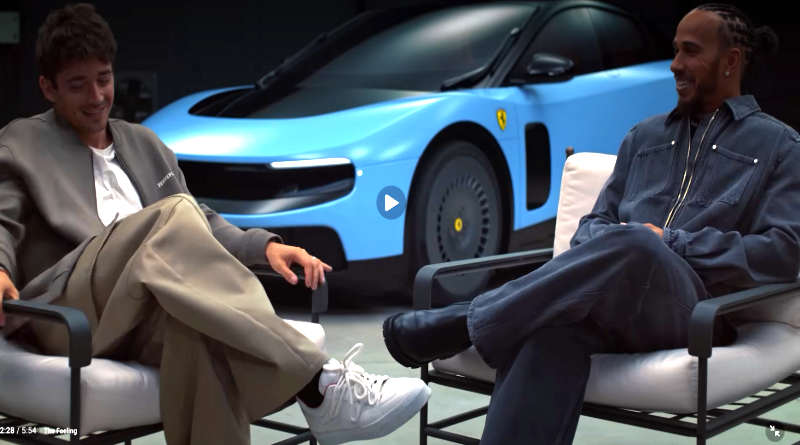
Fun at Maranello: Charles Grins Wildly While Hamilton Puts the Ferrari Luce to its Limits
I must admit it: I’ve been a Lewis Hamilton fan for many years. I savored each of his Formula One World Championship victories with Mercedes. When inept race director Michael Masi altered FIA rules on a 2021 final lap that shifted the advantage to Red Bull bad boy, Max Verstappen, Hamilton lost his chance at an eighth championship, and I’ve been indignant on his behalf ever since.
Mercedes CEO Toto Wolff promised Hamilton another competitive car, but it didn’t happen over a handful of years, so Hamilton moved to the Ferrari team to partner with Charles LeClerc. Now in his second year, Hamilton is settling in with Scuderia Ferrari and its “prancing horse” (which represents the “horse stable,” or racing team) mindset.
The storied team out of Maranello, Italy is the only automotive manufacturer to own their own dedicated race track for testing. The Pista di Fiorano is a 1.86 mile track where each corner is designed specifically to test certain aspects of the vehicle’s chassis, braking, and road-holding capabilities. It’s a track that is useful to simulate corners from numerous F1 tracks around the world, and the track is also utilized for the development of street cars.
Lewis Hamilton and Charles LeClerc took turns behind the wheel of the Ferrari Luce ahead of its unveiling. While Hamilton seemed rather laissez-faire in the passenger seat, LeClerc was unsettled when they switched seats and Hamilton accelerated.
“Whoa! No-no-no-no-no, please don’t do that!” LeClerc pleaded. “LH! LH-LH-LH… …LH. Careful! Careful! Careful! Careful! Careful, yeah? Wow! LH! Stop laughing!” Later on, still unable to shake off his experience with Hamilton at the wheel, LeClerc explained, “I thought you were pushing like crazy.”
Afterward, under the camera lights, Hamilton described his impressions of the Ferrari Luce. “In terms of the attention to detail, you can tell that it’s very Ferrari,” he noted. “The power delivery is amazing. You just feel centered the whole time, even when you’re going through corners.”
Slightly countering Hamilton’s description of the Luce’s styling, LeClerc noted, “The design is very-very different to what we’ve seen from Ferrari in the past.” He quickly added, “But I think it’s very futuristic.” LeClerc then complimented Ferrari on taking the next steps in automotive engineering. “It’s very Ferrari-like to look towards the future and to innovate.” Showing his love of legacy vehicles, though, LeClerc offered a backward compliment. “I love that it’s back to having more physical buttons so you can actually drive, look at the road, and you can feel.”
Want some weekend fun? Watch “Hamilton and Leclerc unveiling the Ferrari Luce | Episode 4” on YouTube.
Ferrari Gets Criticism from all Corners
A range of consumer reactions followed the vehicle’s unveiling — some were in awe, others in shock. Some felt betrayed, yet others slowly came around after giving it a full vehicle look over.
No, the first Luce revealed to the public was not painted in the quintessential Rosso Ferrari F1-75 color. Ferrari has been admonished by di Montezemolo and others for veering away from its traditional styling, but the company says “the form is defined by the glass house, an uncompromised, shell-like form.” Part of that form is floating front and rear wings, which drive aerodynamics and performance. Its exterior emerges from a flowing glass-and-polished-aluminum frame.
The specs may convince other naysayers.
- The powertrain comprises four-F80-derived permanent magnet synchronous engines with radial flux, delivering a maximum speed of 30,000 rpm at the front and 25,500 rpm at the rear.
- The system operates on 800 V architecture.
- The high-voltage battery pack was designed, validated, and built in Maranello. It comprises 210 cells in series that deliver 122 kWh and is designed as a structural element of the car.
- Power electronics feature compact inverters and a DC/DC resonant converter for the active suspension to achieve record-breaking efficiency of more than 98%.
- The extensive use of recycled secondary-alloy aluminium allows a reduction in CO₂e emissions during production of around 70% of the overall vehicle weight.
The waiting list for the most-sought-after Ferraris can last years. Ferrari, whose profits had largely defied the woes of the automotive sector, seems unfazed. Ferrari’s chief executive, Benedetto Vigna, said the car was garnering interest from potential buyers; the legendary motorsports firm has a small but very wealthy and loyal tech-focused following.
Investment bank Berenberg expects 25 Luce units to be delivered in the fourth quarter and 1,000 units by 2027. The bank was positive on May 28 on the stock and designated it with a Buy rating.
Resources
“Charles Leclerc’s hilarious reaction to Lewis Hamilton driving Ferrari’s new EV goes viral.” Lydia Mee. Motorsport. May 28, 2026.
“Ferrari Luce: A new chapter for the Maranello marque.” Press Release. May 25, 2026.
“Ferrari is finally going electric. Will the purists buy it?” Bernhard Warner. The New York Times. May 25, 2026.
“Fourteen interesting facts about Ferrari that every car enthusiast should know.” Quora. June 21, 2017.
Sign up for CleanTechnica's Weekly Substack for Zach and Scott's in-depth analyses and high level summaries, sign up for our daily newsletter, and follow us on Google News!
Have a tip for CleanTechnica? Want to advertise? Want to suggest a guest for our CleanTech Talk podcast? Contact us here.
Sign up for our daily newsletter for 15 new cleantech stories a day. Or sign up for our weekly one on top stories of the week if daily is too frequent.


CleanTechnica uses affiliate links. See our policy here.
CleanTechnica's Comment Policy

