
Leaked: Car Industry’s Latest Demands Could Cost EU Extra €74 Billion In Oil Imports
Support CleanTechnica's work through a Substack subscription, on Patreon, or on Stripe. Help us produce all of the high-quality, original content we publish week after week despite the challenges of content-scraping AI, antisocial media, inflation, and other hurdles.
ACEA document told Environment Ministers to slash car CO2 targets, depriving motorists of more affordable EV models.
The European car industry’s latest demands for weaker climate targets could result in an extra €74bn of oil imports — just as interest in buying EVs reaches new peaks. That’s according to T&E analysis of a leaked position paper issued by lobby group ACEA to Environment Ministers in March. T&E said the irresponsible proposal would delay the rollout of more affordable EV models at a time of high petrol prices and drastically increase oil dependency compared to the current EU car CO2 targets.
The ACEA paper calls for the averaging of carmakers’ 2030 EU CO2 targets over five years — a significant weakening compared to the EU Commission’s proposal to average over three years. It also calls for the cancellation of the new utility factor that more accurately counts plug-in hybrid vehicles’ (PHEV) emissions. The German government yesterday adopted ACEA’s position of prolonging sales of polluting PHEVs, a move which — if implemented — would only delay the EU car industry’s transition to fully electric cars and widen the gap with China.
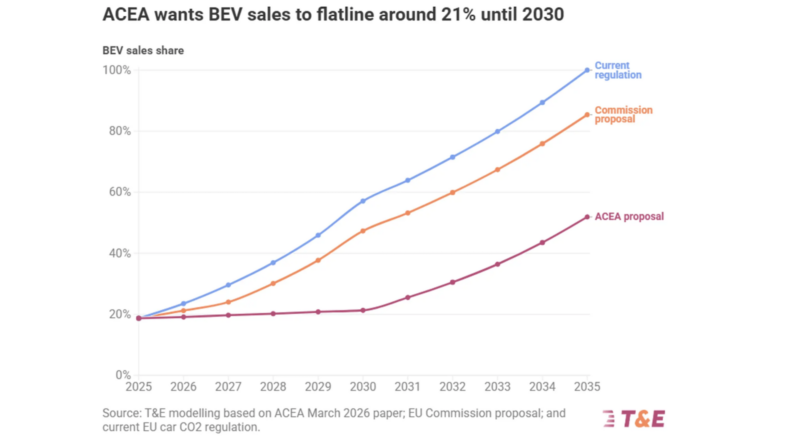
If ACEA’s demands are accepted, it would allow carmakers to sell far fewer battery electric vehicles (BEV) and far more polluting combustion engines than under the current target. T&E calculates it could lead to BEV sales flatlining at their current 21% market share for the rest of the decade — instead of 57% in 2030 required by the current law.

Émilie Casteignau Bernardini, vehicles policy manager at T&E, said: “Carmakers are fuelling Europe’s oil dependency at a time when many Europeans are paying €2 a litre for petrol. While drivers are struggling to fill their tanks, ACEA wants to delay the supply of more affordable EVs that people want. It’s disappointing to see the German government give in to the car industry’s lobbying to slow down electrification. The future is electric, and delaying that will hurt citizens and Europe’s competitiveness.”
In December, the EU Commission proposed weakening carmakers’ 2035 target from a 100% reduction in CO2 to -90%. ACEA is demanding the target be weakened further to -80% by awarding 10% worth of credits to carmakers without conditions, and a further 5% for fuels that emit less than petrol, and 5% for low-carbon materials. T&E calculates these could result in BEV sales accounting for just 52% of the market, instead of 100%, in 2035. The fuel credits would allow carmakers to sell fewer EVs in return for non-existent emissions savings.
The ACEA proposal could cost the EU €74bn extra in oil imports between 2026-2035 by slashing the amount of crude oil that would be displaced by BEVs under the current law. It could increase CO₂ emissions from European cars by up to 2.4 GtCO₂ between 2026-2050 compared to the current regulation. This equates to over five years of emissions from today’s EU car fleet.

T&E called on EU lawmakers to maintain the current car CO2 targets and strengthen demand for EVs by supporting an ambitious Clean Corporate Fleets law. The draft fleets law, and the proposed revision of the car CO2 targets, are currently being debated by the European Parliament and EU governments.
Notes:
T&E analysed the demands contained in ACEA’s paper. The analysis is based on high exploitation of each flexibility.
Methodology:
The following flexibilities have been modelled based on the ACEA proposal:
-
Five-year averaging of the 2030 target (averaging over 2028–2032).
-
From 2027 onwards, a 1.3 super-credit multiplier is applied to all small BEVs, regardless of their production location (assumed to account for a quarter of the market in 2030 and 35% by 2035). An additional 1.3 multiplier is assumed for highly efficient BEVs (assumed to comprise a third of the market).
-
The 2035 target would be weakened to 80%. (10% without conditions and 10% assuming carmakers gather sufficient fuel and material weakening-credits under the so-called ‘compensation’ mechanism).
-
In addition to the weakening of the target, it is assumed that 10% of cars sold in 2035 could be non-zero-emission vehicles, under the derogation for vehicles exclusively running on so-called ‘carbon-neutral fuels’.
-
The zero and low emission vehicle (ZLEV) threshold is lowered to 15% between 2027 and 2029, and is set at 35% between 2030 and 2034. The bonus cap is removed.
-
PHEV emissions are calculated using the 2025/26 utility factor (UF), as the 2027/28 UF correction would be cancelled. A central scenario is used for PHEV range and efficiency improvements forecast, resulting in official (WLTP) emissions of 27 g CO₂/km in 2030 with the 2025/26 UF, and real-world emissions of 97 g CO₂/km.
-
T&E assumed that the cancellation of the UF correction and the weaker ZLEV benchmark would lead to greater reliance on PHEV sales, reaching 14% of the market in 2030 and up to 34% in 2035.
News release from T&E.
Sign up for CleanTechnica's Weekly Substack for Zach and Scott's in-depth analyses and high level summaries, sign up for our daily newsletter, and follow us on Google News!
Have a tip for CleanTechnica? Want to advertise? Want to suggest a guest for our CleanTech Talk podcast? Contact us here.
Sign up for our daily newsletter for 15 new cleantech stories a day. Or sign up for our weekly one on top stories of the week if daily is too frequent.


CleanTechnica uses affiliate links. See our policy here.
CleanTechnica's Comment Policy

