

Gogoro’s Reset: From Electric Scooter Brand to Energy Infrastructure Company
Support CleanTechnica's work through a Substack subscription, on Patreon, or on Stripe. Help us produce all of the high-quality, original content we publish week after week despite the challenges of content-scraping AI, antisocial media, inflation, and other hurdles.
Most of CleanTechnica’s contacts at Gogoro have cleared the deck. Luckily, we have one or two of them still in the Taiwan HQ and we will get more insider information during Computex 2026. But for now, here are the goods.
Gogoro is trying to stop the bleeding. After years of losses, the company enters 2026 with a narrower strategy, tighter cost controls, and a cheaper electric scooter aimed at stabilizing market share rather than reviving aggressive growth.
Once promoted as the “Tesla of scooters,” Gogoro lost its early advantage as competition intensified. The Ezzy 500, launched in late 2024, reflects the reset. It is simpler, cheaper, and designed for affordability rather than differentiation. At roughly US$1,330 after subsidies, it undercuts earlier models by about 5%. The objective is margin defense, not market disruption.
Founded in 2011, Gogoro pioneered battery swapping in Taiwan, replacing home charging with a subscription-based swap network. Adoption scaled quickly, but the economics did not. Earnings have been weak since 2020, culminating in a record net loss of US$122 million in 2024.
Under CEO Henry Chiang, management has shifted from expansion to financial containment. Fixed costs have been cut, capital spending tightened, and international ambitions scaled back. By late 2025, operating cash flow had nearly doubled to US$25.7 million, and gross margins improved to 12.2%. The company remains unprofitable, but the decline has been arrested.
Gogoro’s global footprint has contracted sharply. After the collapse of its partnership with Ayala Corporation in early 2025, the company exited the Philippine retail market. Returns did not justify further capital exposure, and management chose to preserve cash rather than subsidize scale.
What remains is a more selective, risk-aware approach to international markets, shaped less by ambition than by balance-sheet reality.
Vietnam vs. India: execution now versus option value later
Vietnam and India illustrate two very different roles in Gogoro’s revised strategy.
Vietnam is the company’s only active expansion market because it fits current capital constraints. Gogoro has partnered with Castrol (BP) to deploy battery swapping through Castrol’s existing network of mechanic shops. This structure avoids heavy infrastructure spending and shifts customer acquisition and local operations to a partner already embedded in the market. Gogoro supplies the battery technology, software, and energy platform rather than financing a full retail rollout.
Competition from VinFast is intense, but the asset-light model limits downside risk. Vietnam is not the largest two-wheeler market Gogoro could pursue, but it is one where execution is feasible without reopening the losses that defined earlier overseas efforts.
India occupies the opposite role. The market is vast, utilization rates are extreme, and long-term upside for battery swapping is substantial. At the same time, infrastructure fragmentation, regulatory complexity, and price sensitivity make consumer expansion prohibitively risky.
Gogoro has responded by bypassing retail entirely. Partnerships with Zypp Electric and Rapido focus on delivery and bike-taxi fleets that prioritize uptime and operating cost over purchase price. By January 2026, Gogoro localized production in Maharashtra through Foxconn, qualifying for FAME 3 subsidies. The locally produced CrossOver GX250 is built for rough roads and high daily mileage, but volumes remain limited.
Vietnam is about controlled execution under tight constraints. India is about validation under extreme conditions. The former can move the needle near term; the latter remains strategic option value rather than a growth engine.
Battery swapping, cost cutting, and product simplification
Gogoro’s revenue mix has inverted. Battery swapping now drives the business while scooter sales contract.
In 2025, battery swapping revenue reached US$137.9 million, growing 11.5%, while vehicle sales fell 37.6% to 28,000 units. Energy services became the primary revenue source for the first time.
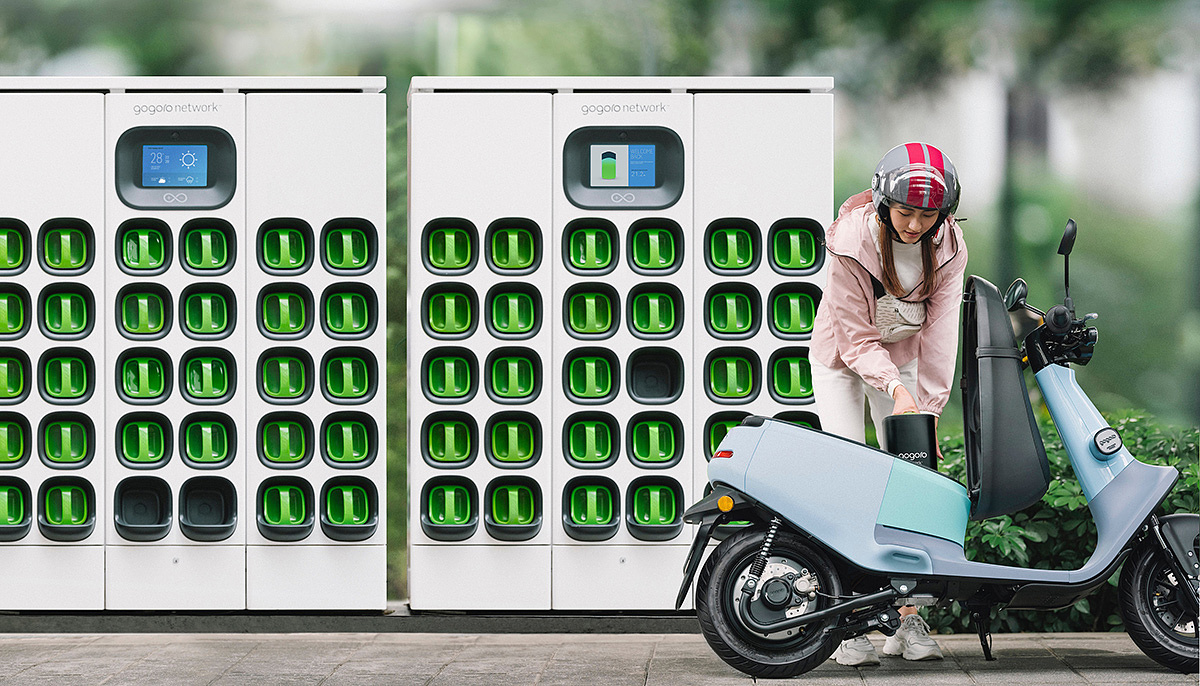
The original model assumed scooters would anchor the network. Instead, the network has become the product, with vehicles functioning as access points rather than profit centers.
Chiang has reduced fixed spending from US$120 million to US$82 million annually. Gross margins recovered from 2.4% in 2024 to approximately 12.2% by late 2025. Management targets 15–18% margins in 2026, with breakeven in the energy division.
The vehicle lineup is being pared back. Three models are planned for 2026, all aimed at mainstream utility segments. Premium positioning has been abandoned in favor of shared components, simplified platforms, and manufacturing efficiency. A revised 9.0 kW powertrain underpins the next generation, but the emphasis is on cost reduction rather than performance.
Investor control and international strategy
Ruentex Group, controlled by the Tsai family, has assumed direct oversight of Gogoro. Chairman Tamon Tseng’s appointment formalized the transition from founder-led governance to investor control. The priority is financial containment rather than brand expansion.
That urgency intensified following the subsidy compliance scandal that preceded founder Horace Luke’s exit in late 2024. Regulators found that Gogoro received Taiwanese subsidies while sourcing key components from China, triggering investigations and reputational damage. Management has since overhauled compliance, reporting, and supplier transparency.
Gogoro’s overseas strategy now reflects constraint rather than aspiration. The Philippines has been abandoned, India remains limited to pilots, and Vietnam stands out as the only scalable near-term market.
The “Powered by Gogoro Network” licensing model enables market entry without replicating Taiwan’s dense infrastructure. It reduces capital risk while capping upside, reinforcing Gogoro’s transition from vehicle OEM to energy platform provider.
The test ahead
Investor skepticism remains high. Gogoro’s share price reflects a survival narrative rather than a growth story. Subscriber numbers increased from 587,000 to over 657,000, but Taiwan vehicle sales fell from 55,000 units in 2024 to 28,176 in 2025. Even a recovery to 35,000 units in 2026 would leave the vehicle business structurally smaller.
Chiang has committed to achieving profitability in the Gogoro Network by the end of 2026. The vehicle division is not expected to break even until 2028. Execution in Vietnam, continued cost discipline in Taiwan, and sustained growth in swapping utilization will determine whether the reset holds.
Gogoro is now organized around energy infrastructure, with vehicles treated as supporting assets. The next twelve months will show whether this structure is durable—or merely delays an unavoidable reckoning.
Sign up for CleanTechnica's Weekly Substack for Zach and Scott's in-depth analyses and high level summaries, sign up for our daily newsletter, and follow us on Google News!
Have a tip for CleanTechnica? Want to advertise? Want to suggest a guest for our CleanTech Talk podcast? Contact us here.
Sign up for our daily newsletter for 10–15 new cleantech stories a day. Or sign up for our weekly one on top stories of the week if daily is too frequent.


CleanTechnica uses affiliate links. See our policy here.
CleanTechnica's Comment Policy

