
A Solar-Powered Christmas: How Sunshine Powers The Philippines’ Largest Malls For More Holiday Cheer
Support CleanTechnica's work through a Substack subscription or on Stripe.
SM Bicutan, one of the many malls under the ShoeMart chain in the Philippines, is along the flight path as my Korean Air flight lands in Manila. I can see the bright Christmas light array from 200 feet up.
As millions of Filipino families gather beneath towering Christmas trees illuminated by thousands of energy-efficient LED lights at SM Supermalls this holiday season, few realize they’re witnessing renewable energy in action. The spectacular 60-foot Christmas tree at SM City North EDSA, the 50-foot London-themed display at SM Megamall, and the 65-foot pop culture-inspired centerpiece at SM Mall of Asia all share a common power source: the Philippines’ most extensive commercial solar energy infrastructure.
With the 30th Conference of the Parties (COP30) currently convening in Belém, Brazil, to address the planet’s climate crisis, SM Prime Holdings demonstrates that corporate climate action need not sacrifice tradition or spectacle. Instead, the company has engineered a model where sustainability powers celebration—quite literally.
The Fairview holiday magic
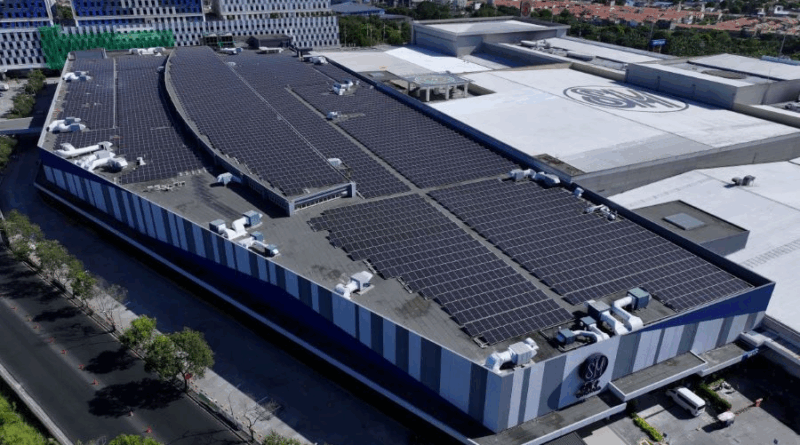
In July 2025, SM Supermalls activated what would become the energy backbone for this year’s Christmas festivities: the Philippines’ largest rooftop solar photovoltaic installation at SM City Fairview in Quezon City. The 3.785-megawatt peak (MWp) system spans 4.3 hectares of rooftop space and comprises 6,882 solar panels capable of generating approximately 5,960 megawatt-hours (MWh) annually—enough to power the mall’s operations through the energy-intensive holiday season while offsetting 4,133 tons of carbon dioxide emissions.
The installation, which features energy-efficient LED technology similar to that used in SM’s Christmas displays, supplies 11% of the mall’s total annual energy consumption. This includes the electricity required for the elaborate Christmas decorations, thousands of lights, and the extended operating hours that characterize the Filipino holiday shopping tradition from September through January.
The technical achievement extends beyond capacity. Despite launching during monsoon conditions following two typhoons, the system achieved 85–90% capacity output at activation, ensuring reliable power generation even during the Philippines’ most challenging weather months—precisely when Christmas preparations intensify.
Christmas lights, sustainably sourced
SM Supermalls’ commitment to sustainability extends directly into its Christmas celebrations, with installations like SM Aura’s 33-foot tree adorned with energy-efficient LED lights as part of the mall’s sustainable Christmas showcase. Since 2018, all 85 SM Supermalls have utilized LED lighting systems throughout their facilities—a transition that delivers 50% energy savings compared to traditional lighting while producing the brilliant displays that define Filipino Christmas celebrations.
The mathematics of sustainable celebration are compelling. SM City North EDSA’s Elfdale transformation features a 60-foot Christmas tree surrounded by vibrant digital displays, cascading waterfalls, and elaborate lighting installations. SM Mall of Asia’s Paskong Pinoy celebration showcases grand Filipino-themed installations, including illuminated kalesas, sorbetes carts, and jeepneys flanking a towering Christmas tree. SM Megamall’s 50-foot London Christmas scene features elaborate lighting and tuxedo-donned teddy bears—all powered increasingly by renewable energy.
The visual spectacle extends to SM Seaside City Cebu’s 40-foot Christmas tree and SM Aura’s Sinag at Saya, featuring handcrafted ornaments and parols made from native materials. These installations, launched in mid-October and maintained through early January, represent continuous energy demands that solar infrastructure helps meet.
88 malls, one green grid
SM Prime’s solar commitment encompasses all 88 operational malls nationwide, representing a total rooftop solar capacity of 73 MWp as of July 2025—an increase from 63 MW earlier in the year. The company targets 100 MWp capacity by year-end 2025, positioning SM Prime as holder of the Philippines’ largest commercial solar portfolio precisely as the Christmas season reaches peak energy consumption.
The renewable energy journey began in 2014 when SM City North EDSA became the first commercial property in the Philippines—and reportedly in Southeast Asia—to install rooftop solar PV panels. That pioneering installation now powers part of the same mall where Christmas icon Jose Mari Chan performed during the 2024 tree-lighting ceremony, connecting sustainability infrastructure with cultural tradition.
The progression continued with SM Mall of Asia’s 2.7 MW solar system in 2016, which subsequently received a Sustainable Energy Award from the Department of Energy. The MOA installation now contributes to powering the mall’s elaborate Christmas displays, including its recent All-Star Christmas campaign featuring pop culture-themed installations and performances by Sarah Geronimo.
Most recently, the Fairview installation—at 3.785 MWp—surpassed SM City Santa Rosa’s previous record of 3.088 MWp. Santa Rosa’s system, featuring 5,772 panels across two hectares, generates sufficient energy to power over 2 million mobile phone chargers—a telling metric during the holiday season when families document Christmas memories and share festive greetings.
SM Prime’s renewable energy expansion relies on diversified partnerships with major energy providers, creating a procurement model that extends beyond onsite generation. In 2022, the company secured a long-term power purchase agreement with AboitizPower for clean energy sourced from the Tiwi-MakBan Geothermal Power Plant and PV Sinag’s solar facilities.
In 2023, SM Prime executed an agreement with Citicore Renewable Energy Company to procure 90 megawatts from CREC’s Lumbangan Solar Power Plant in Tuy, Batangas. Most recently, a partnership with TotalEnergies resulted in deployment of a 2 MWp solar PV system at MOA Square, featuring 3,672 panels designed to generate 3,000 MWh annually while reducing carbon emissions by 1,430 tons per year—equivalent to removing hundreds of vehicles from Metro Manila’s congested roads.
These partnerships exemplify the renewable energy procurement strategy that enables SM Prime to source over 50% of its electricity from renewable sources—a milestone achieved in 2022 that directly supports the Department of Energy’s mandate to elevate the Philippines’ renewable energy supply to 35% by 2030 and 50% by 2040.
SM Prime’s renewable energy investments serve its commitment to achieve net zero greenhouse gas emissions by 2040—a full decade ahead of the global 2050 target established by the Paris Agreement. This commitment, developed in partnership with World Wide Fund for Nature Philippines and submitted to the Science-Based Targets Initiative (SBTi), positions SM Prime among the few Philippine corporations adopting this rigorous global standard.
The timing proves significant. As Filipino families begin Christmas celebrations earlier than any other nation—often starting in September—the extended holiday season creates sustained energy demands from elaborate lighting displays, extended mall hours, theatrical performances, and climate control for increased foot traffic. The company’s approach demonstrates that renewable infrastructure can support these traditions while reducing environmental impact.
SM Prime allocates 10% of capital expenditures to sustainability and disaster resilience design, reflecting integration of climate considerations into fundamental business planning. The renewable energy infrastructure serves dual purposes: powering daily operations while enabling the spectacular seasonal displays that have become cultural touchstones.
Tradition meets transition
The Filipino Christmas celebration represents both cultural identity and substantial energy consumption. SM’s 100 Days of Joy campaign, which launched in September 2024, features enchanting light projections across its malls displaying cheerful greetings alongside vibrant decorations. These displays operate continuously for more than three months, creating sustained electricity demands that solar infrastructure helps meet.
The scale of seasonal celebration is substantial. SM City North EDSA’s Elfdale installation transforms an entire atrium into an immersive environment with digital elements, while SM Seaside City Cebu’s Santa’s Cirque World features theatrical performances and attractions including ferris wheels and carousel installations—all requiring reliable power.
The Podium’s Holidays are in Bloom celebration features gold and ivory floral arrangements with elaborate lighting, while SM Aura’s Sinag at Saya showcases handcrafted Filipino ornaments alongside energy-efficient LED systems. These installations balance cultural celebration with technical efficiency, reflecting SM’s articulated commitment to sustainability without sacrifice.
Beyond generation capacity, SM Supermalls participates in the Department of Energy’s Interruptible Load Program (ILP), contributing 110 MW of reserve capacity through 56 malls that utilize backup generator sets during power interruptions rather than drawing from the national grid. This capability proves particularly crucial during the holiday season when grid stress intensifies due to increased commercial and residential consumption.
The dual approach—generating renewable energy while providing demand response capabilities—positions commercial infrastructure as active grid participants. During the Christmas season, when electricity demand peaks across Metro Manila and provincial cities, this infrastructure helps maintain grid stability while supporting the elaborate displays that have become central to Filipino holiday tradition.
While COP30 deliberations in Belém focus on climate finance mechanisms and nationally determined contributions, SM Prime’s infrastructure investments demonstrate real-world implementation of climate commitments. The company’s 73 MWp capacity across 88 properties shows how large commercial real estate portfolios can function as distributed energy infrastructure—a model particularly relevant for rapidly urbanizing nations in Southeast Asia.
The approach addresses what sustainability experts term the “energy trilemma”—the intersection of security, affordability, and sustainability that challenges businesses and policymakers. Through direct procurement partnerships, onsite generation, and grid support mechanisms, SM Prime maintains operational continuity and cost management while reducing fossil fuel reliance. The Christmas season serves as a stress test for this model, demonstrating that renewable infrastructure can support peak consumption periods.
As articulated by Hans T. Sy, Chairman of the Executive Committee of SM Prime, the initiatives reflect scaling of sustainability commitments across the company’s property portfolio. The systematic deployment of solar PV systems, coupled with LED lighting conversion and architectural designs incorporating natural lighting through skylights and windows, represents comprehensive energy management.
Blueprint for corporate climate action
SM Prime’s trajectory from its pioneering 2014 installation to its current 73 MWp capacity illustrates both technical learning and scaling challenges in commercial renewable energy adoption. The company’s target of 100 MWp by end-2025, combined with continued partnership development and new installations, suggests sustained momentum.
For the Philippines—a nation vulnerable to climate impacts including typhoons, sea-level rise, and temperature increases—corporate climate leadership carries particular significance. The country’s unique cultural practice of celebrating Christmas for more than three months creates distinct energy challenges that SM’s renewable infrastructure helps address.
The question now extends beyond whether commercial infrastructure can contribute to renewable energy transitions, but how cultural traditions can be preserved and even enhanced through sustainable infrastructure. As families gather beneath solar-powered Christmas trees this season, they participate unknowingly in a demonstration that celebration and sustainability need not compete.
This holiday season, when Jose Mari Chan’s familiar melodies echo through SM malls and children pose for photos beneath towering Christmas trees, the lights illuminating their memories are increasingly powered by the sun—a quiet revolution in how the Philippines celebrates its most cherished season.
Sign up for CleanTechnica's Weekly Substack for Zach and Scott's in-depth analyses and high level summaries, sign up for our daily newsletter, and follow us on Google News!
Have a tip for CleanTechnica? Want to advertise? Want to suggest a guest for our CleanTech Talk podcast? Contact us here.
Sign up for our daily newsletter for 15 new cleantech stories a day. Or sign up for our weekly one on top stories of the week if daily is too frequent.
CleanTechnica uses affiliate links. See our policy here.
CleanTechnica's Comment Policy

