
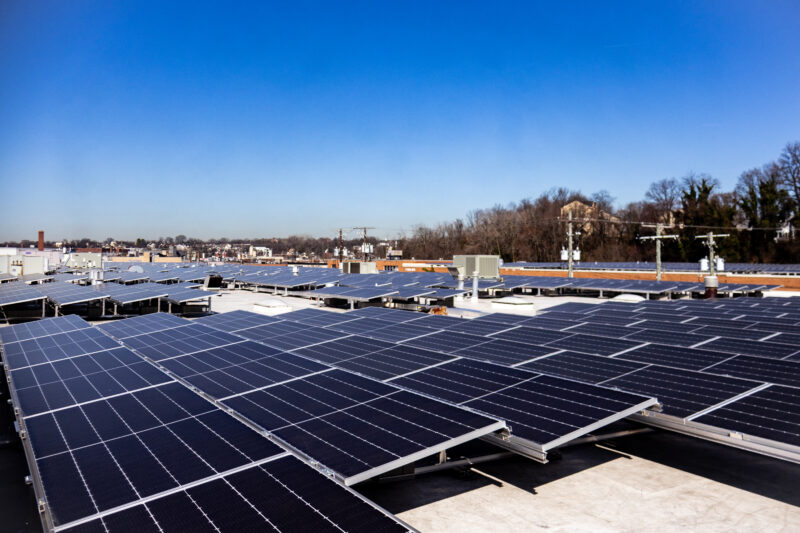
6.1 MW Community Solar Power Project Completed In DC
Support CleanTechnica's work through a Substack subscription, on Patreon, or on Stripe. Help us produce all of the high-quality, original content we publish week after week despite the challenges of content-scraping AI, antisocial media, inflation, and other hurdles.
Solar power is not only for residences, commercial buildings, and large-scale solar farms. Community solar power installations are designed to generate electricity that can be low-cost, discounted, or free for people in a defined location. It can be a solar power system in a park with a free public garden or on rooftops in a specific neighborhood in a town or city. In this particular instance, a rather large community solar project was recently completed in northeast Washington, D.C. With community solar, the electricity can be distributed to people who might not otherwise have the ability to purchase their own personal solar power systems. The new D.C. community solar power system provides electricity to a great number of homes.
Peter Davidson, CEO and founder of Aligned Climate Capital, answered some questions about the new project.
How many solar panels are in the community solar project, and what was the source?
12,614 (485W) from Hanwha QCells.
How long did it take to complete the project and how many people worked on it?
Approximately six months.
How will the project result in $7.5 million in savings?
The project supplies electricity to over 1,000 households across DC, offering existing PEPCO customers a 10% discount on their current rates. This locks in automatic bill savings with no upfront cost to the subscriber. These savings are estimated over the next 20 years.
How do low and moderate-income DC households receive the electricity from the project?
Community solar operates through virtual billing. The subscribers continue to get power from the grid, but get reduced payments as a result of their community solar subscription. For instance, if they consume 100kWh, their PEPCO bill is reduced by 100kWh (which lowers their bill), and then they pay the community solar project for the 100kWh at the discounted price, which generates the savings. There is no interruption to electric service to the customer.
Is there an estimate for the average annual savings per subscribed household?
Customers will reduce their electricity cost by 10%. Dollar amounts vary based on electricity usage.The total savings for the project are estimated to be $7.5 million over the next 20 years.
How long are the solar panels warranted for, and how long will they last?
The solar modules are rated for a 40-year useful life.
About how much carbon emissions will be avoided by using the solar power instead of electricity from coal or natural gas power plants?
The project will avoid approximately 5,610 MT of CO2e annually, the equivalent of taking 1,300 cars off the road for a year, per the EPA’s Greenhouse Gas Equivalencies Calculator. This is compared to the current carbon intensity of the PEPCO DC grid.
What was the project cost?
This is proprietary information that we do not disclose publicly.
Sign up for CleanTechnica's Weekly Substack for Zach and Scott's in-depth analyses and high level summaries, sign up for our daily newsletter, and follow us on Google News!
Have a tip for CleanTechnica? Want to advertise? Want to suggest a guest for our CleanTech Talk podcast? Contact us here.
Sign up for our daily newsletter for 10–15 new cleantech stories a day. Or sign up for our weekly one on top stories of the week if daily is too frequent.


CleanTechnica uses affiliate links. See our policy here.
CleanTechnica's Comment Policy

