Phase-Change Energy Storage On A Barge, On The Thames, In London
Sunamp’s mobile energy storage solution combines a new phase-change material in a space-saving containerized, transportable form.

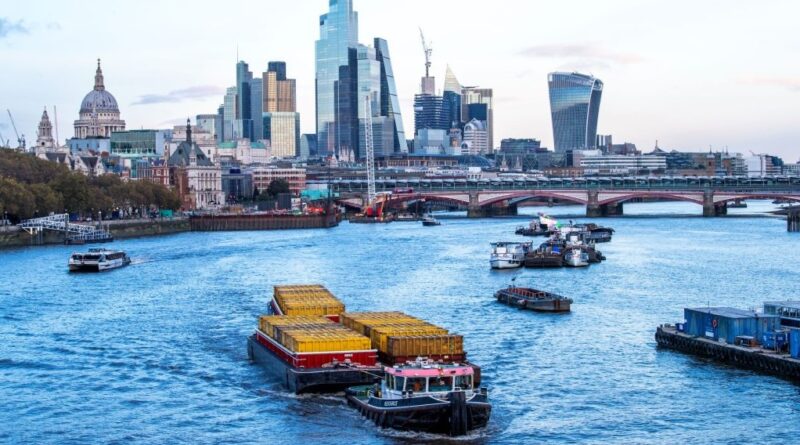 Sunamp's energy storage solution deploys a new, transportable phase change material that can be put on a barge and ferried to points of charge and discharge (image courtesy of Sunamp).
Sunamp’s mobile energy storage solution combines a new phase-change material in a space-saving containerized, transportable form.
 The devolution of hydrogen for energy infographic by Michael Barnard, Chief Strategist, TFIE Strategy Inc.
About 25 years ago, hydrogen was the solution of choice for climate-aware technocrats and politicians, and with good reason. At the time, there really wasn’t much choice in terms of low-carbon energy carriers. Batteries were good enough for laptops and phones, but clearly no one was going to be running … [continued]
If we are going to keep the global temperature rise below 1.5°C, we need to fix our buildings. They are the largest end-users of energy, generating nearly 40 percent of annual global greenhouse gas emissions. However, addressing energy efficiency and renewable energy one building at a time will not be enough. To make real change, we must also work at a district level.
An innovative facility is turning seawater into sustainable power for district heating to low-income homes just outside The Hague, Holland.
A new 44-megawatt biomass district heating plant is replacing natural gas with sustainable heat at 99% plant efficiency in one Dutch city.
It’s called “urban biomass,” and it’s ours (spsmw.org). Hard to imagine a subject that would find The Wall Street Journal and Grist in line with each other’s thinking, but burning wood for energy has achieved it. Neither outlet seems to view the topic positively. Both have cited the scientific work … [continued]
The Mayor of London, Boris Johnson, is going to utilize excess heat from subway tunnels and an electric substation in London to supply homes with heat. Substations contain electronics such as transformers through which massive amounts of power travel, and these transformers do generate a great deal of heat because … [continued]
Scientists of the Heriot-Watt University, Edinburgh are working on photo-catalytic reduction technology which would recycle carbon dioxide emissions from power plants into liquid and gaseous fuels for the domestic and transport sectors. Another positive aspect of this conversion process is the use of solar radiation. A team of scientists led by … [continued]
Helsinki is pioneering the worlds most advanced municipal heating system. A century ago, New York City put in an early form of this kind of district heating: the steam that gasps from ancient downtown loft radiators in the middle of winter nights is the remaining evidence. But that was before … [continued]
it is a very fortunate accident of history that water made for such easy hauling. Early roads got muddy and it was easier to move stuff along waterways. As a result many big cities like New York City and Hong Kong and Toronto are now ideally situated to use that cold water nearby for carbon-neutral district air conditioning.
These cities now are virtually artificial cliffs, right at waters edge, right where they need to be to take advantage of a very simple concept. Cold water from the depths can be piped very efficiently up through these “cliffs” at water’s edge to cool the towers of downtown office buildings.
Canadian Company Enwave leverages this difference between the cold ocean depths and warm surface temperatures – using lake water to cool downtown Toronto office buildings.