
Nuclear Energy, Carbon Capture, & More: Questions From Smart Energy Webinar
Thanks to all the participants in the webinar who took the time to craft and submit the questions.

Thanks to all the participants in the webinar who took the time to craft and submit the questions.
C-Crete, a startup company begun by an MIT Ph.D, has invented a way to make concrete without using cement. Its first pour happened recently.
Researchers at MIT are discovering new ways of making concrete that will release less carbon dioxide in the atmosphere.
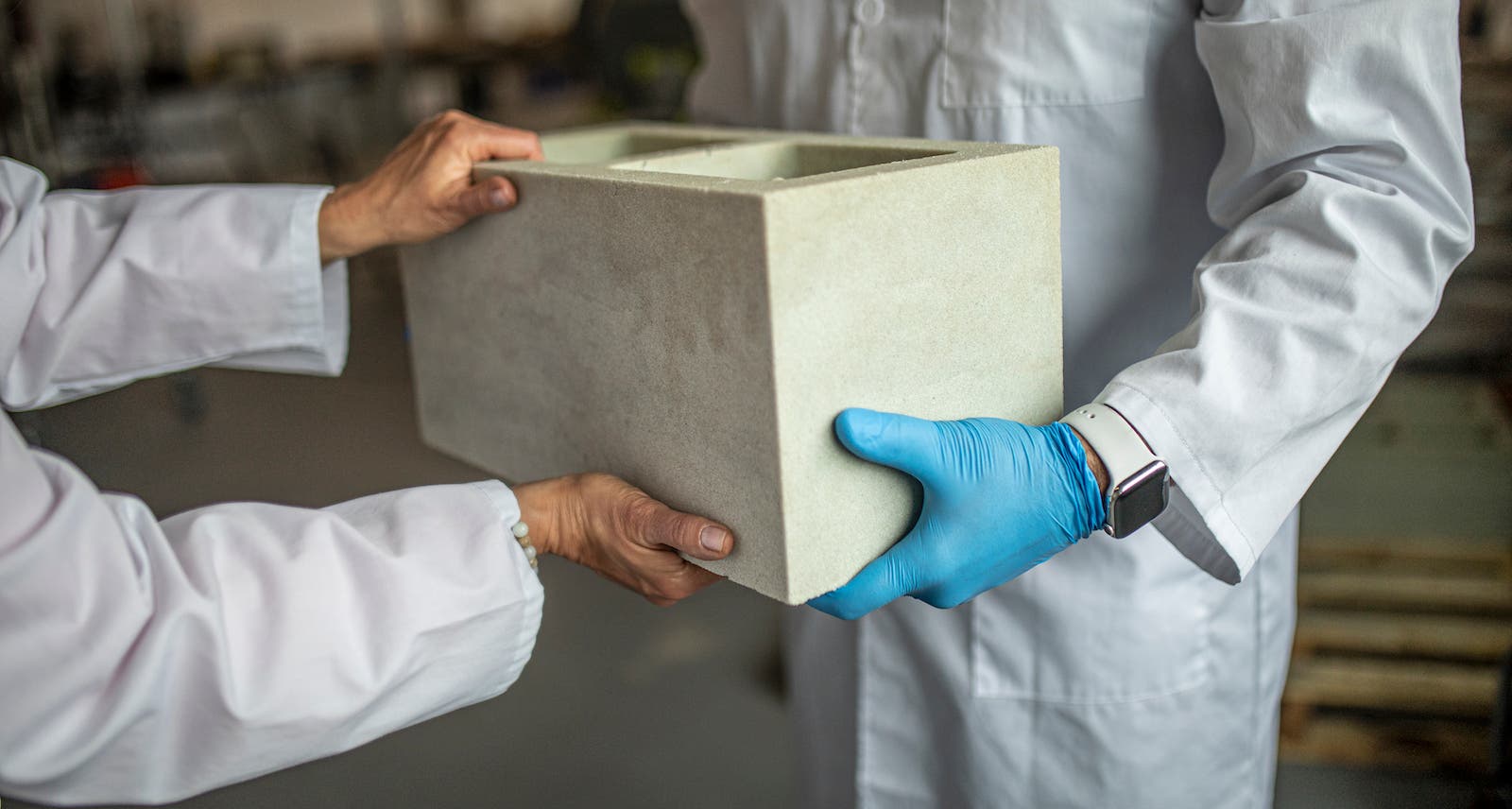 After stumbling on biofuel, algae steps up to save the concrete and cement industries from themselves (photo courtesy of Prometheus Materials).
After stumbling on biofuel, algae finds its footing and steps up to help the concrete industry cut its carbon footprint, too.
Demand Changes Can Drive The Future Of Zero-Carbon Concrete As world leaders convene at the World Economic Forum’s annual conference in Davos to discuss global issues including climate change, they will spend the day surrounded by concrete. Houses, skyscrapers, roads, freeways, bridges, sidewalks, water systems, dams, and more rely on … [continued]
Steel and cement both produce large amounts of carbon dioxide, but two new startups say they have a way to avoid most of it.
The National Renewable Energy Laboratory (NREL) has been selected to receive over $5.4 million from the U.S. Department of Energy Advanced Research Projects Agency-Energy (ARPA-E) for the development of technologies that can transform buildings into carbon storage structures. The funding is part of ARPA-E’s Harnessing Emissions into Structures Taking Inputs from … [continued]
Today, the EU is investing over €1.8 billion in 17 large-scale innovative cleantech projects with a third round of awards under the Innovation Fund. Grants will be disbursed from the Innovation Fund to help bring breakthrough technologies to the market in energy-intensive industries, hydrogen, renewable energy, carbon capture and storage … [continued]
In this interview, we’ll be explore the technology and methods behind decarbonizing cement – yes, the cement that is just about everywhere in our daily lives! – with Brimstone Energy Co-Founder Hugo Leandri. When did you found Brimstone as a company, and what’s the story behind it? What was … [continued]
By Veena Singla & Sasha Stashwick Decarbonizing cement plants is a critical part of reaching our climate goals. Cement is a key ingredient in concrete, which is the most widely used manmade material on the planet, and has few, if any, viable alternatives. Cement is incredibly dirty to produce: while it … [continued]