cement

Brimstone’s Cement Pitch Hides A Bigger Minerals Refinery Bet

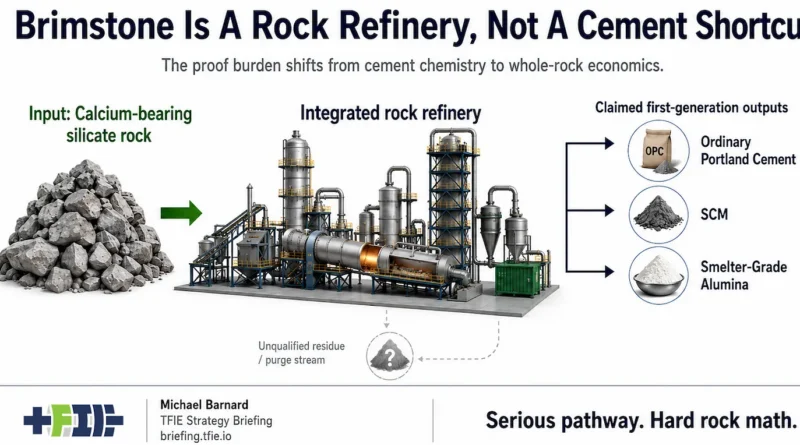
Brimstone’s cement story is interesting because it is not only a cement story. The company’s public positioning is now much bigger than ordinary Portland cement without limestone process CO₂. Brimstone is presenting itself as a Rock Refinery: a process that starts with calcium-bearing silicate rock and co-produces multiple industrial materials … [continued]

Cement’s Future Is Less Portland, Not One Magic Cement

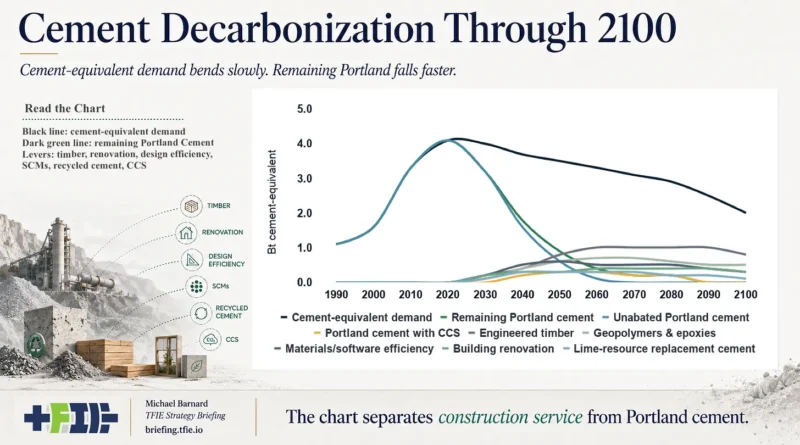
Cement decarbonization attracts miracle stories. One company has a new binder. Another has a carbon-negative aggregate. Someone else has an electrochemical process, a hydrogen kiln, a low-carbon limestone route, a supplementary cementitious material, a recycled cement process or a carbon-capture retrofit. Some of these ideas are useful. Some will become … [continued]

The Realistic Future Of Carbon Capture: Pure Streams, Right Locations, Smart Uses

Carbon capture and storage has been marketed as a general solution to climate change. The record shows it is not. Where it does make sense is where chemistry gives you a high-volume, concentrated stream of CO2, where geography puts that stream on top of storage or at a pier with … [continued]

From Gray Glue to Green Foundations: Cement’s 2100 Transition

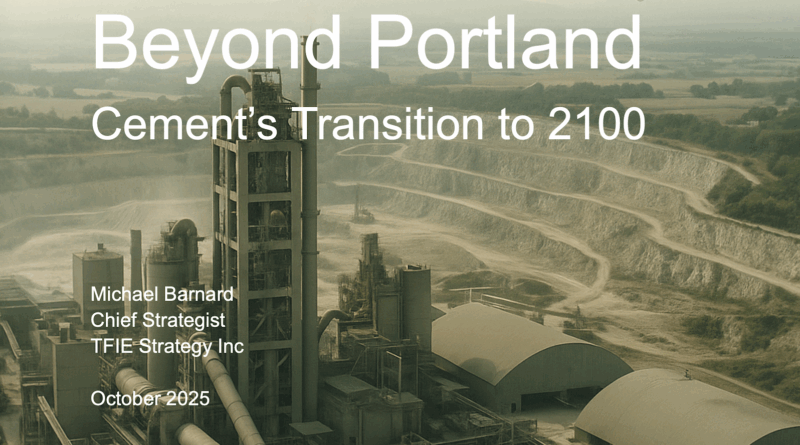
The publication of the white paper Beyond Portland: Cement’s Transition to 2100 by TFIE Strategy Inc comes at a moment when the cement and concrete industries stand at the center of the global climate challenge. Cement is everywhere—in the foundations of homes, the bridges that span rivers, the ports that … [continued]

Paving the Road for Cement and Concrete Technologies

NREL Brings Together Specialists From Across the Country To Discuss Cement and Concrete for Its Third Annual Critical Technologies Meeting Cement and concrete are essential to United States infrastructure, from our roadways to the buildings we occupy. Accounting for 50% of all materials produced globally, domestic production of this critical material is … [continued]

How CLT Displacement Makes Steel & Cement Decarbonization Realistic

Cross laminated timber is often presented as a housing solution, a way to build faster and more affordably while reducing the carbon locked into buildings. That is true, but it is also part of a larger story about the heavy materials industries. Every time a cubic meter of cross laminated … [continued]

Reassessing Steel: How Falling Cement Use Alters Future Projections

My recent online conversation with Scott Norris, a structural steel expert and Director of Engineering Solutions at Steelcon, prompted me to reexamine some assumptions I had previously made about global steel demand projections. Scott, whose practical experience within the steel industry grants him clear insights into current operational constraints and … [continued]

Ideology Accidentally Aligns with Reality: US $3.7B CCS Cancellation Explained

Once again, the Trump administration has swung its ideological axe at clean energy initiatives, cutting $3.7 billion in funding previously earmarked by the Department of Energy (DOE) for carbon capture and storage (CCS), hydrogen fuels, synthetic fuels, and a variety of other industrial decarbonization technologies. Predictably, the knee-jerk cancellations were … [continued]

Cement Decarbonization Policy Makers Need To Understand All Levers

The global cement industry, long recognized as a backbone of infrastructure development, faces mounting pressure to reduce its environmental impact. Responsible for approximately 7–8% of global carbon emissions, cement production is one of the most carbon-intensive industrial processes. Yet, as climate policies tighten and innovation accelerates, the industry stands at … [continued]