Author: Transport & Environment (T&E)

The Zombie Engine: How Brussels Bureaucrats Are Breathing False Life Into Combustion

If you poured rapeseed oil into a combustion engine and declared it a “zero-emission vehicle,” you would be laughed at. But in the EU Parliament, this fiction is being drafted into law. If you poured rapeseed oil into a combustion engine, watched toxic exhaust billow from the tailpipe, and declared … [continued]

The Need for Maintaining Renewable Energy Directive Stability in the Post-2030 Energy Framework

NGOs, civil society and industry call on the European Commission to refrain from reopening the RED legislative framework during the negotiation of the post-2030 energy architecture. Ahead of the Energy Council of 29 October, a group of NGOs, civil society actors and companies are calling on the European Commission and Member … [continued]

The EU Is Showing How Regional Maritime Rules Can Support A Global Framework At The…

Carbon pricing in a global context In April 2025, governments at the International Maritime Organization (IMO) agreed on a historic global regulation, the Net-Zero Framework (NZF). It was designed to set global shipping on a course to net-zero by 2050 in a just and equitable way. Global shipping is responsible … [continued]

The EU Clean Corporate Vehicles Regulation: The Industrial & Economic Benefits of “Made-in-EU” Electric Company…

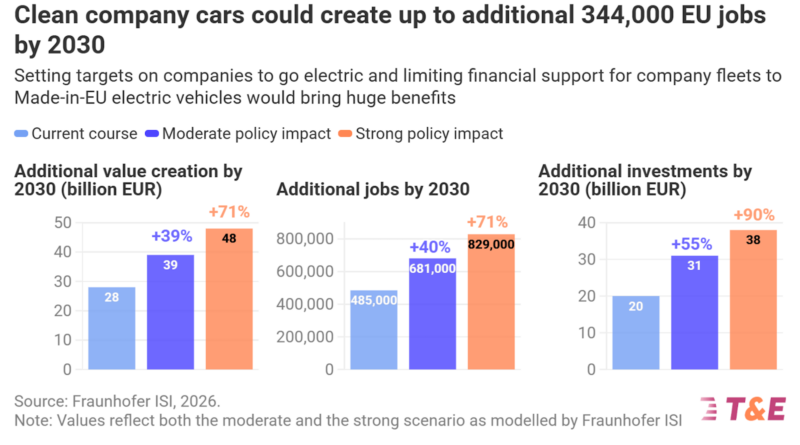
New independent modelling by Fraunhofer ISI shows that implementation of the Clean Corporate Vehicles Regulation could deliver up to €48bn in value creation and 344,000 jobs by 2030. CCVR and IAA explained The CCVR sets binding minimum targets for zero- and low-emission vehicles (ZLEVs) among large companies’ new car registrations: … [continued]

Rapid Transition to Electric Company Cars Could Generate 344,000 EU Jobs by 2030 — Study

Setting targets on companies to go electric and limiting financial support only for company cars that are electric and Made-in-EU would see economic gains of €20 bn and boost investments by €18 bn EU-wide electrification targets for large fleets, combined with limiting national fiscal benefits only to electric Made-in-Europe company … [continued]