
NYC’s E-Bike & Scooter Death Headlines Leave Out a Vehicle
Support CleanTechnica's work through a Substack subscription, on Patreon, or on Stripe. Help us produce all of the high-quality, original content we publish week after week despite the challenges of content-scraping AI, antisocial media, inflation, and other hurdles.
A recent New York Times newsletter described fatal e-bike and electric-scooter crashes in New York City as reaching a record high. “Record” is a powerful word, especially when the vehicles involved are relatively new, but it can also direct attention toward what the victim was riding and away from what else was involved in the collision.
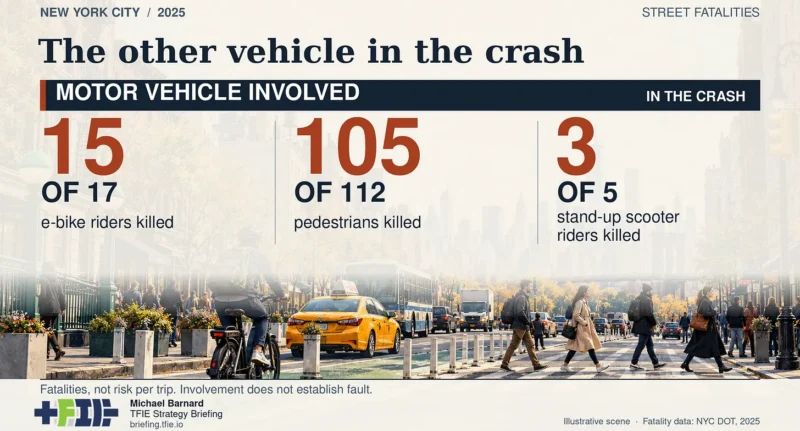
The latest complete-year NYC DOT crash data make that omission important. Seventeen people were killed while riding e-bikes in 2025, and 15 of those deaths occurred in crashes involving a motor vehicle. Five people were killed while riding stand-up scooters, three in motor-vehicle crashes. Among pedestrians, 105 of 112 deaths occurred in crashes involving motor vehicles. Those figures do not establish that a motor-vehicle driver was at fault in each collision, but they do show why describing these deaths primarily as an “e-bike problem” or “scooter problem” can give a distorted picture of street risk.
I looked at the fatality numbers, the problem with small annual counts, illegal fast devices and the trips that electric bikes and scooters replace in New York’s e-bike death count is a car and truck crash count. The broader issue is what gets counted when a new transport mode attracts scrutiny — and what tends to disappear from the accounting.
Small numbers make record-based reporting particularly unstable. If stand-up scooter deaths rise from five in one year to six the next, that is a 20% increase even though the absolute change is one person. That does not make the death unimportant; it makes the denominator important. Electric Citi Bike alone recorded more than 29 million trips in 2024, before privately owned e-bikes and scooters are counted. A higher absolute fatality count can occur simply because vastly more people are riding, without demonstrating that an individual trip has become more dangerous.
There is a genuine safety problem inside those numbers. New York said in an August 2026 enforcement announcement that 45 e-bike rider deaths from 2017 through 2025, 54% of the total, involved devices capable of exceeding 25 mph. For stand-up scooters, 14 deaths, or 52%, involved devices capable of exceeding 20 mph. Capability does not tell us the speed at impact or assign responsibility for a crash, but it is enough to support enforcement against sellers of prohibited high-speed machines and against dangerous operation. Treating that problem seriously does not require treating every legal e-bike as if it were one of those machines.
The denominator also needs to include what these trips replace. In New York’s East Bronx scooter pilot, riders reported that some journeys otherwise would have been made by car, car-share or ride-hail. A broader 48-city travel-diary analysis estimated median reductions of about 0.15 car miles per shared-scooter trip and 0.25 car miles per bike-share trip, including e-bikes. Some electric trips replace walking or transit, so it would be wrong to count every ride as an avoided car journey, but there is evidence that a portion of them substitute for driving.
That substitution has consequences which rarely appear beside a fatality headline. A car trip replaced by an electric two-wheeler no longer produces tailpipe emissions along the route and requires far less energy. New York estimates motor vehicles account for about 28% of local nitrogen oxide emissions and 11% of fine particulate emissions, while the city health department attributes roughly 320 premature deaths annually to traffic-related fine particles. E-bikes are not a complete solution to that burden, but displaced combustion-vehicle mileage is an air-quality and public-health benefit that belongs in the transport ledger.
The same applies to noise, road space and urban freight. An e-bike has no idling engine or exhaust note, and replacing a gasoline vehicle removes one source of engine noise. Delivery riders use e-bikes as working equipment, while New York’s microhub pilot replaced more than 3,000 truck trips in its first year by transferring goods to handcarts, cargo bikes and small electric vehicles. Cargo bikes were only part of that result, but it illustrates why compact electric mobility has economic value in a dense city as well as environmental value.
None of that is an argument for overlooking sidewalk conflicts, reckless riding, battery safety or illegal high-speed devices. Cities should investigate every fatal crash and regulate machines which operate outside legal classifications. But a transport-safety story should also identify what struck whom, distinguish rider fatalities from pedestrian fatalities and put annual deaths beside the scale of travel.
That is particularly important because the larger street-safety picture remains dominated by motor vehicles. A New York City comptroller analysis covering 2020 through 2023 found motor vehicles involved in 434 of 449 pedestrian deaths, while e-bikes and stand-up scooters were involved in six. Electrified two-wheelers create new risks that require management, but presenting them as the defining pedestrian threat reverses the relative scale evident in the fatality data.
The useful policy objective is not to choose between e-bike safety and motor-vehicle safety. New York can enforce speed and equipment rules, improve infrastructure and reduce conflicts involving electric two-wheelers while also making streets safer from cars and trucks. The accounting should include the lives lost, the vehicles involved, the number of trips being made and the car and truck journeys that smaller electric vehicles avoid.
The full TFIE Strategy Briefing article puts the fatality figures beside the travel denominator and looks at the less visible air-quality, noise, mobility and delivery benefits that disappear when transport policy is reduced to the latest record-high headline.
Sign up for CleanTechnica's Weekly Substack for Zach and Scott's in-depth analyses and high level summaries, sign up for our daily newsletter, and follow us on Google News!
Have a tip for CleanTechnica? Want to advertise? Want to suggest a guest for our CleanTech Talk podcast? Contact us here.
Sign up for our daily newsletter for 10–15 new cleantech stories a day. Or sign up for our weekly one on top stories of the week if daily is too frequent.


CleanTechnica uses affiliate links. See our policy here.
CleanTechnica's Comment Policy

