
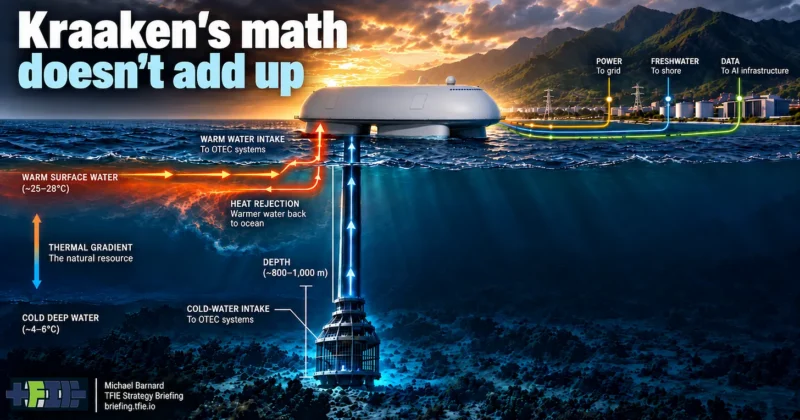
Kraaken’s Floating AI Platform Still Has To Close The OTEC Math

A floating data centre that generates its own electricity from the ocean, cools itself with seawater, produces drinking water for a coastal community and can sail away when a hurricane approaches is almost tailor-made for the current AI data center hype bubble. Optimal Transit’s Kraaken concept is ambitious even by that standard: the company describes a roughly 91-metre vessel delivering 100 MW of continuous power, allocating 60 MW to AI computing, exporting as much as 40 MW to shore and producing about 30 million litres of freshwater per day.
The interesting part is that none of those constituent technologies is imaginary. Ocean thermal energy conversion works. Ammonia Rankine cycles work. Liquid-cooled data centres reject substantial quantities of heat. Large offshore vessels, floating desalination plants, subsea pipelines and disconnectable mooring systems all exist. The diligence problem appears when those real technologies are put together and several major pieces of the conventional OTEC plant are claimed to become dramatically smaller at the same time.
I rebuilt those balances from the public engineering in Kraaken’s Math Doesn’t Add Up, the full TFIE Strategy Briefing diligence assessment. The paid analysis contains the hydraulic, heat-transfer, thermodynamic and offshore calculations, published reference designs and an auditable workbook. Here I’m keeping to the system-level questions that can be established without reproducing that diligence.
Optimal Transit says its Digital Ocean Thermal process can reduce the cold-water pipe by about 70%, reduce cold-water pumps and the condenser by about 70%, and use a turbine about 70% smaller, while data-centre waste heat helps “supercharge” the ammonia working fluid. Those claims lead quickly to a set of linked questions. What exactly is 70% smaller: diameter, area, equipment count, mass, cost or pumping power? If less cold water moves through the plant, where does the rejected heat go? If essentially the same water moves through much smaller piping, what happens to velocity and pumping demand? If the condenser shrinks dramatically, what compensates for the lost heat-transfer surface? And how much useful thermodynamic leverage can low-temperature server heat really provide?
The basic difficulty comes from OTEC itself. Tropical surface water might be around 25°C while deep water is near 5°C, leaving only a modest temperature difference from which to extract useful work. That makes enormous seawater flows a feature of utility-scale OTEC rather than a design accident. One published 100 MW-net reference examined in the diligence uses roughly 235 cubic metres per second of cold seawater and 470 cubic metres per second of warm seawater, with a sample cold-water pipe around 12 metres in diameter. Kraaken may use a different architecture, but any alternative still has to move enough heat through the system to support its electrical output.
This is why the meaning of a “70% smaller” cold-water pipe matters so much. A smaller individual pipe is entirely plausible if several pipes replace one enormous riser, and that could make manufacturing and installation easier. What it does not do is eliminate the total seawater flow or the heat that has to be rejected. If the claim instead means forcing approximately the same flow through dramatically less cross-sectional area, water velocity and hydraulic losses rise sharply and the pumps begin consuming more of the electricity the plant is intended to produce. There are engineering trade-offs available, but diameter, flow, velocity and pumping energy cannot be adjusted independently.
The same problem appears in the condenser and turbine claims. A smaller heat exchanger can perform the same duty if heat-transfer coefficients, fluid velocities or usable temperature differences improve sufficiently, but those changes bring consequences elsewhere in the cycle. Higher velocity generally means more pressure drop. Changing condensing or evaporating temperatures changes working-fluid pressures and turbine conditions. Server waste heat can contribute useful energy, but because it is relatively low-temperature heat, it is not equivalent to another high-quality primary energy supply. Optimal Transit may have an effective integration strategy, but its public material does not yet disclose the state points and full mass-and-energy balance needed to establish how all of the claimed reductions occur simultaneously.
The vessel itself provides another useful denominator. Published 50–100 MW OTEC reference designs examined in the assessment are roughly 198 to 285 metres long, while Kraaken is described as about 91 metres. Those reference vessels are not statutory minimum sizes, and differences in hull design, technology and integration matter, so length alone cannot demonstrate that Kraaken is infeasible. The departure is still large enough to require explanation, especially because Kraaken is supposed to contain not only the OTEC plant but also a large data-centre installation, desalination equipment, electrical infrastructure and propulsion adequate for storm relocation.
Storm mobility adds another layer that is easy to underestimate. Making the vessel capable of leaving does not make a kilometre-scale cold-water intake, mooring system, electrical export, freshwater line and fibre connection mobile with it. Offshore engineering has mature approaches to disconnectable systems, so none of this is unprecedented in principle. The relevant question is what remains offshore when the vessel departs, how it survives the storm, and how quickly the complete plant can be inspected and reconnected afterward. A ship surviving a hurricane and a coastal customer continuing to receive power, water or computing service through one are different engineering requirements.
Some of Kraaken’s claims are much less problematic than they initially sound. Thirty million litres of freshwater per day is a large number, but floating desalination systems already operate at greater scale. The challenge is not whether that volume of water can physically be produced or piped ashore. It is integrating desalination with the generation plant, data-centre load, offshore connections and storm operating model while still producing the promised net electricity.
That word net deserves particular attention. A 100 MW-net OTEC plant has to generate more than 100 MW gross because pumping enormous seawater flows and running the rest of the plant consumes substantial electricity. Kraaken additionally has desalination, marine systems and a data centre whose own support equipment sits around the IT load. Public descriptions do not yet provide the complete electrical load balance needed to reconcile those items with 60 MW of AI computing and as much as 40 MW of shore export.
Optimal Transit may ultimately have engineering answers to these questions. The company says its current financing will support ABS-ready engineering drawings and comprehensive digital-twin validation, which is useful context for where the project actually sits in development. The issue for investors is that the commercial story is already unusually specific about output and component reductions while some of the engineering required to substantiate those claims is still being developed.
A relatively compact engineering disclosure could change the assessment materially: actual warm- and cold-water flows, working-fluid state points, gross generation and complete internal loads, the cold-water-riser arrangement, condenser duty and operating temperatures, vessel weight and arrangement, and the architecture connecting the risers, mooring and storm-disconnect system. If those numbers close together, Kraaken becomes a much more interesting proposition. Until then, the key question is not whether OTEC, floating desalination or data centres are real technologies, but whether this particular combination closes as a system.
The full TFIE Strategy Briefing diligence assessment follows those flows quantitatively, tests the component-reduction claims against published OTEC reference designs and provides the calculations in an auditable physics-and-energy workbook.

