
China’s Electric Aviation Advantage Is A Transport System, Not A Prototype
Support CleanTechnica's work through a Substack subscription, on Patreon, or on Stripe. Help us produce all of the high-quality, original content we publish week after week despite the challenges of content-scraping AI, antisocial media, inflation, and other hurdles.
The electric-aviation contest is often presented as a race between aircraft startups. That is probably the wrong unit of analysis. An airplane that flies once, wins a certification milestone or accumulates a large order book has demonstrated something useful, but it has not demonstrated an industry. What matters is whether operators can put hundreds of aircraft into regular passenger and cargo service, maintain them, charge them, replace their batteries economically, order a second fleet after seeing the real operating costs and eventually sell the system abroad.
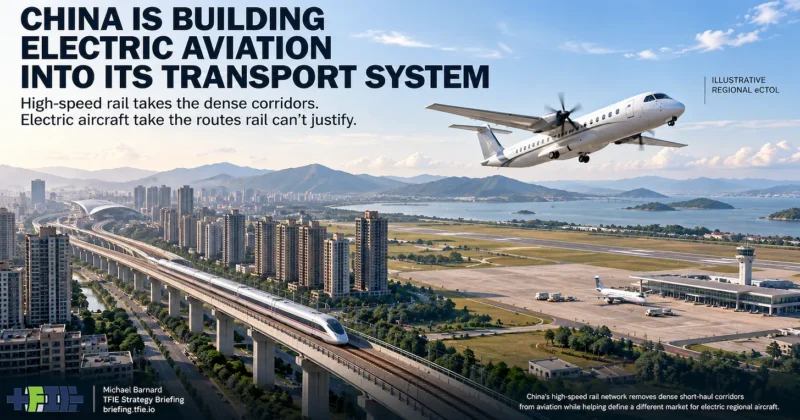
China is unusually well positioned for that test because it is not approaching electric aviation as an isolated aircraft problem. Its transport system is already removing many of the routes that aircraft serve poorly. China’s high-speed rail network reached about 50,400 kilometres by the end of 2025 and is expected to approach 60,000 kilometres by 2030. Dense city pairs can remain rail markets, leaving thinner regional routes, islands, difficult terrain, cargo links and poorly connected cities as a more clearly defined aviation opportunity.
That is an important inversion. Seen from an aircraft manufacturer’s sales department, every successful high-speed rail line removes potential passengers. Seen from a transport ministry, rail and aviation have different jobs. China does not need battery aircraft to compete with 350 km/h trains between dense major cities. It needs them to become the better transport product on routes where another railway has poor economics and conventional regional aviation remains too expensive or infrequent.
The full analysis in TFIE Strategy Briefing goes deeper into the battery systems, COMAC and AECC programs, CAAC’s operating framework, the Western countercase and the export pathways that could turn early domestic fleets into an industry.
The threshold for “scale” should be correspondingly demanding. A fleet of electric trainers is not the same thing as a regional passenger market. A few subsidized demonstration routes do not prove utilization or maintenance economics. The stronger evidence would be hundreds of runway-based electric or hybrid aircraft flying repeated schedules, batteries reaching expected replacement intervals, operators understanding real maintenance costs, second orders arriving and foreign operators doing the same.
China already has a small but real certified electric-aircraft base, but that is not the central advantage. Europe certified the Pipistrel Velis Electro in 2020, so China is hardly alone in getting electric aircraft through certification. The more important difference is industrial context. The IEA says China produced more than 80% of global battery cells in 2025, along with even larger shares of some key active materials. Aviation batteries have much tougher mass, safety, power and lifecycle requirements than automotive packs, but electric aircraft developers in China can specialize an industrial base built for markets orders of magnitude larger than aviation.
CATL makes the distinction clear. The company has publicized an aviation-oriented condensed cell at up to 500 Wh/kg, an eye-catching number that becomes much less useful if treated as an installed aircraft-system specification. Real aircraft batteries also require containment, thermal management, electrical protection, battery management, structure, reserves and enough power late in a flight. CATL’s more recent aviation work includes certification-oriented safety testing on a lower-specific-energy configuration, evidence that the company is working both the energy-density and integration sides rather than merely publishing a laboratory number.
Policy matters because aircraft alone do not create scheduled transport. China’s Green Aviation Manufacturing Development Outline for 2023–2035 explicitly includes electric propulsion, aviation batteries and the systems needed to integrate them into civil aircraft. CAAC’s short-haul aviation operating framework deals with the boring but essential pieces—routes, schedules, airport integration, passenger service and operating oversight. That matters more to a real transport market than another spectacular prototype flight because airports need power, airlines need reliable charging windows, crews and maintenance organizations need training, and regulators need experience with battery and propulsion failure modes.
China’s state aerospace industry is also participating rather than leaving the field entirely to venture-backed startups. COMAC-associated programs are doing electric-propulsion and aircraft integration work, while AECC describes a megawatt-class hybrid propulsion system intended for applications extending into next-generation regional aircraft. None of that establishes a certified 70- or 90-seat hybrid airliner today. It establishes that the difficult bridge from small battery aircraft toward larger regional systems is already inside the work programs of organizations responsible for China’s wider aerospace capability.
The Western countercase is strong enough that this remains a forecast rather than a foregone conclusion. Heart Aerospace’s X1 demonstrator flew for 27 minutes in August 2026, at more than 25,000 pounds takeoff weight with over one megawatt of electric propulsion. Europe has certified electric propulsion hardware, established airframers and serious testing environments. Airbus, ATR, Embraer, Safran, Pratt & Whitney Canada, Collins and others have deep aerospace experience China is still building.
China’s advantage is that it can connect those pieces into a deployment system faster. Its batteries come from an enormous manufacturing base, its regulator has explicit institutional reasons to build expertise, its state aerospace organizations can remain involved through multiple development cycles, and its transport system already separates dense rail corridors from routes where smaller aircraft can add more value.
Exports would be the stronger test. China does not need FAA or EASA validation before an electric aircraft can become commercially relevant outside China. COMAC has already demonstrated the broader precedent: by early 2026, C909 aircraft were operating commercially in Southeast Asia, supported through certification acceptance, leasing, training, maintenance and operating support. Electric aircraft are more dependent on batteries and charging infrastructure, but the commercial principle is similar. The export product is not just an airframe; it is the aircraft, ground power, battery support, spares, maintenance, training, finance and regulatory acceptance together.
That is why the next prototype flight is not the most interesting milestone. Watch for delivered aircraft entering repeated service, utilization accumulating, battery replacement intervals becoming visible, operators placing second orders and foreign fleets following domestic ones. Those events would show that China had crossed the line from electric-aircraft development into an electric-aviation industry.
China has not crossed that line yet. It has, however, assembled more of the surrounding industrial and transport system than any other country currently pursuing it. If hundreds of useful aircraft enter routine service, second orders follow and exports begin accumulating operating history, the argument will have moved from industrial forecast to demonstrated leadership.
Read the full systems analysis in TFIE Strategy Briefing.
Sign up for CleanTechnica's Weekly Substack for Zach and Scott's in-depth analyses and high level summaries, sign up for our daily newsletter, and follow us on Google News!
Have a tip for CleanTechnica? Want to advertise? Want to suggest a guest for our CleanTech Talk podcast? Contact us here.
Sign up for our daily newsletter for 10–15 new cleantech stories a day. Or sign up for our weekly one on top stories of the week if daily is too frequent.


CleanTechnica uses affiliate links. See our policy here.
CleanTechnica's Comment Policy

