
New Life For EV Charging Stations Trump Tried To Kill
Support CleanTechnica's work through a Substack subscription, on Patreon, or on Stripe. Help us produce all of the high-quality, original content we publish week after week despite the challenges of content-scraping AI, antisocial media, inflation, and other hurdles.
“A crushingly stupid waste of taxpayer dollars” is only one way to sum up the current state of the US government, but it’s a good one. When President Donald Trump took office last year, he hacked away at numerous federal plans and programs, some of which have already been restored by court order after a series of expensive legal battles. One such example is the “NEVI” public EV charging program, which Trump tried — and failed — to kill.
The NEVI Public EV Charging Plan In A Nutshell
NEVI is short for the National Electric Vehicle Infrastructure program, a $5 billion EV charging plan funded through a carve-out from the 2021 Bipartisan Infrastructure Law. NEVI provides state transportation planners with federal dollars to build public fast-charging stations in priority locations. The goal is to encourage EV uptake by ensuring that long-distance drivers can rely on a coordinated, national network of fast-charging stations, located on interstate highways and other major arteries.
Some states intentionally dragged their feet on NEVI planning. Others lagged due to a shortfall in staffing and other resources. Identifying suitable locations was also a challenge for some states. However, three years after the BIL passed, all 50 states had submitted their NEVI plans. In addition, eight states were already installing NEVI-funded EV charging stations.
By July of 2024, 61 charging ports were in operation and another 2,500 ports were in the pipeline. Nevertheless, upon taking office in January of 2025, Trump ordered the US Department of Transportation to suspend the NEVI program.
That was a surprise to Pennsylvania, for example. “On February 26, just 20 days after Trump suspended NEVI, the Pennsylvania Department of Transportation celebrated the official opening of three additional NEVI-funded stations,” CleanTechnica reported, noting that PennDOT officials made an extra effort to inform everyone that NEVI paid for the new charging stations. With the three new additions, Pennsylvania had a total of eight NEVI-funded stations up and running by February last year.
I Want My NEVI!
Some states took the NEVI suspension lying down. Others sprang into action. On August 1 of 2025, a group of states filed a lawsuit against Transportation Secretary Sean P. Duffy and the administrator of the Federal Highway Administration, Gloria M. Shepherd, demanding re-activation of the NEVI funds.
“President Trump has unleashed an attack on an increasingly popular consumer choice—the electric vehicle,” the lawsuit reads, citing Trump’s executive order titled, “Unleashing American Energy.”
The EO established elimination of the “electric vehicle (EV) mandate” as US policy. However, the plaintiffs note that the US government “never adopted any such ‘EV mandate.’”
More to the point, the lawsuit describes how Trump broke the law — namely, the Bipartisan Infrastructure Law — when he directed the Federal Highway Administration to suspend the NEVI program.
“Pursuant to 5 U.S.C. § 706(2)(B) and 28 U.S.C. § 2201, Plaintiff States are entitled to a declaration that the Defendants’ actions to categorically ‘suspend’ or revoke all State Electric Vehicle Infrastructure Deployment Plan approvals and to categorically withhold or withdraw NEVI Formula Program funds violate the Take Care Clause,” the lawsuit concludes, referring to the President’s Constitutional duty to “take care that the laws be faithfully executed.”
Apparently the whole thing was a misunderstanding. Duffy didn’t really mean to prevent states from using their Congressionally mandated dollars to build EV charging stations. Just a few days after the lawsuit was filed, on August 11 the Department of Transportation posted a press release headlined, “President Trump’s Transportation Secretary Sean P. Duffy Unveils Revised NEVI Guidance to Allow States to Actually Build EV Chargers.”
Errr…whut?
“U.S. Transportation Secretary Sean P. Duffy today unveiled revised guidance for the National Electric Vehicle Infrastructure (NEVI) Formula Program. The updates streamline applications, provide states with more flexibility, and slash red tape left by the Biden-Buttigieg Administration,” DOT explained.
“This will ensure charging stations are actually built,” DOT emphasized.
Okay, Sean. You do you. EV charging stations were already “actually” being built, but perhaps he didn’t get the memo.
NEVI In Motion
Despite Duffy’s suggestion that Trump would “actually” accelerate the NEVI-funded network, the August 11 announcement was largely just another public relations exercise. As noted by the legal news organization Leg1, staffing cuts at the Transportation Department slowed down the administration of the program. Cuts at the Energy Department also impeded progress, which was involved in the NEVI program through the Joint Office of Energy and Transportation — which also suffered cuts.
Additionally, under the Consolidated Appropriations Act, 2026, Duffy took almost $1 billion in un-disbursed NEVI funds and other NEVI-related programs, and transferred them to other highway programs. The action included NEVI funds that were earmarked for maintenance and repair costs.
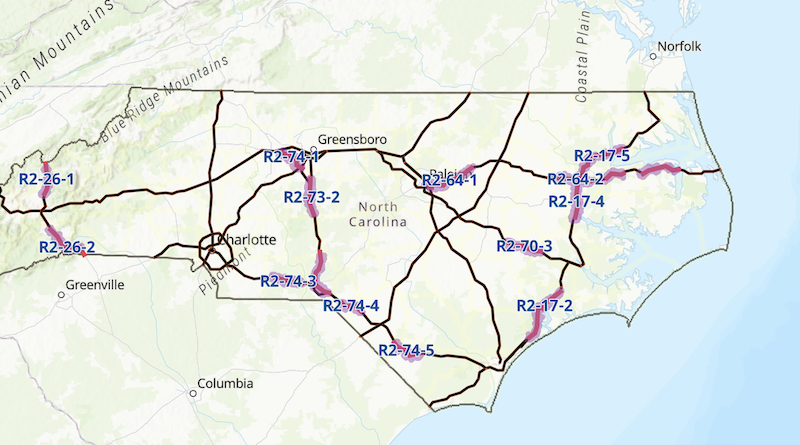
Nevertheless, NEVI soldiers on. On September 14, the North Carolina Department of Transportation issued a brief announcement describing a new round of NEVI awards, adding seven new locations to the five stations funded in 2024, before Trump took office.
North Carolina received a $109 million share of the NEVI pot. This week’s activity covered $14.4 million of the total.
“By expanding our electric vehicle charging network, we’re making it easier for everyone to travel confidently across the state, while supporting a cleaner, more modern transportation economy,” enthused NCDOT’s State Initiatives Manager Heather Hildebrandt.
NCDOT expects its share of NEVI funding to cover a three-year build-out program. The next step in the state’s electric mobility plan will bring EV charging stations to rural areas and other communities that don’t necessarily sit on major transportation arteries.
Another Day, Another 6oo EV Charging Stations, Another #TrumpFail
Trump’s war against the “EV mandate” certainly did throttle down momentum in the US vehicle electrification movement. However, in typical Trump fashion, he then launched a war of choice against Iran, which continues to spin out in the form of upward-spiraling fuel prices, motivating more drivers to research EV alternatives.
Whether or not all that EV-curious activity levels up to an EV sales recovery remains to be seen. However, in some jurisdictions drivers won’t have much of a choice. New York City, for example, is adding 600 more curbside charging stations to its current roster of 88, in support of a phased-in municipal mandate requiring all drivers licensed by the Taxi and Limousine Commission to use zero emission or wheelchair-accessible vehicles.
Image: Trump tried, and failed, to stop states from building new public EV charging stations along major transportation arteries with funds from the federal NEVI program (GIS map of EV charging stations courtesy of NCDOT).
Sign up for CleanTechnica's Weekly Substack for Zach and Scott's in-depth analyses and high level summaries, sign up for our daily newsletter, and follow us on Google News!
Have a tip for CleanTechnica? Want to advertise? Want to suggest a guest for our CleanTech Talk podcast? Contact us here.
Sign up for our daily newsletter for 10–15 new cleantech stories a day. Or sign up for our weekly one on top stories of the week if daily is too frequent.


CleanTechnica uses affiliate links. See our policy here.
CleanTechnica's Comment Policy

