
ARES’ Nevada Demonstrator Shows Why Rail Gravity Storage Is A Train Wreck
Support CleanTechnica's work through a Substack subscription, on Patreon, or on Stripe. Help us produce all of the high-quality, original content we publish week after week despite the challenges of content-scraping AI, antisocial media, inflation, and other hurdles.
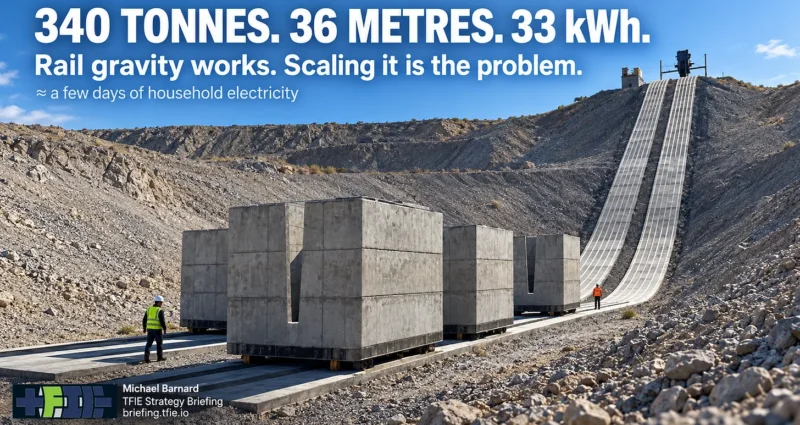
ARES North America has now operated enough of its GravityLine system at Gamebird Pit in Nevada to make clear its deep limitations to people who didn’t simply do the grade 7 math and science calculations. Sandia National Laboratories documents a pair of mass cars weighing roughly 340 tonnes climbing a slope of about 55% grade, driven by a stationary motor and chain system through approximately 36 metres of elevation. That enormous mechanical movement stores only about 33 kWh of gross gravitational energy.
The result is exactly what the underlying physics predicts. Stored gravitational energy is mass multiplied by gravity and elevation. A pair of cars weighing hundreds of tonnes can produce several megawatts briefly on the way down because power is energy delivered quickly, but there is still very little energy available when the vertical movement is only a few dozen metres. The commercial question for solid-mass gravity storage has always been what happens when that mechanism has to provide hundreds of megawatt-hours rather than tens of kilowatt-hours.
This is the short version of a deeper TFIE Strategy Briefing assessment. I gave ARES more than eleven times Gamebird’s elevation, kept the plant relatively small at 20 MW, required twenty hours of output, and compared it with closed-loop pumped hydro and lithium-ion providing exactly the same electrical service. The important number is not how much rock ARES can move. It is how much machinery has to exist before enough rock has been moved uphill to become useful grid storage.
Gamebird does change one detail from my 2024 assessment of gravity storage. I expected conventional funicular cable forces to constrain practical moving masses more severely. ARES’ chain-drive configuration sidesteps that particular limitation. The larger problem remains unchanged: solid-mass gravity storage has extremely low energy density, so useful energy inventories require enormous physical inventories.
Using Gamebird’s 36 metres of elevation as the commercial comparison would be too easy, so I gave ARES a 400-metre effective elevation difference. I kept the output at only 20 MW and asked for twenty hours of delivery because ARES markets GravityLine for long-duration storage extending well beyond the durations normally associated with lithium-ion systems. That produces a 400 MWh plant in what should be comparatively favorable territory for the concept.
Once the service requirement is specified, the system ceases to look like cheap ballast moving up and down a hill. Hundreds of thousands of tonnes of stored mass have to be divided among large purpose-built carriers. Those machines require storage areas at both elevations, operating paths, stationary drives, transfer systems, controls, maintenance access and enough redundancy that stored energy remains accessible when equipment is unavailable. A massive heavy rail, cement, rock crushing and concrete forming manufacturing plant has to be custom built for each site, and maintained for decades for servicing the equipment.
Cheap ballast does not remove those requirements. A gravel quarry such as Gamebird is unusually convenient because aggregate, roads and disturbed industrial land are already present, but it offers little elevation. A high-head site improves gravitational energy density but may lack cheap nearby aggregate, heavy industrial access, transmission, usable storage areas at both elevations or straightforward geotechnical conditions. The useful site is the intersection of several requirements rather than simply a steep hill.
Closed-loop pumped hydro uses the same gravitational physics with a very different material-handling architecture. Hundreds of thousands of tonnes of water can sit in irregular reservoirs without each increment of mass needing a chassis, rollers, bearings and parking position. Water finds its own level, moves through a common conduit and remains accessible to another generating unit when one part of the power train is unavailable.
Lithium-ion goes in the other direction. Its energy inventory is heavily manufactured, but the manufacturing happens in permanent factories supplying a global market. A storage developer receives standardized modules rather than creating a project-specific heavy-equipment production system beside a suitable landscape.
That leaves rail gravity with characteristics of both architectures and none of their advantages. It retains gravity storage’s dependence on geography while adding a large manufactured moving inventory. Every carrier has to be built, inspected, sequenced and maintained, and failures can make stored energy inaccessible even when the mass itself is still sitting uphill. For enthusiasts who want to respond with other options, such as 100 meter elevations, I point to the basics of the equation: mass times gravity times height. Gravity isn’t going to change, so to get the same energy, you have to quadruple the mass. That would mean thousands more concrete filled steel rail cars that would have to be manufactured and have to be marshaled at top and bottom. The physics is unforgiving and it’s science that’s taught to 13 year olds. That also multiplies the embodied carbon by four.
Recent battery procurement also weakens the old assumption that twenty-hour storage necessarily creates an open field for mechanical alternatives. Britain’s 2026 long-duration storage procurement includes lithium-ion projects extending well into the teens of hours, showing that battery systems are already competing at durations that were commonly treated as outside their practical range only a few years ago.
I didn’t bother to do the embodied carbon calculations for this as I did recently for Energy Vault’s equally unnecessary one-off construction project in China. They would come out the same, likely in the range of adding the equivalent of natural gas generation to the per kWh electricity carbon debt. That’s because while the rock is low carbon, everything else is high carbon. The amount of high-quality steel and Portland cement necessary to build the massive plant, massive winches, massive rails and massive rail cars is obvious to anyone looking at this with any sense of reality. It’s not remotely a climate solution and clearly isn’t a viable energy storage solution. It’s remarkable to me that this was funded and that the US DOE’s usually sensible Sandia Lab spent any time on this at all.
Gamebird does not change the central commercial assessment of rail gravity storage. It demonstrates that ARES’ chosen drive system can move very heavy carriers on a steep alignment. The decisive issue begins after that mechanical question has been answered: enough solid mass must be turned into enough rolling machinery to provide a useful energy inventory, and that machinery has to compete with water moving through a pipe and batteries arriving from permanent factories.
The full TFIE Strategy Briefing analysis shows what 20 MW for twenty hours becomes once the stored mass is costed as machinery rather than cheap rock, and why that single change overwhelms the apparent economic niche.
Sign up for CleanTechnica's Weekly Substack for Zach and Scott's in-depth analyses and high level summaries, sign up for our daily newsletter, and follow us on Google News!
Have a tip for CleanTechnica? Want to advertise? Want to suggest a guest for our CleanTech Talk podcast? Contact us here.
Sign up for our daily newsletter for 10–15 new cleantech stories a day. Or sign up for our weekly one on top stories of the week if daily is too frequent.


CleanTechnica uses affiliate links. See our policy here.
CleanTechnica's Comment Policy

