
Aviation’s $4 Trillion Footprint Does Not Prove Every Flight Adds Growth
Support CleanTechnica's work through a Substack subscription, on Patreon, or on Stripe. Help us produce all of the high-quality, original content we publish week after week despite the challenges of content-scraping AI, antisocial media, inflation, and other hurdles.
Aviation performs useful economic work. It connects remote communities, moves urgent and high-value cargo, brings visitors to places that genuinely depend on tourism and enables work that still requires people to be physically present with equipment, sites, customers or negotiating partners. Those are strong arguments for aviation as a service. They do not prove that every additional passenger journey creates additional economic growth.
The industry usually presents its economic case as a footprint. IATA, drawing on the latest Aviation: Benefits Beyond Borders work, says aviation supports 86.5 million jobs, generates $4.1 trillion in economic activity and accounts for 3.9% of global GDP. Those figures describe activity associated with airlines, airports, suppliers, employees and tourism. They do not tell us what would happen if a marginal flight, route or passenger journey did not occur.
That is the additionality problem. Public-sector appraisal has long used concepts such as deadweight, substitution, displacement and leakage to separate activity genuinely caused by an intervention from activity that would have happened anyway. The UK Treasury’s Green Book explicitly requires that kind of counterfactual thinking. The full TFIE Strategy Briefing assessment applies the same lens to passenger aviation, and the result is much less flattering than the industry’s aggregate messaging.
When someone does not fly to a distant holiday destination, the money rarely vanishes from the economy. It might be spent on a closer holiday, restaurants at home, renovations, consumer goods, savings or investment. The destination that would have received the visitor loses a sale, but another place or sector may gain one. Some of the original tourism spending would also have leaked through foreign airlines, booking platforms, imported goods and external ownership.
Tourism is real economic activity, but it is not automatically net additional global growth. Air access to a small island economy with spare accommodation and few alternative export sectors can be highly additional. Another weekend frequency into London, Dublin, Edinburgh, Paris or Barcelona during peak season is a different economic proposition because visitors are competing for rooms, workers, restaurants and transport capacity that often have other potential users.
I am part of the discretionary category myself. This year my spouse and I are flying to the UK and Ireland for a six-week holiday. The trip will have considerable value to us and we will spend money in hotels, restaurants, museums, cafés, trains and pubs. I am not claiming the moral high ground and suggesting that other affluent people should stay home while I fly. I am saying something much narrower: I do not have to make the trip, and my enjoyment and tourism spending do not turn my transatlantic passenger-kilometres into a productivity programme.
Passenger-purpose data make the scale of this distinction clearer, although public global data are thinner than they should be for such a large industry. A 2024 UK Civil Aviation Authority survey covering eight major airports found that 53% of passengers travelled for leisure, 34% to visit friends and relatives and 13% for business. Business travel had fallen from 19% in 2019. The familiar estimate that corporate travellers account for around 12% of air traffic is actually a widely cited pre-COVID benchmark, not a precise current global census.
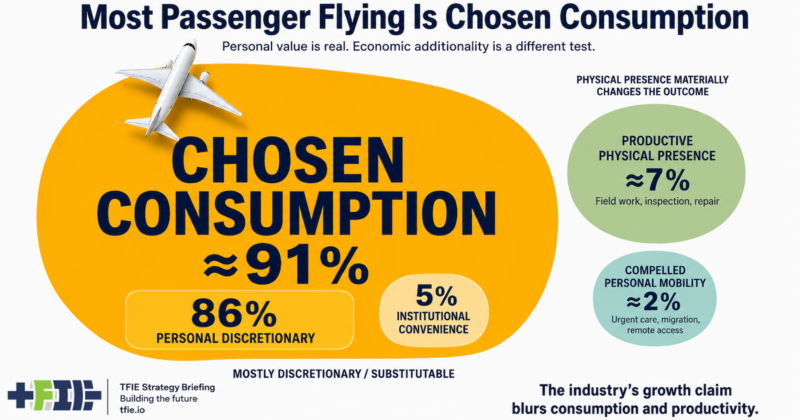
That makes roughly 88% personal and 12% institutional travel a reasonable working split, but purpose is not the same thing as economic additionality. The TFIE stress test goes one step further. It assigns an illustrative 86% of passenger journeys to discretionary personal travel and another 5% to institutional convenience such as routine meetings, generic conferences, oversized delegations and similar journeys where the objective could often be achieved another way. Together they make up roughly 91% chosen consumption. The remaining illustrative 9% consists of 7% productive institutional presence and 2% compelled personal mobility. Those subdivisions are an analytical stress test, not measured global statistics.
Business travel has the same boundary problem as tourism. Equipment commissioning, field inspection, emergency response, specialist repair, site-specific due diligence and some negotiations can require physical presence. Routine internal reviews, status visits, generic conferences, remotely deliverable training and large delegations are harder to defend as economically additional. They are not personal leisure, but they are still chosen, substitutable consumption of aviation services. An expense code proves that an organization paid for the journey. It does not prove that the journey made the organization more productive.
COVID provided the closest thing aviation has had to a global natural experiment in that distinction. Companies moved internal meetings, preliminary sales discussions, routine oversight and many conferences online almost overnight, while much of the underlying work continued. McKinsey’s post-COVID analysis put field operations and businesses managing distributed physical assets into a much smaller essential-travel category, around 15% of 2019 corporate travel spending, while identifying another substantial block of travel as particularly exposed to permanent replacement by digital tools and local oversight.
Zoom did not replace every client visit, site inspection or negotiation. Nor did the return of business travel prove that every returning trip was indispensable. Organizations resumed flying for a mixture of reasons: physical presence sometimes genuinely matters, clients and competitors started travelling again, organizational habits returned and travel remained an executive perk or status signal in some organizations. COVID demonstrated something narrower but economically important: a meaningful layer of institutional flying could disappear without the work disappearing with it.
That distinction also matters when looking at the industry’s enormous economic-benefit numbers. Aviation: Benefits Beyond Borders attributes only about $1.1 trillion of its roughly $4.1 trillion economic footprint to direct aviation activity. The rest comes from suppliers, spending by aviation and supplier employees, and tourism enabled by air travel.
None of that activity is fictitious. Aircraft need maintenance, airports buy services, employees buy groceries and tourists book hotel rooms. But nurses, software engineers, grid technicians and railway employees also buy groceries. Counting induced household spending demonstrates that wages circulate through the economy. It does not demonstrate that aviation uniquely caused the spending, that those workers would otherwise be unemployed or that increasing passenger traffic is the highest-value use of the labour, infrastructure, capital and energy involved.
Aviation does have powerful economic functions. Remote and island communities can depend on it. Time-sensitive and high-value air freight can enable trade that would otherwise be impossible. Physical work at distant sites, emergency mobility, some knowledge transfer and some high-stakes interactions genuinely depend on putting people or goods somewhere quickly. A first reliable air connection to an isolated economy is economically very different from another low-cost frequency between two wealthy cities already connected by dozens of services.
The stronger aviation argument is therefore narrower than the industry’s messaging. Aviation can enable economic growth without every additional passenger flight being an economic growth engine.
That becomes more than an accounting distinction once aviation starts paying seriously for decarbonization. Today’s passenger network was built around abundant, inexpensive kerosene. Sustainable aviation fuels, synthetic fuels, lifecycle rules and carbon costs make long-distance liquid-fuel aviation more expensive. Shorter routes face a very different emerging cost structure because electric and hybrid-electric aircraft can use much cheaper energy where range, payload and reserve requirements allow them to compete.
Those pressures do not hit every journey equally. Urgent mobility, field work and genuinely high-value physical interactions are relatively sticky. The much larger chosen-consumption category is more exposed to ticket prices and alternatives. A holiday can move closer to home. Three business trips can become one. A conference can lose half its attendees. Rail can replace some short flights. Video can replace some meetings. People can travel less frequently but stay longer.
That is why my aviation fuel-demand projection through 2100 shows sorting rather than collapse. Under roughly 1,000 kilometres, hybrid-electric aviation gains a much cheaper energy basis and can expand regional mobility where rail or geography leave an opening. Longer flights remain dependent on scarce and increasingly expensive liquid fuels. A 5,000-kilometre discretionary trip does not become a 5,000-kilometre electric flight. It might become a 700-kilometre regional trip, a rail journey, a less frequent but longer holiday, another destination or no trip.
Aviation will survive. It will remain economically important where speed, distance and physical presence materially change the outcome. But if roughly nine-tenths of passenger journeys are reasonably placed in an illustrative chosen-consumption category, slower growth in passenger-kilometres is not automatically slower growth in productivity or global GDP.
The industry’s strongest economic case is diminished, not strengthened, when it wraps my holiday spending, a routine executive conference trip, an airport supplier’s revenues, an aviation employee’s grocery purchases and an essential technician’s field visit into one enormous economic-benefit number and then treats the whole passenger-growth curve as indispensable.
Aviation is a valuable service. Its economic footprint is large. Most passenger flying is still chosen consumption. Those statements are compatible. The industry’s claim that every increment of passenger growth is an engine of prosperity is what fails the additionality test.
For the full passenger-purpose stress test, economic-additionality analysis and implications for long-term aviation demand, read the TFIE Strategy Briefing assessment.
TFIE Strategy works with investors, policymakers and organizations on aviation demand, fuels and transition scenarios that distinguish durable economic value from inherited growth assumptions.
Sign up for CleanTechnica's Weekly Substack for Zach and Scott's in-depth analyses and high level summaries, sign up for our daily newsletter, and follow us on Google News!
Have a tip for CleanTechnica? Want to advertise? Want to suggest a guest for our CleanTech Talk podcast? Contact us here.
Sign up for our daily newsletter for 10–15 new cleantech stories a day. Or sign up for our weekly one on top stories of the week if daily is too frequent.


CleanTechnica uses affiliate links. See our policy here.
CleanTechnica's Comment Policy

