
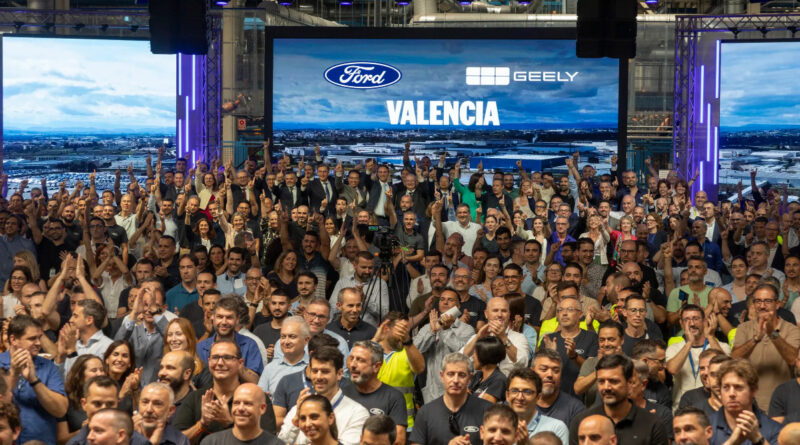
Ford Partners With Geely To Produce “Multi-Energy” Cars In Valencia
Support CleanTechnica's work through a Substack subscription, on Patreon, or on Stripe. Help us produce all of the high-quality, original content we publish week after week despite the challenges of content-scraping AI, antisocial media, inflation, and other hurdles.
Ford and Geely announced this week that they plan to create a joint venture at Ford’s assembly plant in Spain to build a new generation of multi-energy vehicles for the European market under both brands. Is “multi-energy” another way of saying “plug-in hybrid”? Apparently so. According to The Detroit News, Ford will own 66 percent of the partnership and Geely will own the remaining 44 percent.
“For nearly 50 years, Valencia has built some of the most-loved cars in our history, and now this team will help build our future,” Jim Baumbick, president of Ford of Europe, said in a statement. “That’s why we’re building a flexible, cost effective industrial system with a capable partner in Geely Auto. Together we can fully utilize a best-in-class plant with a great workforce and match the industry’s new cost benchmark. This partnership shows how automakers are strengthening Europe’s industrial base, but we can’t do it alone.”
Ford’s On The Road blog this week carried this message: ”Through this strategic, European focused joint venture, the new company will manufacture Ford and Geely multi-energy passenger vehicles for the European market — pooling production volume across two automakers to use the plant more fully, lower the cost of every vehicle we build there, and strengthen the local Valencia economy.
“The world class lineup of new electric and plug-in hybrid vehicles that Valencia produces will deliver the rally-bred thrills and enable the offroad adventures that are part of Ford’s unique appeal to European drivers. This isn’t just a partnership. This is our blueprint to win in an environment where intense competition, European electric vehicle mandates and industrial costs create challenges that no single company can solve alone. We are making the Valencia plant an automotive manufacturing powerhouse in Europe. ”
He added: “The joint venture is expected to produce an all new multi-energy crossover for Ford, in addition to a new member of the Bronco family, plus two electric Geely SUVs, with production starting in 2028. Kuga production continues uninterrupted. The collaboration accelerates Geely Auto’s European expansion, and supports Ford’s product offensive to bring five new passenger vehicles to European showrooms by 2029.”
V Is For Valencia
The Valencia factory has an annual capacity of 500,000 vehicles and is expected to start building a new Bronco for the European market in 2028. A multi-energy family crossover designed by Ford and jointly developed with Geely will follow by 2029. The popular Ford Kuga — which is available with a plug-in hybrid powertrain already — is currently assembled at the Valencia factory. It will continue in production while the factory is being reconfigured. Geely also plans to produce two electric SUVs in Valencia, with the first arriving in 2028.
“This JV with Ford in Europe reflects our commitment to open, collaborative product development as part of our growth strategy, deepening our local presence and commitment to customers in Europe,” Alex Nan, vice president of Geely Auto, said in a statement. “We are dedicated to delivering vehicles that European customers will choose on merit, on industry leading features, on high quality, and on actively contributing to Europe’s green future. Put simply, we are building cars in Europe, for Europe, alongside a trusted partner.”
Condemnation Ensues
Blowback was swift. Soon after the announcement, John Moolenaar, a congressperson from Michigan, criticized the deal. “Ford is actively helping the Chinese Communist Party advance its ambitions to dominate global automotive supply chains and increase the world’s dependence on China,” said Moolenaar, who is chairman of the House Select Committee on China.
“This partnership with Geely will further enable China’s decimation of auto markets in Europe as Chinese automakers set their sights on North America,” he said. “Ford’s decision (on Geely) is incomprehensible as its seeks protection from Chinese automakers coming to the United States. Ford should work with our nation’s allies, not our adversaries.”
Moolenaar, despite his xenophobic rhetoric, has a point. Virtually every automaker in the US is screaming for protection from Chinese competition while lobbying for further rollbacks in exhaust emissions standards. China is portrayed as the big bad wolf, but the US government has also been far more susceptible to political pressure than the European Union. Ford, like every other special interest group, will use any lever it can find that gives it an advantage.
Ford spokesperson Dave Tovar fired back in a statement that said Ford builds more vehicles annually in the United States than its domestic and foreign rivals that import millions of vehicles from Asia. “No company has done more to advance the US auto industry than Ford. Over in Europe, the landscape is changing fast and we are competing head-on with the Chinese and every other major global automaker. This new reality is forcing every car company to get radically leaner and smarter, which is exactly what we’re doing with our plant in Valencia, Spain.”
“While other US automakers chose to exit Europe altogether,” Tovar added, “we’re building strategic partnerships with companies like Renault, Volkswagen and Geely to build a sustainable future in Europe.” That “other US automakers” remark is clearly aimed at crosstown rival General Motors, which hastily dumped its European operations on Opel and beat feet for the border a decade ago. Last December, Ford announced a partnership with Renault to build two EV models for Europe. It also once intended to utilize the Volkswagen MEB platform for some European models, but that collaboration has gone mostly dormant recently.
An Existential Threat
Ford CEO Jim Farley has said that Chinese automakers are an “existential threat” to the US automotive industry, thanks to low priced, heavily subsidized electric vehicles and other advantages. In response, Ford has developed a next-generation platform for affordable EVs in the United States that will launch next year. Its first offering will be an as yet unnamed electric pickup truck that will be significantly smaller and less expensive than the F-150 Lightning. But Farley has also expressed an interest in an international partnerships to help it compete in markets where Chinese competitors are rapidly increasing their market share and European government regulations are requiring reductions in carbon emissions.
Ford has also suffered a mountain of criticism for its battery licensing agreement with CATL to produce batteries for its next-generation EVs in Marshall, Michigan. In the US today, it is popular to bash the Chinese for taking battery, solar, and wind technologies invented in America and making them commercially viable. Yet in the words of Harry Truman, “America was not built on fear. America was built on courage.”
So far, Ford and other US based manufacturers have shown precious little courage as they continue to prioritize monstrous gas hogs and fight any exhaust emissions standards that are more stringent than those from 30 years ago. This latest joint venture shows Ford knows what to do; now it needs to do it — not just in Europe, but in America as well.
Sign up for CleanTechnica's Weekly Substack for Zach and Scott's in-depth analyses and high level summaries, sign up for our daily newsletter, and follow us on Google News!
Have a tip for CleanTechnica? Want to advertise? Want to suggest a guest for our CleanTech Talk podcast? Contact us here.
Sign up for our daily newsletter for 15 new cleantech stories a day. Or sign up for our weekly one on top stories of the week if daily is too frequent.


CleanTechnica uses affiliate links. See our policy here.
CleanTechnica's Comment Policy

