
This Robotaxi Company Is Growing Its Share Of US Market — Not Waymo, Not Tesla
Support CleanTechnica's work through a Substack subscription, on Patreon, or on Stripe. Help us produce all of the high-quality, original content we publish week after week despite the challenges of content-scraping AI, antisocial media, inflation, and other hurdles.
Depending on which side of the fence you sit on, either Waymo or Tesla is leading the robotaxi revolution in the United States. Objectively, Waymo has far more self-driving cars and robotaxi users, but Tesla fans think only Tesla has the right approach long term, and that improvements in “Full Self Driving” have the company on the verge of a massive robotaxi rollout that will dwarf Waymo’s operations. (Of course, the latter has been the idea for several years now.) But there’s a third robotaxi company across the street, and perhaps it’s worth watching.
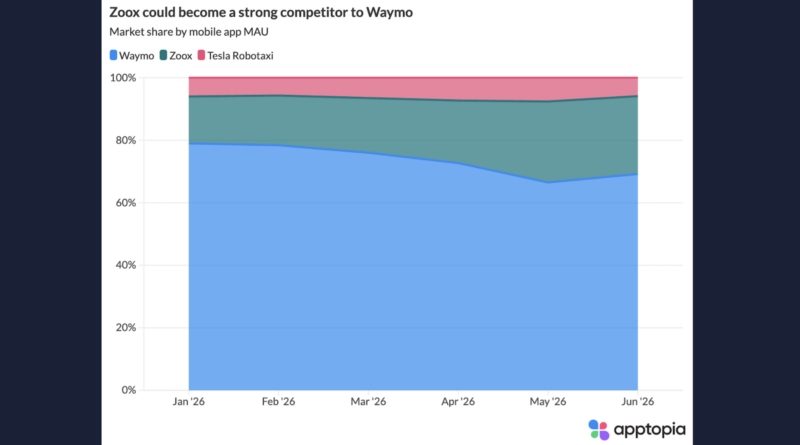
Apparently, according to mobile app tracker Apptopia, Amazon-backed Zoox has grown its share of the market from 15% of active monthly users to 25% so far in 2026. That’s from January 2026 (15%) to June 2026 (25%).
Waymo is still the market leader by far, but its share dropped from 79% to 69% in that timeframe. Its user base is still growing, but monthly active user (MAU) growth has dropped from 79% (ironically) to 15% year over year.
Yes, if you do the math, the third company in the nascent market, Tesla, was steady at about 6% from January to June. Actually, though, it wasn’t exactly steady. It has an interesting story of its own. “Tesla Robotaxi’s usage jumped after its April city launches, then shed more than a fifth of its active users in June. Expansion headlines and durable ridership are not the same thing,” Apptopia writes. So, it seems people decided to try out a Tesla Robotaxi following launch and then decided it wasn’t actually worth using.
Here’s more from Apptopia attempting to explain changes at Waymo and Zoox:
“Part of the answer is inside Waymo’s own base. Its 17-25 age cohort was a rounding error in January and grew several times over by June to become a real slice of active users. User Churn in that band fell from near-total early in the year to roughly 60% by June. Rising adoption and falling churn in the same cohort is the pattern that signals habit forming rather than a one-time try. Meanwhile Waymo’s core 26-45 riders lost penetration over the same stretch. The flat headline is masking a trade: mature-user saturation for a fast-growing young base that maps to the freeway rollout and Sun Belt expansion into student-heavy metros. Younger riders age into the highest-value years for a category built on habit, which makes this the more encouraging half of an otherwise soft growth print.
“Amazon’s [NASDAQ: AMZN] autonomous unit roughly doubled its monthly active users between January and June and pulled its share of the three-app set from 15% to a quarter of the market. The inflection lines up with operations, not necessarily marketing. In late March, Zoox quadrupled its San Francisco service area, more than doubled its Las Vegas footprint, began public deployments in Austin and Miami, and put its vehicles on the Uber app in Las Vegas. When a service opens up geography, the app is where demand shows up first, and Zoox’s numbers moved accordingly.”
Interesting….
If that looks complicated, don’t worry, Tesla’s story is even more complicated. Well, Apptopia’s Adam Blacker said it’s harder to read, but I think his explanation was actually pretty clear, straightforward, and logical. Here’s what he said on Tesla:
“Tesla is the harder case to read, and the more interesting one for anyone underwriting the stock’s autonomy narrative. Tesla Robotaxi [NASDAQ: TSLA] downloads more than doubled from January to their April peak as the company launched unsupervised rides in Dallas and Houston ahead of schedule. Active users followed to a May high, then fell more than 20% in June even as the app stayed live in its markets. New cities generated a wave of trial but much of it did not stick.”
That’s not really surprising based on what we’ve seen. Tesla launches in a new city, a ton of fans want to try it out, but then the service ends up having serious issues and isn’t convenient to regularly use — so usage drops. The idea is that everything will change once it gets a little better. There’s always tomorrow — it’s only a day away.
“The bull case treats Tesla’s robotaxi as a question of when, not if, so a month where active users fall after a multi-city launch is the kind of thing worth sitting with,” added Tom Grant, VP of Research at Apptopia. “Trial is easy to manufacture with new cities and a launch cycle; retention is the part you can’t fake. Right now the app data says Waymo and Zoox are keeping riders and Tesla is still proving it can.”
Good points.
Black makes a few more points:
“One caveat before over-reading a single month: summer travel and tourism markets like Las Vegas and Miami inflate trials across all three apps, which makes retention the cleaner signal than installs. On that measure Zoox held its new users while Tesla’s cohort thinned.
“None of this dents the structural point that Waymo is years ahead in driverless miles and commercial cities, and it raised $16 billion at a $126 billion valuation to keep that lead durable. What the app data reframes is the question. For two years the only relevant number was how fast Waymo could grow. Now it is how much new demand Waymo keeps, because Zoox is competing for it in the same neighborhoods, and Tesla’s June dip is answerable in the usage data before it reaches an earnings call.”
Personally, I find his fascinating stuff. It sort of makes me think of the early days of Uber and Lyft … before I knew what Uber and Lyft were. It’s great that we have this active user data from Apptopia. I look forward to seeing how the robotaxi market in the US evolves. I expect we’re going to see a lot of launches in the coming 6–12 months. That alone will be interesting to track, but having a closer look underneath the surface at monthly active users and user retention is going to be just as interesting — or maybe much more interesting. Any predictions on the user split in December 2026? Or December 2027?
Sign up for CleanTechnica's Weekly Substack for Zach and Scott's in-depth analyses and high level summaries, sign up for our daily newsletter, and follow us on Google News!
Have a tip for CleanTechnica? Want to advertise? Want to suggest a guest for our CleanTech Talk podcast? Contact us here.
Sign up for our daily newsletter for 15 new cleantech stories a day. Or sign up for our weekly one on top stories of the week if daily is too frequent.


CleanTechnica uses affiliate links. See our policy here.
CleanTechnica's Comment Policy

