The US Is Stuck With This Ninny For How Much Longer?

What a week for US President Donald Trump. It was a typical week, in fact. Quickly following up on his failure to restore the Lincoln Memorial Reflecting Pool, he attached his name to a uniquely disastrous July 4th celebration and meddled with the US Men’s National Soccer Team, thereby taking a personal share in the team’s humiliating 4-1 World Cup loss against the teeny tiny nation of Belgium. To cap it all off, new signs have emerged that his war on renewable energy is fizzling out to a lame conclusion.
Trump’s War On Renewable Energy Is Already Fizzling Out
Despite some major successes, Trump has failed, and will continue failing, to stop the inevitable transition to renewable energy. After all, various energy resources have come and gone throughout American history, with some clinging on around the fringes to various degrees.
Everybody chopped wood at the nation’s birth in the 18th century, and we don’t do that so much any more. Whale oil offered something new and different in the 19th century, only to fall by the wayside when the whales ran out and fossil fuels came in.
Now that coal has lost its grip on power generation in the US, oil and natural gas are next to tumble into the dustbin of history. Somewhat ironically, Trump himself affirmed the decline of oil and gas upon taking office for the second time last year, when he tapped geothermal energy, hydropower, and biomass for federal support under his “American Energy Dominance” plan, with nuclear energy also coming in for considerable assistance and energy storage sharing the benefits as well.
Only the US wind and solar industries failed to make Trump’s cut, and they have not given up the ghost. In the latest news, the Center for Energy and Environmental Policy Research at MIT has just published a commentary demonstrating how the Biden-era 2022 Inflation Reduction Act continues to support renewable energy, including wind and solar, despite being undercut by Trump’s 2025 OBBA (One Big Beautiful Bill Act).
The Inflation Reduction Act Lives To See Another Day
Authored by Lily Bermel under the title, Glass Half Full: Building a Decarbonized Power Sector, the paper describes how OBBBA cut IRA funding programs and phased out key tax credits for wind and solar, among other burdensome provisions.
“Indeed, removing and restricting energy tax credits will contribute to higher energy prices, project cancellations, job losses, and less energy added to the grid at a time when power demand is surging. These effects are already apparent,” Bermel emphasizes.
However, Bermel also notes that the IRA engine has not gone cold. Her commentary focuses on the power sector, which is where the “glass half full” part comes in. Comparing two power sector models for the 10-year period beginning in 2025, Bermel makes the case that the IRA continues to serve its intended function, albeit at a less than optimal level.
“The answer, in short, is that the Glass is more than Half Full: across the three dimensions of power-sector decarbonization — clean electricity, fossil electricity, and emissions reductions — the substantial majority of the IRA trajectory’s benefits remain under the OBBBA scenario,” Bermel reports.
“The OBBBA scenario preserves 74% of new clean energy capacity, 71% of new clean generation, and 67% of emissions reductions that the IRA trajectory would have delivered relative to 2021,” she elaborates.
Another #TrumpFail: American Energy Dominance
When Trump launched his “American Energy Dominance” plan, CleanTechnica was among those noting that the plan short-changes wind and solar — the two most abundant, accessible, and economical energy resources in the US — while glad handing others that are less abundant, accessible, and economical, including some that have barely gotten out of the R&D phase.
Glass Half Full underscores the disconnect. Despite Trump’s ham-handed attempts to quash the wind and solar industries, they now routinely account for virtually all new utility-scale capacity additions in the US, far outpacing any other resources, with energy storage also chipping in. Under Bermel’s 10-year scenarios from 2025 to 2035, wind and solar will continue to dominate
“In both scenarios, wind, solar, and storage account for all of the new clean capacity…because the model registers essentially zero new nuclear, geothermal, or hydropower under its cost and performance assumptions,” Bermel emphasizes.
So much for the good news. Because the OBBA prevents solar and wind (in particular, onshore wind) from fulfilling 100% of its IRA potential, fossil energy steps in the fill the gap. “Coal retires more slowly than it would have under the IRA trajectory’s regulations, while gas capacity is actually 3% higher under the IRA trajectory,” Bermel explains.
Unleashing Renewable Energy
Even without the OBBA or other interventions by Congress, Bermel indicates that the full potential of the IRA would likely fall short due to the unchecked actions of the person currently occupying the Oval Office. “In the near term, a coordinated set of executive-branch actions — permitting freezes, stop-work orders, investigations, tariffs, and impoundments — pushes real deployment below the OBBBA scenario,” she explains.
With the mid-term elections coming up fast, Bermel recommends a path forward for lawmakers who are keen to support American’s most abundant, accessible, and economical energy resources. Rather than focusing on the limited gains from restoring wind and solar tax credits, Bermel advises lawmakers to focus their attention on adding new supportive policies.
“The OBBBA–IRA gap is inherently limited: both scenarios have the same ceiling on how fast clean energy can be permitted, sited, built, and interconnected,” she explains. “Alleviating supply-side barriers — primarily through permitting reform and transmission buildout — would lift that ceiling, rapidly increasing deployment speed and lowering costs.”
The Battle Continues
So, is the glass more than half full? If you have any thoughts about that, drop a note in the discussion thread.
In the meantime, the US judicial system has been providing some relief from the Commander-in-Chief’s war on renewable energy, with the offshore wind battle being one example.
A more recent example comes from California. Last week, the US District Court for the Northern District of California affirmed that the state can move forward with its claim that the US Department of Energy illegally cut energy programs that were approved by Congress. In particular, the state is looking forward to the restoration of $1.2 billion. in funding for its ARCHES clean hydrogen hub, part of the Biden-era, $7 billion Regional Clean Hydrogen Hubs program.
The California action is part of a 13-state coalition pushing back in court against Trump’s willy-nilly canceling of renewable energy projects approved by Congress through the IRA and the BIL (the 2021 Bipartisan Infrastructure Law, aka the Infrastructure Investment and Jobs Act).
“The lawsuit, filed in the U.S. District Court for the Northern District of California, challenged the decisions by the United States Department of Energy (DOE), DOE Secretary Chris Wright, the Office of Management and Budget (OMB), and OMB Director Russell Vought, to review and terminate billions of dollars in energy and infrastructure awards nationwide,” explains the office of California Attorney General Rob Bonta.
“In the lawsuit, California and the attorneys general alleged that the decision to terminate and abandon these programs violates the constitutional separation of powers, as the funding was approved by Congress,” Bonta’s office continues.
It’s too bad the US Congress of the present moment, majority controlled by the Republican Party, forgot all about the constitution. On the next go-around, voters may choose to select a new crop of representatives with a more constitutionally responsible collective memory. That, of course, depends on the voters.
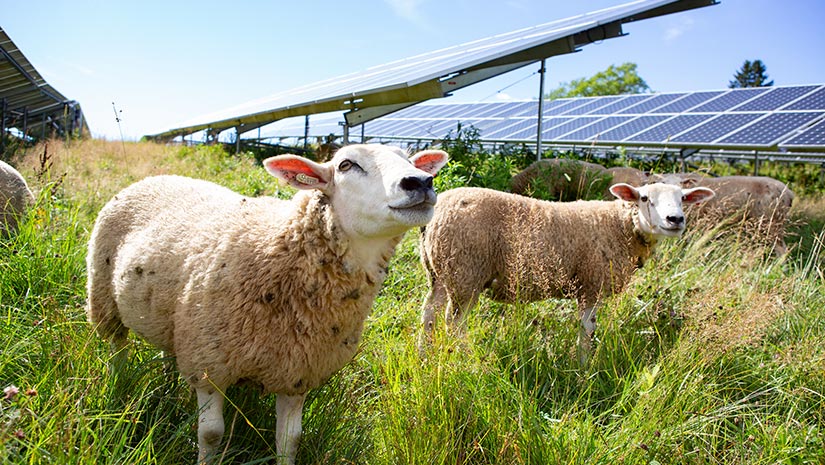
Image: New “Glass Half Full” models indicate that renewable energy technology will continue to beat obstructionist policy (cropped, courtesy of NREL/aka National Laboratory of the Rockies).