
Battery Swapping Is Finally Coming To The USA, Two Wheels At A Time
Support CleanTechnica's work through a Substack subscription, on Patreon, or on Stripe. Help us produce all of the high-quality, original content we publish week after week despite the challenges of content-scraping AI, antisocial media, inflation, and other hurdles.
Battery swapping has caught fire in key global e-mobility regions including Asia, Africa, and South America. The US has been slow on the uptake, but signs of acceleration have finally begun to appear, with Honda joining those seeking an early foothold in the market.
Battery Swapping Is Finally Here…For Two-Wheelers
Despite the substantial improvement in EV range and charging times in recent years, the battery swapping industry continues to grow in key markets around the world, promising improved speed and convenience compared to recharging. The pitch covers all the bases, from two-wheeled e-bikes to passenger cars and trucks.
Here in the US, industry leader Tesla famously dismissed the idea of swapping out full-sized battery packs for electric passenger cars back in 2013, and few other US firms dared to pick up the ball. One exception was the startup Ample. Finding no takers in the US, the company was working with EV stakeholders overseas up until last December, when it nosedived into Chapter 11 bankruptcy (see more battery swapping background here).
Nevertheless, a crack in the anti-swapping facade is finally beginning to emerge, with e-bike delivery service providing the key pivot point.
In 2024, New York City launched a pilot test of public battery swapping stations for e-bike deliveristas, aimed at reducing the risk of fire when uncertified, unsafe e-bike batteries are charged at home. According to the New York City Department of Transportation, e-bike battery recharging has been linked to hundreds of fires in recent years, with 30 deaths and 400 injuries recorded between 2022 and 2025.
In addition to safety considerations, advocates for public swapping stations draw attention to the workforce benefits of delivering with a single battery on board, instead of carrying an extra for backup or waiting around for a battery to recharge.
The pilot project was deemed a success, and in February the city’s swapping partner, Swobbee, announced that it set the wheels in motion to install 25 swapping stations around New York, focusing on high-traffic locations. Also collaborating in the effort is the US branch of the global connectivity firm SINBON.
The Long Road To EV Battery Swapping In The US…
In April, New York City Mayor Zohran Mamdani teamed up with US Senator Chuck Schumer and the organization Worker’s Justice Project to announce the launch of the first station, located at City Hall in lower Manhattan. Under the banner of “City Hall Park Deliverista Hub,” the new station is billed as “the first worker-designed rest and e-bike charging hub for delivery workers in the United States.”
“NYC Parks provided the location at the site of a former newsstand near City Hall Park, and NYC DOT provided bike parking and a street access zone on Broadway near City Hall,” the Mayor’s office noted in a press statement on April 7.
As for the other 24 sites, that’s a work in progress, requiring a thumbs-up from local community boards. Community Board 8 on Manhattan’s Upper East Side provides a good example of the timeline. On July 2, the online news organization Patch reported that the Transportation Committee of CB 8 approved two locations last week. The next step is a full CB hearing at the next meeting, scheduled for July 15.
“On the Upper East Side, the two proposed locations are at the intersection of East 79th Street and Second Avenue, and the intersection of East 73rd Street and First Avenue,” notes Patch reporter Miranda Levingston.
“According to the Department of Transportation, both sites were selected because the stations can be installed without reducing pedestrian space or infringing on existing infrastructure, like tree pits or fire hydrants,” Levingston added.
If all goes according to plan, the installations will begin early next year, with commissioning to follow in 2028.
…Just Became Shorter
Coincidentally or not, earlier this year Honda announced that it is launching its new ‘Honda Mobile Power Pack e:’ battery for two-wheelers in the US, aiming to hook up with other firms for product integration.
“Honda created the Honda Mobile Power Pack e: (MPP), an easy-to-use swappable battery pack, to address the key issues facing electric mobility products, namely the long charging time, inadequate range and high battery cost,” the company explained in a press statement on May 4.
“By leveraging its unique characteristics of being portable and swappable, the MPP can be used not only for Honda products but for a wide range of applications including electric products of other OEMs,” Honda emphasized
It remains to be seen where the new battery will appear in the US. Elsewhere around the world, Honda has already collaborated with Yamaha to introduce battery swapping for the new Yamaha Jog-E electric two-wheeler in select cities in Japan, but Yamaha is not marketing EVs of any sort here in the US.
Two Wheels Good, Four Wheels (And Up) Better
So much for two-wheelers. The potential for applying full scale battery swapping to passenger cars and trucks has been all but extinguished here in the US, but new markets overseas are continuing to evolve. Keep an eye on Europe, where plans for the forthcoming “Swaptopus” are beginning to take shape.
A play on the name of the fast-moving, innovative UK firm Octopus Energy, the Swaptopus effort will begin with an initial tranche of battery swapping stations in the UK next year, with a total of more than 30 to come across Europe by 2035. The aim is to replace gas guzzling trucks with electric trucks, minus the down side of long battery charging times.
At the 30+ mark, Octopus and its partner, the renowned battery innovator CATL, expect to support more than 300,000 trucks.
“Together, our expertise in battery swapping, B2G and energy storage, paired with Octopus’s AI-powered energy trading and management technologies, will speed up the electrification of road transport across the region,” explained CATL Chairman and CEO in a press statement on June 22.
“Not only does it significantly reduce down time but since the batteries at the swapping stations can be charged and discharged when the grid needs it, they act as a virtual power plant and in turn lower costs for consumers,” emphasized Swaptopus CEO and Founder William Rowe.
That’s…interesting! Octopus happens to have a footprint of Texas, where the virtual power plant movement has been taking off like a rocket. If battery swapping for larger EVs ever does emerge within the US market, Texas is the place to watch.
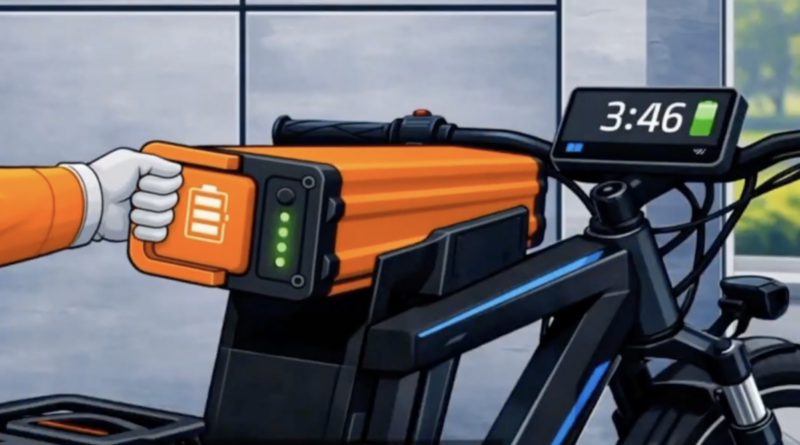
Image: New York City has become the focus of efforts to bring e-bike battery swapping to the US, with the aim of reducing fire hazards linked to home recharging while also benefiting deliveristas (screenshot courtesy of Swobbee).
Sign up for CleanTechnica's Weekly Substack for Zach and Scott's in-depth analyses and high level summaries, sign up for our daily newsletter, and follow us on Google News!
Have a tip for CleanTechnica? Want to advertise? Want to suggest a guest for our CleanTech Talk podcast? Contact us here.
Sign up for our daily newsletter for 15 new cleantech stories a day. Or sign up for our weekly one on top stories of the week if daily is too frequent.


CleanTechnica uses affiliate links. See our policy here.
CleanTechnica's Comment Policy

