
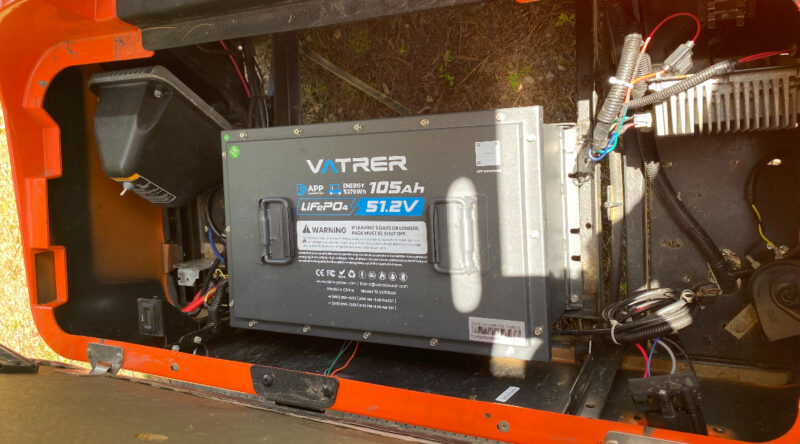
Vatrer LFP Battery Transforms EZ Go Golf Cart
Support CleanTechnica's work through a Substack subscription, on Patreon, or on Stripe. Help us produce all of the high-quality, original content we publish week after week despite the challenges of content-scraping AI, antisocial media, inflation, and other hurdles.
Vatrer is a Chinese company that manufactures a variety of LFP batteries to replace the lead-acid and flooded batteries used in many applications today. Whatever your voltage or amp-hour needs, Vatrer has the right product at the right price.
Recently, the company offered to supply one of its batteries to someone on the CleanTechnica staff who owned an electric golf cart. Since I was the only one to qualify, I became the recipient of a 51.2 volt, 105 amp-hour Vatrer battery with a total capacity of just over 0.5 kWh. All I had to do was install it and go. Such are the advantages of writing for a prestigious online clean energy publication!
Several years ago, my wife and I bought a manufactured home in a seasonal campground in Connecticut. Golf carts have become a fixture of campground living. They bring us to the beach and the laundry room. They pick up our Amazon packages at the office and take us to the restaurant for dinner. We inherited a tired gas-powered cart with our purchase, but since we are both strong advocates for electric transportation, we traded it for a 48 volt electric EZ Go TXT within weeks of buying our unit.
Gas-powered carts have many of the same maintenance issues as conventional cars. They have a small battery and starter. They have piston rings and valves and clutches, all of which wear out and need attention from time to time. Keeping their batteries from freezing in the winter is a challenge. In our campground, a local fellow comes most weekends to service the carts and there is never any lack of work for him to do.
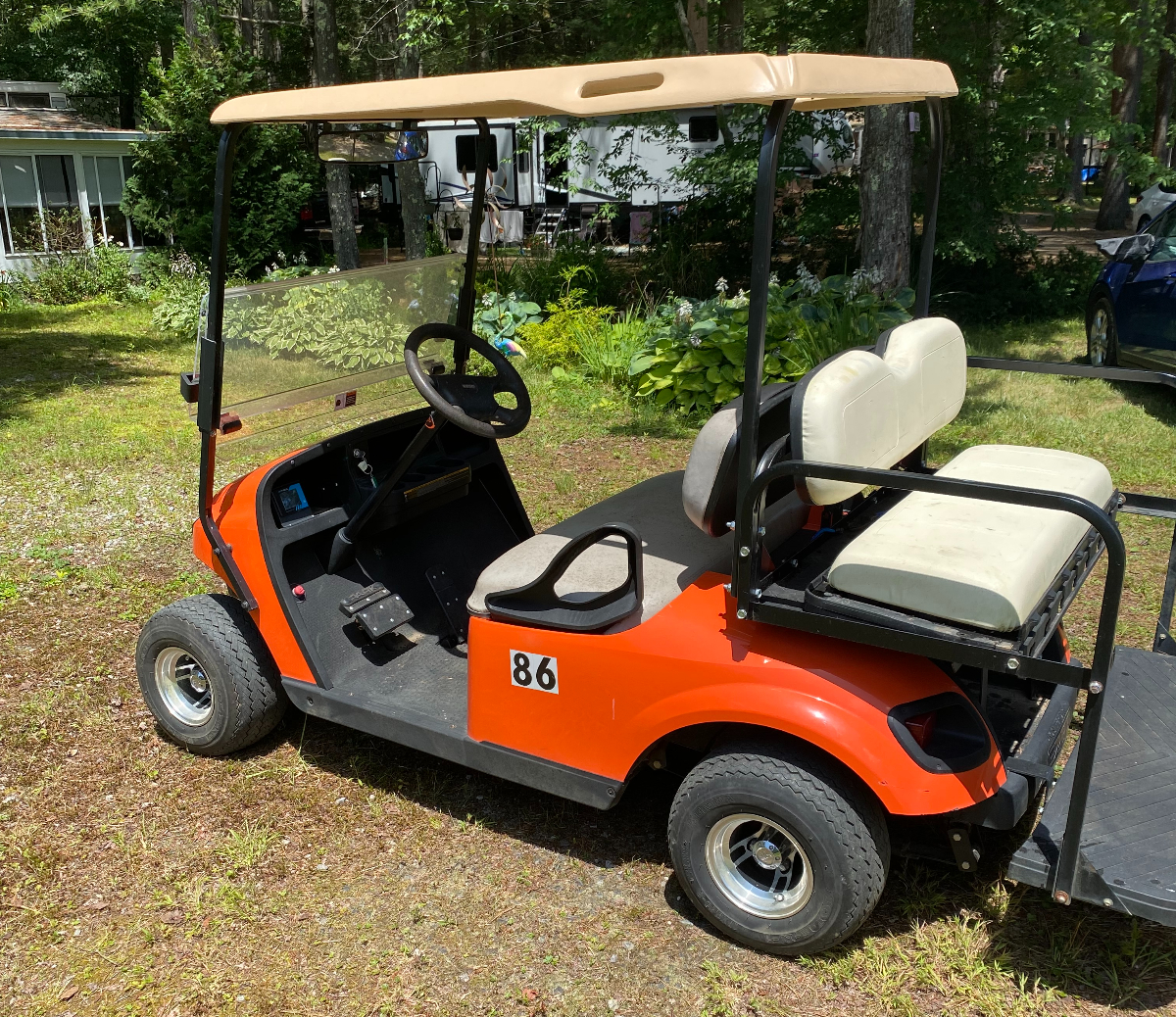
Our cart, which we call Pumpkin, uses six 8 volt lead-acid batteries for a total of 48 volts. We quickly learned there were maintenance challenges with battery electric carts as well. The batteries need to have water added on a regular basis, and not just any water — distilled water only, thank you very much.
Some of the fill holes for the three batteries in the rear are hidden under the bodywork of the cart, so you need three hands to add water to them — one to lift the little flap that gives access to them, one to hold the container with the distilled water in it, and one to guide the water into the proper hole without spilling most of it on the ground.
Even with proper maintenance, those batteries do not last forever. 4 years of service is normal, 5 years if you are lucky. They also must be charged over the winter to keep them from freezing. My batteries developed significant corrosion at all of the 12 battery posts. After 4 years, I had to replace all the battery cables (thank you, Amazon) and I found most of the small positive and negative ring connectors for auxiliary power and charging became so eaten away that they snapped off easily — usually while filling the batteries with water.
By the end of last summer, the lead-acid batteries in Pumpkin were showing signs of wearing out. They struggled to go up hills, the terminal corrosion was getting progressively worse, and they seemed to need water more frequently. Replacing them with new lead-acid batteries was projected to cost at least $1,800. I got one quote of $2,485. Yikes!
The Vatrer battery was delivered before I arrived this summer, so in addition to opening up the modular home and fixing a few things that broke over the winter, then cleaning the house from stem to stern, working on the cart was not my top priority. I called Brandon at Protek Autoworks in Somers, Connecticut, where we bought Pumpkin several years ago. He took the cart to his shop, installed the battery, cleaned and serviced Pumpkin, and had it back to us the next day.
Before & After
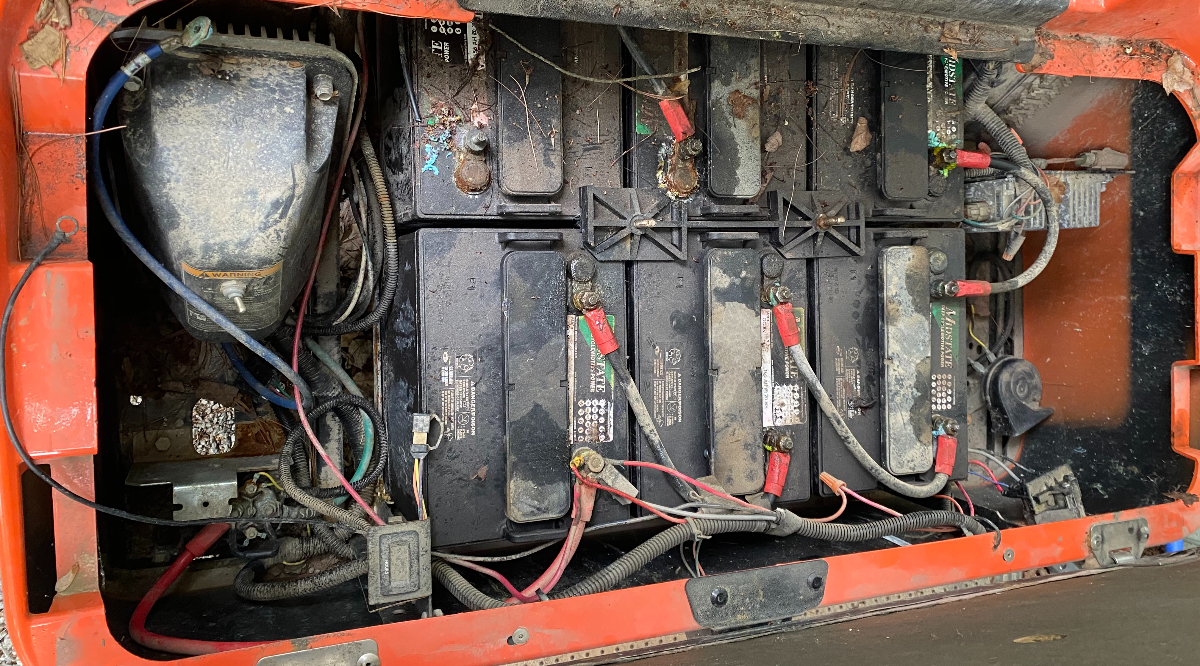
Brandon had his work cut out for him. The photo above shows the old batteries. The one below shows the new Vatrer battery installed and ready to go. He and his family build race cars and have a full metal fabrication shop onsite. This was his first lithium-ion battery conversion, so he spent time on the internet and on YouTube educating himself about the process. The finished product shows his meticulous attention to detail.
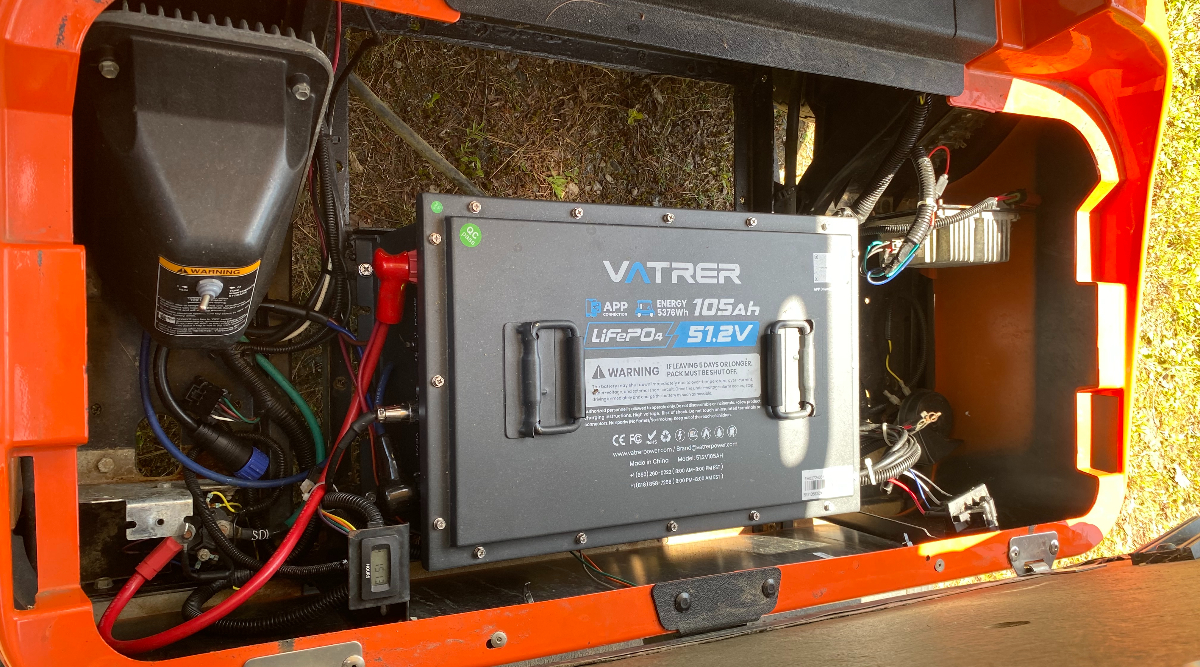
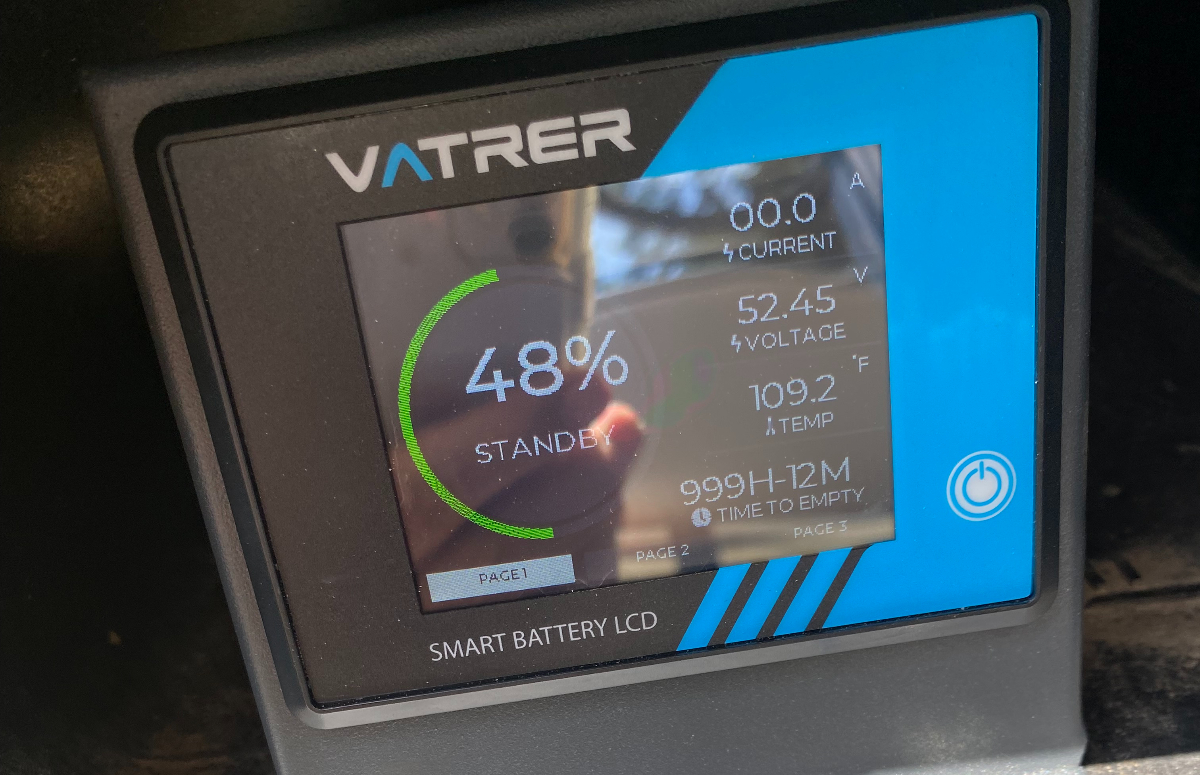
Brandon also installed the display screen, so it is clearly visible to the driver but not prone to being bumped or broken in normal use. The screen displays state of charge and anticipated range for a given throttle opening. For instance, it will tell you that at wide open throttle, you have enough energy for about four hours of operation. We almost never use more than part throttle, so I anticipate needing to charge the battery only about once a month. The battery has a 10 year design life and is rated for 4000 cycles. The way I use Pumpkin, that means my grandkids will probably still be using it when America celebrates its 300th birthday.
All carts have lights and a horn — accessories that run on 12 volts. As I was doing my own research (see video below), I found a lot of chatter about installing a 48 to 12 volt converter. With Vatrer, there is no need to worry, because the voltage converter is included in the package.
Brandon installed it and dressed the wires in a very professional manner. The package also includes a 20 amp charger that takes a couple hours to bring the state of charge back up to 100 percent. Another feature built into the Vatrer battery is an app that allows owners to monitor the status of the battery remotely. That is a nice feature to have, as it will allow me to keep tabs on things during the winter.
My wife and I also have a 2017 Chevy Bolt with the second-generation battery that GM created together with LG Energy to address the battery fires that plagued early examples of that car. Every year, it spends the fall, winter, and spring beneath a car cover, waiting patiently for us to return. While it is idle (we do put a trickle charger on the 12 volt battery), it loses about five percent of its charge, so I have learned not to be too concerned about lithium-ion batteries losing their charge during long periods of inactivity.
The Vatrer battery arrived with 52 percent SOC. I estimate it was dormant for more than a year after it left the factory, got shipped across the ocean, sat in a warehouse, then got trucked across the continent to my campground, where it stayed for several months before it got installed, so I am not concerned about it losing its charge next winter.
With the Vatrer battery, there is no complicated shutdown procedure. There is a button on the right side of the battery. Push it to activate the battery and it glows bright green. Push it again, and the battery shuts down. The company recommends turning the battery off if it will not be used in the next five days.
My camping community has hundreds of campsites built into the side of a mountain. Accessing the upper sites requires quite a bit of energy. Pumpkin used to slow down noticeably going up steep grades, but now it acts like they aren’t even there. Top speed is the same as with the old batteries, but there is reserve power in the Vatrer battery that was not available before. Today, Pumpkin drives like brand new and I couldn’t be happier.
I want to give a shoutout to Brandon at Protek Autoworks. He was attentive to my needs, and his work is neat and professional. He can be reached by email or you can text him at (860) 749-3780. If you are anywhere near Somers, Connecticut, and need service for your golf cart, he is the one to call. Thanks, Brandon. Great job!
Sign up for CleanTechnica's Weekly Substack for Zach and Scott's in-depth analyses and high level summaries, sign up for our daily newsletter, and follow us on Google News!
Have a tip for CleanTechnica? Want to advertise? Want to suggest a guest for our CleanTech Talk podcast? Contact us here.
Sign up for our daily newsletter for 15 new cleantech stories a day. Or sign up for our weekly one on top stories of the week if daily is too frequent.


CleanTechnica uses affiliate links. See our policy here.
CleanTechnica's Comment Policy

