
Tesla Has A Blowout Q2 — The Story Behind The Numbers
Support CleanTechnica's work through a Substack subscription, on Patreon, or on Stripe. Help us produce all of the high-quality, original content we publish week after week despite the challenges of content-scraping AI, antisocial media, inflation, and other hurdles.
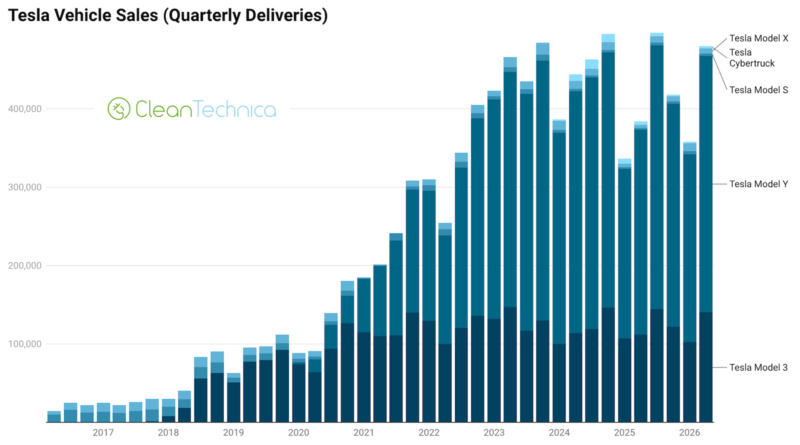
Although Zach did a great job of covering Tesla’s sales report, I want to mention a few other factors and talk about the broader market. Tesla’s strong Q2 deliveries resulted from converging tailwinds: elevated oil prices from the Iran conflict, refreshed Model Y and YL demand, US incentives, new market launches in Colombia and Morocco, and rising European production. Supply increases position Tesla well for further growth as FSD advances.
Factors Affecting Second Quarter Sales
- The biggest factor worldwide was the Iran war in my opinion (even if some people refuse to call it a war). Strait of Hormuz disruptions slashed ~20% of global oil supply after the Iran war kicked off February 28, sending Brent crude soaring 50–60%+ to $100–120+/barrel peaks. Worldwide gasoline prices jumped 30–50%+, with US averages climbing above $4/gallon from ~$3 pre-war. This helped sales of electric vehicles (EV) and hybrids globally. In the US, it has helped hybrid sales more with most automakers, since that’s what they’ve had available to sell and many in the US still aren’t ready for an EV. Even with the higher gas prices, though, fueling an average gas car is still pretty affordable in the US, so it was a modest tailwind. In some other markets where prices rose more sharply and where they had actual shortages of fuel (like Australia), EV and hybrid sales were driven sharply higher. Although oil prices have come down significantly, I’m not very confident the peace deal will hold for long, and as long as there is fighting in the Persian Gulf, I would expect oil prices to be elevated enough to help sales of EVs and hybrids.
- It was an easy year-over-year comparison, because last year Tesla was still ramping production of the refreshed Model Y.
- Tesla offered big incentives on several of its most popular models in the US. Low-interest financing and free options can save a buyer up to $8,000 on a car, and considering most Tesla vehicles are priced less than the average new vehicle, they are very affordable even before considering fuel and maintenance savings.
- Tesla started delivering cars in Morocco and Colombia this year, and is preparing to enter Uruguay and Argentina soon. This drives a modest increase in demand. Columbia shows that there may be pent up demand in some countries. Who would have thought that the Model Y would become the best selling model in the country so quickly?
- Although our own Larry Evans was not too impressed with the new larger Model YL, buyers in many markets — like China, Australia, and South Korea — are buying it at a surprising pace. I owned a series of three minivans for about 30 years. First, for the room to relax on long trips, but later, because three rows was very helpful at reducing the fights between my 3 kids. Although the Model Y has had three rows for years, most (including myself) considered the third row too small. The third row in the YL isn’t as big as a minivan, but it is close enough for many. There is significant pent up demand for a bigger Tesla. The Model YL is similar in interior room to the Model X and MUCH less expensive. So a lot of people who wanted an X but just couldn’t swing it will likely buy the YL, either the launch edition if they can’t wait or the regular edition, which will likely be less than $55,000 in the US — but without all the extras in the launch edition.
- The Standard Model Y and Model 3 are not selling in great numbers, but they are opening up the market a little to people who can’t or don’t want to spend what it costs to buy the premium Model Y and Model 3. If Tesla surprises us by selling a smaller vehicle based on the Cybercab, it will open up the market further. Farzad’s insistent they will add a steering wheel and pedals to the Cybercab. I’m not convinced, but will be following it closely.
- You don’t just need demand to increase sales, you need supply too. Tesla stated on its first quarter earnings call in April that it was expecting a “significant increase in vehicle production in the future.” My impression is they are doing that to support the increased demand they expect for their vehicles as Full Self Driving (FSD) Supervised and Unsupervised is released in various countries around the globe. Although they continue to make steady progress in the US, Europe, China, and the rest of the world, it is slower than many expected. FSD has its loyal fans (I’m one of them), but it doesn’t seem to be good enough to sell many cars. I’ve said many times that Unsupervised FSD won’t need any advertising, a few viral videos made by the fans will let the world know about it, but it sure seems like it might not be until Version 15, and that might not even be this year.
- Tesla produced about 50,000 more vehicles in the first quarter than it delivered, providing ample inventory to support increased demand.
- Tesla is dramatically increasing production in Europe as sales increase and it expands into more markets.
Conclusion
Overall, Tesla’s strong Q2 deliveries weren’t just about easy year-over-year comparisons or one-off incentives. Multiple forces aligned at the same time. The Iran conflict’s disruption of the Strait of Hormuz created a real, if uneven, tailwind for EVs and hybrids by pushing fuel prices sharply higher in many markets. While the effect was more modest in the US, it was meaningful elsewhere and helped accelerate the shift away from pure gasoline vehicles. At the same time, Tesla addressed both demand and supply: refreshed models (especially the Model Y), aggressive US financing and option incentives, the successful launch of the larger Model YL in key markets, and the opening of new countries like Colombia and Morocco all added meaningful volume. The Model YL, in particular, is tapping into genuine pent-up demand for more family-friendly space at a more accessible price than a Model X.
On the supply side, Tesla entered the quarter with healthy inventory from Q1 overproduction and is now ramping output at Giga Berlin and elsewhere to meet rising demand. This positions the company well as Full Self-Driving continues its gradual global rollout. While unsupervised FSD is still likely further out than many hoped, steady supervised progress and the viral potential of future improvements could become a significant demand driver without traditional advertising.
The combination of elevated (and potentially volatile) oil prices, expanding geographic reach, refreshed and more affordable product offerings, and increasing production capacity give Tesla multiple levers to sustain momentum. If the peace deal in the Gulf proves fragile and fuel prices remain elevated, or if FSD takes another meaningful step forward, the upside could be even larger than what we saw in Q2. Tesla has shown it can adapt quickly when conditions shift, and right now several important conditions are shifting in its favor.
If you want to take advantage of my Tesla referral link to get up three months Full Self Driving, here’s the link: https://ts.la/paul92237 — but if another owner helped you more, please use their link instead of mine.
Disclosure: I am a shareholder in Tesla [TSLA] and XPeng [XPEV]. But I offer no investment advice of any sort here.
Sign up for CleanTechnica's Weekly Substack for Zach and Scott's in-depth analyses and high level summaries, sign up for our daily newsletter, and follow us on Google News!
Have a tip for CleanTechnica? Want to advertise? Want to suggest a guest for our CleanTech Talk podcast? Contact us here.
Sign up for our daily newsletter for 15 new cleantech stories a day. Or sign up for our weekly one on top stories of the week if daily is too frequent.


CleanTechnica uses affiliate links. See our policy here.
CleanTechnica's Comment Policy

