
Trump Tanked RV Sales, But There’s An Opportunity For EV Owners
Support CleanTechnica's work through a Substack subscription, on Patreon, or on Stripe. Help us produce all of the high-quality, original content we publish week after week despite the challenges of content-scraping AI, antisocial media, inflation, and other hurdles.
The RV industry is having a tough time right now.. If you look at the latest numbers that were released recently, you’ll see a market in a steep nosedive. The industry has been notoriously slow to adopt cleaner technologies or even improve basic aerodynamic efficiency, and now that stubbornness is coming back to bite it hard.
Total RV shipments from manufacturers to dealers dropped by 18.7 percent in May 2026, falling to just 22,900 units. The picture for the entire year isn’t looking any better. Through the first five months of 2026, shipments are down 14.4 percent, with only 138,160 RVs shipped compared to the previous year.
Why is this happening? It’s simple. The RV sector tied its entire existence to the volatility of global oil markets because they couldn’t imagine a different world. But, this gives savvy electric truck and SUV owners an opportunity to get a cheap travel trailer and turn it into something that complements their tow vehicle.
Political Failures and Global Chaos
If you know any MAGA asshats, you’ve probably seen a bumper sticker or a T-shirt advertising “promises made, promises kept”. It’s a slogan that regularly gets used as Trump’s team desperately tries to keep their political base happy and intact. While the administration has definitely delivered on some of its more controversial policies, the overall track record just isn’t there.
Nobody’s feeling this much more than the RV industry. Under Biden’s leadership, they started to move on electrification a little, sensing that the electric future was coming. But, when Trump got back into office, they breathed a sigh of relief. They believed him when he said cheap gas was back and here to stay. They thought Trump could deliver years if not decades of industry status quo.
The promise wasn’t kept, and in fact Trump managed to break two promises at once. Instead of not starting any new wars, he kicked a hornet’s nest in Iran. The result was record gas prices in many places and diesel prices that caused everyone’s cost of living to go up.
Now, reality is hitting the fan and the industry is seeing that they’ve been thrown under the MAGA bus. With fuel prices up, many Americans simply can’t afford to operate a motorhome or tow a travel trailer. Sure, there are gas stations everywhere and you don’t have to worry about range anxiety, but wallet anxiety isn’t as easy to avoid in 2026.
If your only product is a giant rolling box that struggles to get six miles to the gallon on a good day, you’re going to lose buyers the second gas prices spike. People simply don’t want to buy a leisure liability that costs hundreds of dollars just to drive to the next state or several thousand (one way) on a cross-country adventure.
Bottom line: The dependence on fossil fuels has fundamentally screwed the RV industry.
Building Your Own Clean Escape
But here’s the exciting part for those of us in the clean tech space. This exact crisis is creating a golden opportunity for electric vehicle owners and off-grid campers.
With demand crashing, dealership lots are overflowing with excess inventory. The numbers are especially brutal for towable RVs, which saw a 21.3 percent drop in shipments this past May. Nobody wants to buy a toy that cuts MPG in half, at least not today.
Dealerships are dealing with floor plan financing costs that are eating them alive, and they’re getting desperate to move these trailers. We’re looking at a serious buyer’s market. If you’re smart, you can get some seriously good deals on a small to mid-sized travel trailer.
You don’t need to wait for old school RV makers to figure out electric mobility, and you certainly don’t need to spend six figures on an over-engineered, self-powered smart trailer. Instead, you can take advantage of the current slump to buy a highly discounted, traditional travel trailer. It might also be possible to get a deal on more efficient pop-up and A-frame campers, but given their more efficient nature, they’re probably going to be a little harder to snag.
Once you get it for a steal, you can take all the money you saved and retrofit it yourself. This will cost more if you need to hire an RV tech to do it, and less if you can DIY all or part of it. Whatever you do, DON’T ATTEMPT ANY OF THIS IF YOU DON’T KNOW WHAT YOU’RE DOING. Safety is a high priority.
First, cut back on the fossil fuels. Most travel trailers are still made to do as many things as possible on propane. But, you can’t buy propane out in the middle of nowhere. So, convert as many of the appliances as you can to run on clean electricity. Put in a heat pump AC unit. Install an induction cooktop. Put in a 12v compressor fridge. Put in a toaster oven or convection microwave.
You might want to leave the furnace connected as an emergency heat source, and it’s tough to get a good shower on electric heat, so consider leaving those two things on propane.
You’ll need a big battery bank to power all of this. Either buy some lithium iron phosphate batteries yourself or have an RV or solar tech install them. Put in as much battery storage as you can and an inverter to power the appliances (especially the cooktop). If you can put enough battery in, size that inverter to power the AC.
Next, put on as much solar panels as possible. I’ve personally had pretty good luck with EcoFlow’s RVMax solar panels, but there are many good options these days.
Finally, run a wire from your EV to the travel trailer. If your truck or SUV has 120 or 240-volt output, run a wire directly into the trailer’s normal power inlet, but be sure to attach the power cable firmly for safety. If your EV doesn’t have native power output, you can often add an inverter to the 12-volt battery and run a cable that way. This gives your RV a big power upgrade using the EV batteries you already paid for.
Bonus points: This is something most people will never do, but it’s possible to do what semi-trucks do and improve the aerodynamics. If you add side skirts and a boat tail (often marketed as “Aero Tail” or “Trailer Tail”), you can improve the towing range by 15-20%. It’s tough to do this and still have the trailer look good, but it could be worth it if you don’t mind getting weird looks at campgrounds.
If you can do all of this (or even most of it), you’ll have the trailer that RV companies should have been building all along, and for a decent overall price.
Before you go, don’t forget to visit Charge to the Parks to see how we’re putting these solar-powered setups to the ultimate test out in the wild. You can also catch my real-time updates and join the conversation over on BlueSky. Let’s keep the adventure going!
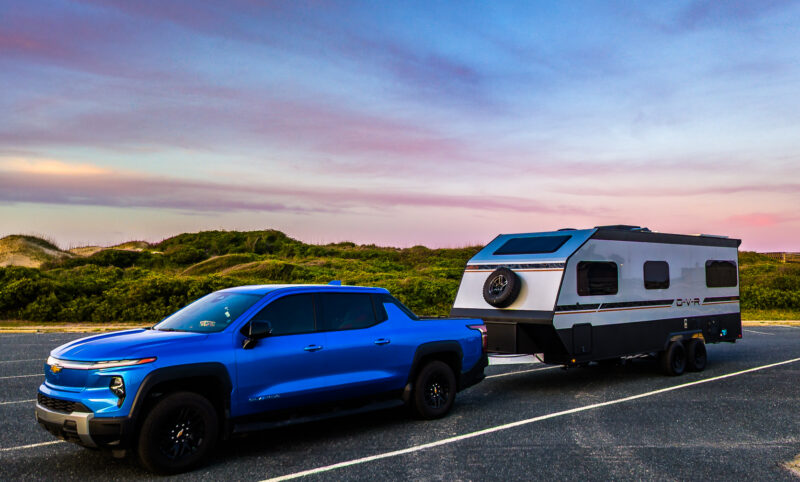
Featured image by Jennifer Sensiba.
Sign up for CleanTechnica's Weekly Substack for Zach and Scott's in-depth analyses and high level summaries, sign up for our daily newsletter, and follow us on Google News!
Have a tip for CleanTechnica? Want to advertise? Want to suggest a guest for our CleanTech Talk podcast? Contact us here.
Sign up for our daily newsletter for 15 new cleantech stories a day. Or sign up for our weekly one on top stories of the week if daily is too frequent.


CleanTechnica uses affiliate links. See our policy here.
CleanTechnica's Comment Policy

