
Aptera Proved Its Solar Generation, Now It Needs To Prove Its Efficiency
Support CleanTechnica's work through a Substack subscription, on Patreon, or on Stripe. Help us produce all of the high-quality, original content we publish week after week despite the challenges of content-scraping AI, antisocial media, inflation, and other hurdles.
My CleanTechnica colleague Tina Casey recently wrote a great piece looking at Aptera’s latest solar tests, titled “Sleek, Futuristic ‘Atlas’ Car Recharges Self With Built-In Solar Cells”. She covered how the company’s validation vehicle recharged itself using its built-in solar cells. The company noted that by repositioning the vehicle during the day to catch more sun, it yielded a peak of 4.6 kilowatt-hours. It got less sitting still all day, as you’d expect, but it still hit the company’s solar targets.
That’s a huge milestone. It proves their curved panels and custom solar charge controller work out in the real world. But pulling in power from the sun is only half of the math equation. In this article, I want to talk about the road ahead to getting the promised 40 miles of daily solar range.
A Tougher Row To Hoe
To turn that 4.6 kWh of total daily generation into 46 miles of range, the car has to hit an efficiency design target of 100 watt-hours per mile. That translates to 10 miles per kWh. For some perspective, most traditional EVs you see on the highway right now get somewhere between 3 and 4.5 miles per kWh. So, Aptera has to prove its vehicle is incredibly slippery and light to make the numbers work.
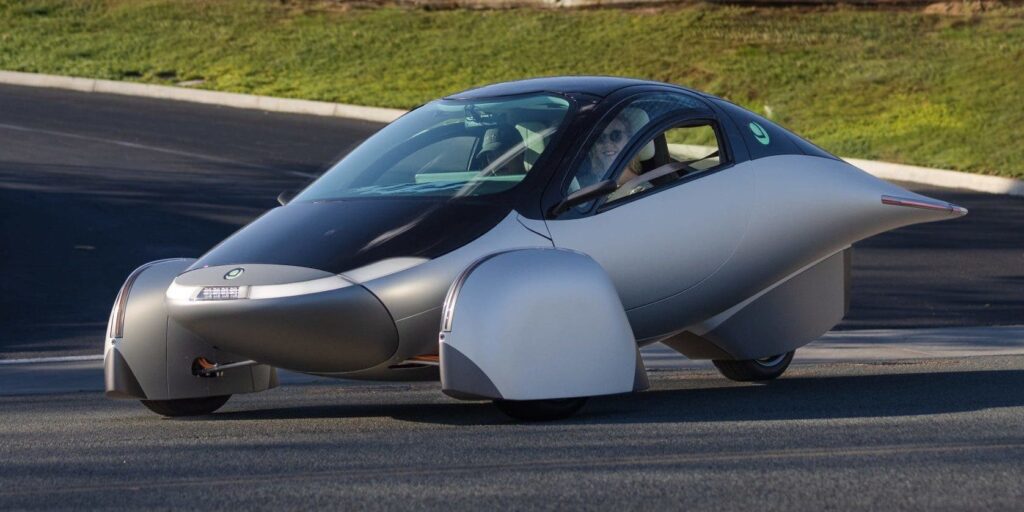
Achieving this might sound impossible to many readers, but it’s well within the realm of physics. Aerodynamics is the biggest hurdle here, especially at higher speeds, but the vehicle does incorporate that clean teardrop shape that prevents vacuum zones from forming behind the vehicle and sucking the car backwards while it tries to go forward. On the rolling resistance side, the car’s made to be very light and it only has three wheels.
But, numbers and simulations don’t pick up groceries. The good news is that the company is actively testing this. They recently published the results of their coastdown testing, which measures aerodynamic and rolling losses. During the test, the Aptera took over three minutes to decelerate from 60 mph to a complete stop. The car even managed to keep rolling uphill on the track. That’s promising, but as they say, “The proof is in the pudding.” Or, as Wendy’s used to say, “Where’s the beef?”
The Pudding Might Be On The Way
If Aptera’s going to achieve this, we won’t have to wait very long for the final proof. Aptera plans to put the vehicle through a third-party validation sequence sometime in July. After that, their engineers are planning to run a full range test and not just extrapolate figures from solar plus a coastdown. They plan to drive the vehicle from a fully charged battery all the way down to 0% to confirm the real-world efficiency across the vehicle’s full voltage range, too.
Once we see the car repeatedly drive 40 miles while only draining 4 kWh from the battery pack, we can definitively say the solar range claim is proven. If the drive cycle tests confirm the 100 Wh/mile target, they will have successfully redefined what an electric vehicle can do at the same time.
Final Thoughts & Why This Actually Matters
This isn’t just a matter of convenience and cost savings. Many people simply don’t have access to home charging, and depending on DC fast charging is both expensive and a giant hassle. The promise of an EV is that you can charge it while you work or sleep, so they’re effectively blocked out from the biggest advantages of EV ownership. Offering a somewhat affordable car that can charge all day sitting in an apartment parking lot or on a street coule prove to be a game changer for EV adoption.
I personally hope to see them smash the number and get better than 40 miles once the final consumption figure is multiplied by the generation figure. Why? Because not everyone lives in sunny southern California. I live in New Mexico, and my Aptera will probably do even better. But, I want it to deliver decent range when I’m visiting other places, too. I probably won’t get 40 miles in North Carolina, but even getting 20-30 would be a big plus.
Before you go, don’t forget to visit Charge to the Parks to see how we’re putting EVs to the test out in the wild. You can also join the conversation and catch my real-time updates over on BlueSky. Let’s keep the adventure going!
Featured image by Aptera.
Sign up for CleanTechnica's Weekly Substack for Zach and Scott's in-depth analyses and high level summaries, sign up for our daily newsletter, and follow us on Google News!
Have a tip for CleanTechnica? Want to advertise? Want to suggest a guest for our CleanTech Talk podcast? Contact us here.
Sign up for our daily newsletter for 10–15 new cleantech stories a day. Or sign up for our weekly one on top stories of the week if daily is too frequent.


CleanTechnica uses affiliate links. See our policy here.
CleanTechnica's Comment Policy

