
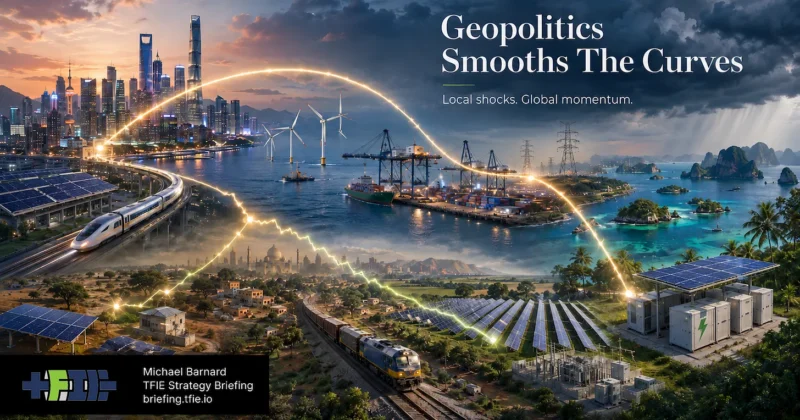
Geopolitics Smooths The Energy Transition Curve
Support CleanTechnica's work through a Substack subscription, on Patreon, or on Stripe. Help us produce all of the high-quality, original content we publish week after week despite the challenges of content-scraping AI, antisocial media, inflation, and other hurdles.
One of the easiest ways to misread the energy transition is to stand inside one country and mistake local political weather for the global climate. A U.S. reversal, European permitting drag, Indian coal and grid constraints, Indonesian diesel politics, Pakistani fuel-price exposure, Chinese overbuild, Gulf hedging, African distributed solar and Latin American commodity cycles can each look decisive from the inside. They are not trivial. They are also not the global transition by themselves.
The global curve is the aggregation of many jagged local curves. Countries stall, surge, obstruct, compete, subsidize, fragment supply chains and make bad short-term decisions. At the same time, they build factories, grids, ports, rail, storage, electric vehicles, processing capacity and deployment experience. That is the point. The transition is not governed by one country’s election cycle or one region’s permitting failure.
This does not depend on elegant global coordination. There is little evidence that the world has suddenly become wise. The transition is increasingly driven by competition, resilience, energy security, affordability, industrial policy, trade advantage, climate damage and the continuing improvement of solar, wind, batteries, grids, motors, heat pumps, electric vehicles and digital controls. Some of that competition is wasteful or protectionist. Some produces announcements instead of assets. Enough of it still produces learning, manufacturing scale and infrastructure.
The United States is the clearest example of why a single-country view is dangerous. U.S. policy can move backward for years, and because the country is rich, loud, militarily powerful and culturally over-covered, that reversal can look globally decisive. It matters enormously inside the United States and for its allies. Investment slows, agencies are damaged, standards weaken and firms hesitate. But the rest of the world does not wait for Washington to become sensible.
China keeps building. Europe keeps regulating and pricing carbon. India electrifies rail and expands solar and grids. Smaller countries, energy importers, mineral exporters, ports, manufacturers and grid operators face their own incentives. A country can damage its own trajectory without becoming the world’s trajectory.
Fossil geopolitics reinforces the same point. Oil, gas and coal are not merely input costs. They are chokepoints, insurance exposure, currency exposure, balance-of-payments exposure and domestic affordability problems. Embargoes, revolutions, wars, tanker risk, pipeline coercion, LNG price spikes, sanctions, cartel discipline and maritime chokepoints have reminded governments for decades that fossil dependence is a strategic vulnerability.
Electrification does not eliminate geopolitics. It changes the exposure. A solar panel, wind turbine, battery, transformer, electric motor, heat pump or rail system is not a cargo of oil or LNG that must be bought, shipped, insured, burned and replaced every day. Durable clean infrastructure shifts energy security away from continuous fuel dependence toward asset buildout, grid integration, manufacturing capacity, materials management, standards, software and maintenance.
That is still geopolitical. Critical minerals matter. Processing concentration matters. Battery manufacturing, power electronics, grid equipment, transformers, cyber risk, shipping lanes and industrial standards all matter. China’s dominance across several clean-technology supply chains is a strategic fact, not a spreadsheet nuisance. But this is a different risk structure than fossil dependence, and it can be managed through industrial strategy, diversification, recycling, standards and infrastructure competence.
China is the largest reason the global curve does not simply follow Western political cycles. Its clean-technology manufacturing, mineral processing, solar and battery scale, rail electrification, HVDC buildout, port capacity and industrial execution have changed the global transition curve. That does not make China benign, risk-free or environmentally pure. It means deployment and cost reduction are not dependent on U.S. or European coherence.
Europe smooths the curve differently. It is slower, more legalistic, more internally fragmented and more exposed to permitting friction. It also has durable tools: carbon pricing, border adjustments, regulation, standards, industrial policy, offshore wind, interconnection and a large market capable of forcing firms to comply. Europe can look painfully slow in one file and structurally serious in another.
India is another case where outside certainty should be handled carefully. It still has coal, diesel, industrial growth, air pollution, poverty, grid constraints and enormous development needs. It also has national-scale rail electrification, large solar deployment, grid expansion, battery and manufacturing ambitions, and a government that treats energy as industrial policy and security. Growth does not automatically become fossil growth when the cheapest new electricity is increasingly renewable and imported fuel exposure remains a strategic problem.
The same smoothing effect shows up under different pressures in Indonesia, Pakistan, Ireland, the Netherlands and other countries. Some are driven by grid planning. Some by fuel import exposure. Some by industrial strategy. Some by affordability. Some by security. None of them is the global transition. Together, they are closer to it.
Trade conflict complicates the curve without cancelling it. Tariffs, local-content rules, export controls, sanctions, anti-China politics, mineral nationalism and industrial subsidies can raise costs and slow deployment. They can also force diversification, regional manufacturing, recycling and strategic procurement. The world can waste money on fragmentation and still move upward because the technologies keep improving and the strategic pressure to control energy systems keeps rising.
The countercase has to stay in view. Geopolitics can slow the transition badly. War can redirect capital. Trade fights can raise costs. Petrostates can subsidize demand. Great powers can weaponize processing capacity. Multiple large regions could slow at once, and if they did, the global curve would suffer. The smoothing effect depends on enough geographies continuing to move, enough firms continuing to learn, enough technologies continuing to improve and enough shocks reminding governments that fossil dependence is not energy security.
For 2100 work, the implication is simple. Do not extrapolate from whichever country is currently making the most noise. U.S. reversal, European permitting delay, Canadian provincial obstruction, Chinese overbuild and Pakistani rooftop solar growth are local signals. None is the global transition by itself. The useful work is understanding how those signals aggregate.
The full TFIE Strategy Briefing article is here: https://briefing.tfie.io/p/geopolitics-smooths-transition-curves
This sits inside WorldView, Michael Barnard’s framing series on useful services, denominators, electrification, molecules, constraints and geopolitics through 2100: https://briefing.tfie.io/p/worldview
For the deeper professional layer behind this argument, subscribe to TFIE Strategy Briefing. Paid subscribers get the country denominator work, geopolitical risk framing, security and affordability tests, deployment evidence, pathway reviews and update triggers behind the public WorldView series.
Sign up for CleanTechnica's Weekly Substack for Zach and Scott's in-depth analyses and high level summaries, sign up for our daily newsletter, and follow us on Google News!
Have a tip for CleanTechnica? Want to advertise? Want to suggest a guest for our CleanTech Talk podcast? Contact us here.
Sign up for our daily newsletter for 15 new cleantech stories a day. Or sign up for our weekly one on top stories of the week if daily is too frequent.


CleanTechnica uses affiliate links. See our policy here.
CleanTechnica's Comment Policy

