
BYD Datang Comparison Reveals Accelerating EV Progress
Support CleanTechnica's work through a Substack subscription, on Patreon, or on Stripe. Help us produce all of the high-quality, original content we publish week after week despite the challenges of content-scraping AI, antisocial media, inflation, and other hurdles.
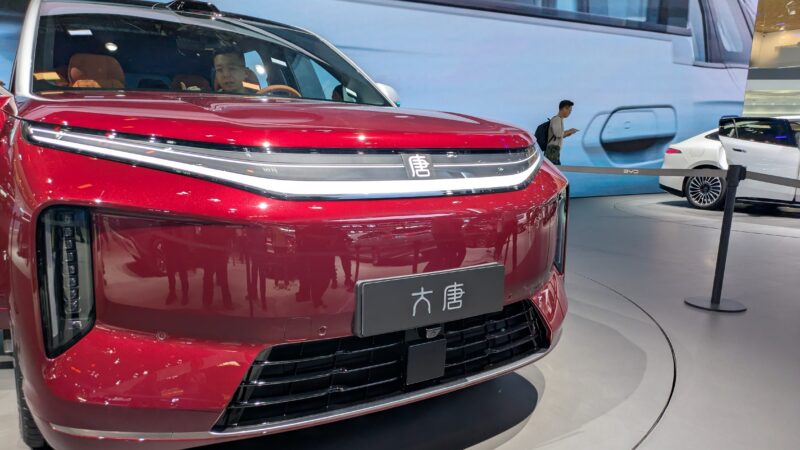
BYD’s Datang EV launched this week. While impressive on its own, the premium SUV becomes more impressive compared to other vehicles in China.
RWD Datang models start at 239,900 RMB ($35,502 USD) for 800 km up to 269,900 RMB ($39,941 USD) for Flagship trim with 950 km of class-leading range (CLTC). The AWD Flagship comes in at 289,900 RMB ($42,908) with 850 km of range and a supercar-like 0-100 km/h time of 3.9s. Above the AWD Flagship, the Grand Edition offers the same capability but adds even more luxurious materials, finishes and amenities for 309,900 RMB ($45,778). All trims include BYD’s LiDAR-based God’s Eye B standard, with BYD assuming responsibility during Level 4 parking and city navigation.
The Datang is part of the new wave of premium, full-size SUV EVs in China, which also includes the hot selling XPENG GX. These vehicles tend to offer levels of performance, technology and amenities that exceed even legacy super-premium luxury brands. However, a comparison with other mainstream SUVs highlights the speed of progress in the Chinese market.

For the default EV comparison, an entry level RWD Tesla Model Y with 593 km of CLTC range starts higher than the Datang at 263,500 RMB ($38,926 USD) in China. However, Tesla Driver Assistance (can’t call it FSD) adds 64,000 RMB to the price, pushing it to 327,500 ($48,380 USD), above the top-of-the-line Datang. However, the standard Model Y really isn’t the most comparable vehicle at over a foot and a half shorter (4790 mm vs 5263 mm for the Datang) with much shorter range (800-950 km for the Datang). The Tesla Model Y and YL are still great EVs, but competitors in China are moving ahead at a rapid rate.
Launched in August of last year, the 4976 mm long Model YL closes almost 40% of the size gap. However, its 751 km range and 4.5s 0-100 km acceleration are still behind the AWD Flagship Datang (850 km & 3.9s, respectively). A 250-kW peak charging rate looks glacial in comparison to the Datang at over a MW. In addition, the Tesla has less space, onboard technology and amenities. When including Tesla Driver Assistance, the YL starts at 403,118 RMB (~$60k), before adding any interior or paint options. Even before the Datang price was announced, the YL already seemed overpriced and under-equipped compared to the competition. Now that we have more details, the value proposition of the Tesla seems even more out of line with the fiercely competitive premium 3-row SUV market in China.

However, a more interesting comparison can be made with BYD’s own Tang L. Introduced a little over a year ago, the Tang L represented the first generation of flash charging with the previous generation battery. The Tang L EV MSRP ranges from 239,800 RMB to 289,800, essentially the same as the Datang. However, the comparison shows how far BYD has come in the past year.
The AWD Datang is rated at 585 kW (784 hp), which is less on paper than the 810 kW (1086 hp) of the Tang L. However, due to a little more torque, gearing and how that power is delivered, they have the same 0-100 km/h time of 3.9s.

The Datang can charge from 10-70% in 5 minutes and 10-97% in 9 minutes. While the ability of the Tang L to add 400 km of range in 4 minutes was impressive last year, it takes 7 minutes to go from 10-70%, according to BYD. Both are on 1000V architecture.
The Tang L EV curb weight ranges from 2675 kg to 2967 kg. Meanwhile, despite being 223 mm longer, better equipped and having a larger battery, the Datang curb weight stays in the same range, from 2640 kg to 2970 kg.

With +/- 7 degrees of rear steering, the Datang has a turning radius of 5.2 m, which is smaller than its length and smaller than some compact cars. For comparison, the Tang L takes 5.8 m. With a more advanced suspension, the Datang will also likely handle better than its size would indicate.
The RWD Tang L offers 670 km of range from a 100.5 kWh battery, while the same battery provides 600 km of range with AWD. Meanwhile, the Datang offers 950 km of range on the RWD version and 850 km for the AWD, from a 130.2 kWh total capacity battery. That means the Datang offers more range and is also more efficient, despite the increase in size and equipment. It doesn’t completely defy physics, as it is not as efficient as some of BYD’s sedans, but an improvement in efficiency while becoming larger and better equipped is not what many would expect.

The Datang interior is configured for two passengers in the first and second rows and three in the third row. This maintains the wide, comfort-oriented captain’s chairs in the second row that have become popular in China, while still enabling seven passengers when necessary. For comparison, the 2-3-2 layout of the Tang L feels more cramped and far less comfortable in the second row.

Beyond all the numbers, having sat in a pre-production model of the Datang, as well as the Tang L, the Datang is a step up qualitatively. Everything just feels more premium. The leather is softer and materials are high quality. And the technology and amenities are a step above. Not that the Tang L was bad, and it is better than many cars available in other markets. But the Datang truly feels world-class, up there with luxury brands. For a company often seen as the mainstream “Toyota” of China, it feels above a Lexus.

Which gets to another important comparison. The new Datang costs less than a locally-produced Toyota Highlander in China. That model ranges from 249,800 to 325,800 RMB ($36,900 to $48,129 USD). If you were to put them side by side, the Datang is almost a foot longer (293 mm), more powerful, offers more room and looks like it is from at least a decade in the future. The Datang is also faster with more advanced suspension and safety systems. Dramatically more advanced ADAS and interior technology. Even the base Datang has more power and is better equipped than the top Highlander. Higher quality materials, more luxury amenities and a much more modern design. In addition, the Datang is an EV that doesn’t sacrifice in range or refueling time vs. ICE, while saving in operating costs.
With the Datang as an example, Toyota is simply outclassed. With the speed of improvement, Toyota is poised to fall even farther behind. BYD’s goal of becoming the world’s largest automaker by the end of the decade looks increasingly possible once production ramps up and their most advanced vehicles reach the markets that let them in.

While Chinese prices are different, a base RWD Model Y that sells for $38,926 in China sells for $39,990 in the US or $41,630 with fees and destination charges. Of note, that same price in China converted to ~$36k last year, but the RMB has risen in value compared to the US Dollar. The gap between market prices isn’t as large as it once was. Once a brand and its sales/distribution infrastructure is established, we could potentially see a similar gap for other models in the US if the politics got out of the way. Especially if the fierce competitive pressure currently seen in China enters the US market and drives down prices.
Large SUV like the Datang might not be your preferred type of vehicle, but it elevates a segment that appeals to many customers. A premium category where many may have previously never considered an EV. The latest vehicles are removing compromises in a segment where customers expect not to have to make compromises, as well as making better vehicles available to people who once thought that they would have to compromise within their budgets. The Datang doesn’t just make electric vehicles available to more customers, but it also makes a fundamentally better vehicle more accessible. In addition, the technology showcased in the Datang is likely to spread to other BYD models.
BYD sales are currently supply constrained and poised for growth once production ramps up. If more markets are allowed the freedom of choice, BYD and their top Chinese competitors could see even more growth. The progress seen in the BYD Datang has implications not just for the company and its competitors, but also for vehicle electrification and the automobile industry overall.
Sign up for CleanTechnica's Weekly Substack for Zach and Scott's in-depth analyses and high level summaries, sign up for our daily newsletter, and follow us on Google News!
Have a tip for CleanTechnica? Want to advertise? Want to suggest a guest for our CleanTech Talk podcast? Contact us here.
Sign up for our daily newsletter for 10–15 new cleantech stories a day. Or sign up for our weekly one on top stories of the week if daily is too frequent.


CleanTechnica uses affiliate links. See our policy here.
CleanTechnica's Comment Policy

