
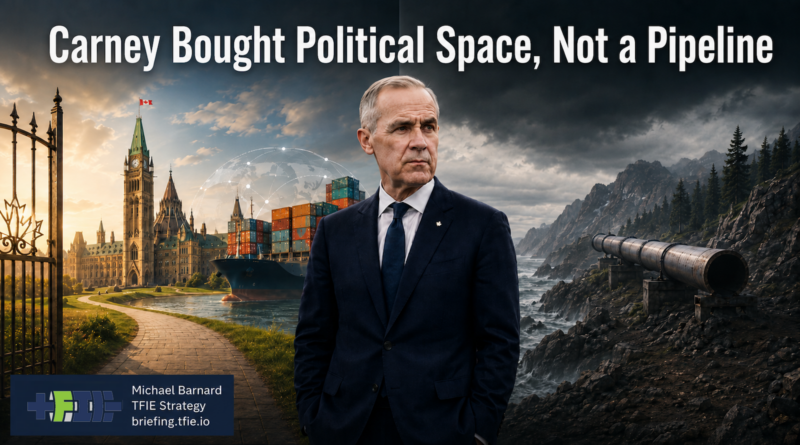
Carney’s Alberta Pipeline Deal Is Strategy, Not A Funded Pipeline
Support CleanTechnica's work through a Substack subscription, on Patreon, or on Stripe. Help us produce all of the high-quality, original content we publish week after week despite the challenges of content-scraping AI, antisocial media, inflation, and other hurdles.
The new Alberta pipeline deal should be read as political strategy first and infrastructure second, if second at all. Prime Minister Mark Carney gets something real from it: a “Canada is open for business” signal, a trade-diversification pathway to point at, and a way to undercut opponents who want to frame Ottawa as reflexively anti-resource, anti-Alberta and anti-build. Those are not trivial gains in a country still heavily exposed to U.S. market risk, regional grievance politics, and a long-running inability to build major projects without turning them into national arguments.
That does not make the pipeline real. In my assessment, this pipeline will never be built. Of course, I said much the same thing about the Trans Mountain expansion, and I was wrong: TMX was eventually completed. But it was completed only after the private-sector economics collapsed, Ottawa bought the project, public costs ballooned, and the federal government inherited the kind of infrastructure hangover that should make it deeply reluctant to repeat the experiment. TMX did not prove that new west-coast oil pipelines are easy in Canada. It proved that one can be forced through if the federal government is willing to absorb extraordinary cost, political risk and execution burden after private capital walks away.
The reported deal raises Alberta’s effective industrial carbon price over time and ties that to a pathway for considering a new Alberta-to-west-coast oil pipeline. Alberta’s own public description presents the agreement as establishing a framework for possible construction, with a start as early as September 2027, subject to obligations around Indigenous consultation and accommodation. That is useful political language, but it remains a long way from a financed project. Canada does not lack pipeline announcements. It lacks the conditions that turn announcements into built infrastructure: capital, a proponent, a route, permits, Indigenous consent, provincial alignment, tanker access, construction economics and durable market demand. Those are not details to be filled in after the press conference. They are the project.
Carney’s political logic is coherent. Canada has a real trade-diversification problem, the United States is an increasingly unstable trading partner, and Canadian governments now need credible ways to show access to non-U.S. markets. Alberta wants another export outlet for bitumen, and Ottawa wants to show that major projects can still move in Canada. A west-coast pipeline gives all of those arguments a convenient focal point. It also helps Carney occupy economic-development ground that Conservatives and Alberta’s government would prefer to control. The strategy is understandable. The project case is much weaker.
The more interesting trade-diversification play is that the pipeline itself is less important than the conversations it opens. In the current energy-security crisis, even the possibility of additional non-U.S. crude reaching tidewater gives Canada a broader negotiating surface with allies. Crude is the door-opener, not necessarily the deal. Once ministers, utilities, industrial firms and trading partners are in the room, Canada can widen the discussion to critical minerals, uranium, AI data-center power, renewables, grid equipment, clean manufacturing, port capacity and long-term energy security. That is useful statecraft. It lets Carney talk about Canada as a reliable supplier of strategic inputs rather than only as a country trying to move more bitumen. The pipeline agreement supports that diplomatic posture even as pipeline itself never becomes a financed project.
That diplomatic usefulness, however, does not reduce the infrastructure test. There is no funded pipeline, no final route, no private proponent with a balance sheet behind it, and no demonstrated project-finance case. B.C. opposition, First Nations opposition, tanker-ban politics, difficult terrain, regulatory risk, cost escalation and oil-demand uncertainty still sit in the middle of the file. None of those problems disappears because the federal and Alberta governments have agreed on a framework. The Union of British Columbia Indian Chiefs has already rejected the idea of fast-tracking an Alberta-to-B.C. oil pipeline through First Nations territories. Governments can talk about consultation and accommodation, but infrastructure across British Columbia is not a line on a map waiting for federal and provincial executives to agree. Consent, rights, legal risk and local opposition are central to whether a project can proceed at all.
The commercial signal is not encouraging either. Cenovus CEO Jon McKenzie reportedly described a proposed west-coast pipeline as currently unfinanceable, citing Canada’s regulatory environment. That is not an environmental NGO talking point. That is one of Canada’s largest oil-sands companies putting a cold project-finance frame around the idea. Canada already spent extraordinary public money, $34 billion, rescuing and completing TMX after the private-sector case failed, and the result will make Ottawa more cautious, not less. Carney isn’t Trudeau and Finance Minister Champagne isn’t a Bay Street M&A suit as Morneau was. When pipeline economics, politics, regulatory risk and construction costs collide, private capital becomes selective very quickly. If another west-coast pipeline requires governments to create the conditions, manage the politics and possibly carry the risk, it is not a market signal. It is a political workstream.
The carbon-pricing bargain does not fix that. Industrial carbon pricing can be useful policy, and Alberta’s emissions problem is real, but tying carbon-market adjustments to a notional pipeline pathway risks making two hard problems look easier than they are. Reducing oil-sands emissions is difficult, expensive and slow. Building a new pipeline to the Pacific through contested geography and politics is also difficult, expensive and slow. Combining them in one political package does not make either denominator smaller. It may make the bargain more sellable, but it does not turn the pipeline into an investable asset.
For climate policy, the optics are ugly. A prime minister trying to present Canada as serious on climate is also giving political oxygen to another bitumen-export route. That has upset environmentalists, Indigenous opponents, B.C. coastal communities and people who think Canada should be using its industrial-policy bandwidth on electrification, transmission, ports, housing, clean manufacturing and resilience instead of another fight over oil-export infrastructure. For political strategy, however, the move is more understandable. Carney gets to say Canada can build, signal that his government is not hostile to resource provinces, give Alberta a reason to stay inside a federal bargain rather than campaign permanently against it, and keep trade diversification in the frame at a moment when Canadian dependence on the U.S. market looks riskier than it did a decade ago.
The hard part is separating those two readings. The deal is politically useful. It is not evidence that the pipeline will be built. My expectation is that it remains a political pathway, not a construction project. Ottawa still has the TMX hangover, and the federal government should understand better than anyone what happens when a pipeline that private capital will not carry becomes a public balance-sheet problem.
Energy politics often treats announcements as assets, but investors, provinces, Indigenous governments and construction firms eventually return to the same filters: capital, route, proponent, consent, permits, cost, market demand and execution risk. Until those have better answers, this is not a funded pipeline. It is a political strategy with infrastructure language attached, and that is not the same thing as a project.
Read the full TFIE Strategy Briefing analysis:
Carney’s Alberta Pipeline Deal Is Ugly Optics, Not A Funded Pipeline
Subscribe to TFIE Strategy Briefing for the deeper professional layer: capital filters, infrastructure-risk logic, denominator checks and decision context for separating political strategy from investable projects.
Sign up for CleanTechnica's Weekly Substack for Zach and Scott's in-depth analyses and high level summaries, sign up for our daily newsletter, and follow us on Google News!
Have a tip for CleanTechnica? Want to advertise? Want to suggest a guest for our CleanTech Talk podcast? Contact us here.
Sign up for our daily newsletter for 15 new cleantech stories a day. Or sign up for our weekly one on top stories of the week if daily is too frequent.


CleanTechnica uses affiliate links. See our policy here.
CleanTechnica's Comment Policy

