
Battery Storage Boom Brings Free Electricity To Australia
Support CleanTechnica's work through a Substack subscription, on Patreon, or on Stripe. Help us produce all of the high-quality, original content we publish week after week despite the challenges of content-scraping AI, antisocial media, inflation, and other hurdles.
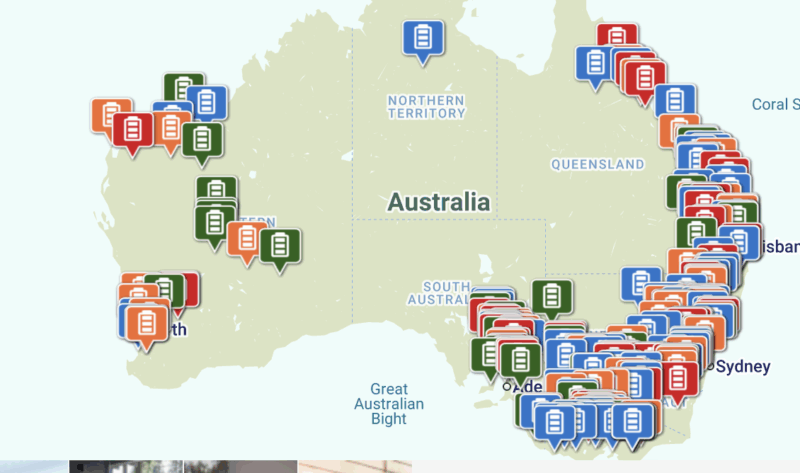
Writing in The Guardian last month, Adam Morton and Petra Stark reported that a large increase in the amount of battery energy storage systems in Australia will permit some residential and small business owners to pay about 10 percent less for electricity in the coming year.
Clare Savage, who heads the Australia Energy Regulator, said the addition of a large number of energy storage batteries, together with more solar and wind power, has reduced system volatility, even as the disruption in energy markets caused by the closure of the Strait of Hormuz has caused severe economic dislocations elsewhere. “Batteries have been displacing more expensive gas and hydro in the evenings, and we’ve just seen flatter prices through the whole day. That’s really translated to lower forward electricity contract prices,” she told The Guardian.
In addition to the large number of new grid-scale BESS installations all across Australia, in the last year, more than 415,000 residential storage batteries have been added to Australian homes. That is roughly one battery for every 25 houses. “It’s amazing,” said Tristan Edis of Green Energy Markets. “It shows again that if you go big with a technology and you kick it off big from the start, you can make a really significant difference. If you’re a battery manufacturer focused on residential right now you really must be focused on Australia.”
“The role of gas used to be in the evening to meet the evening peak and that came at a cost, because gas is not a cheap fuel. But more and more every day, it is batteries that are surging into the market at 6 pm,” Tennant Reed, the climate change and energy director for the Australian Industry Group, told The Guardian. “Gas will still play a backup role, but on average, batteries are not as expensive as gas peakers and they are pushing those [gas plants] out even as electricity demand increases.”
Batteries are an essential component of renewable energy technology. They are what allow solar and wind power to be “dispatchable,” which, in the world of grid-scale electricity, means that when the need arises, electrons will be available. They give the lie to complaints by fossil fuel apologists that the sun doesn’t always shine and the wind doesn’t always blow.
That much is true — up to a point. What that argument overlooks is that when the sun does shine and the wind does blow, solar panels and wind turbines generate more electricity than the grid needs and the excess gets stored in batteries for use later. This time shifting capability is a relatively new concept in the electrical power industry, so perhaps fossil fuel advocates and utility owners simply didn’t read the memo or chose to ignore it.
While solar panel prices fell rapidly a few years ago, it is only in recent years that batteries have become similarly affordable. The unprovoked US attack on Iran and the resulting increase in energy prices has highlighted the advantages of renewable technologies like this. The number of BESS installations around the world has moved from a trickle a few years ago to a growing tide. China is far ahead, spending more on energy storage than all other countries combined. But Australia, with its 27 million people, now ranks fourth in energy storage installations, surpassing many nations with much larger populations.
112 GW In 2025
In May, BloombergNEF announced the world added 112 GW of battery energy storage in 2025 — the first year in which additions topped 100 GW. It predicts the world will add 158 GW of new BESS installations in 2026 and that by a decade from now, battery storage additions will top 300 GW each year. “Deployment in Australia rose nearly sixfold from 2024, driven by favorable power market conditions and a new subsidy scheme for residential storage,” it said.
BNEF added that the war on Iran has had little effect on BESS prices, since China is the primary supplier of energy storage equipment. In fact, as the price of methane increases due to that conflict, the economic case for battery storage may actually improve. Bloomberg also foresees longer term energy storage of 6 hours or more being a small but growing component of the total energy storage picture in the years to come.
Dispatchability
Speaking of dispatchability, Bill McKibben last week told his Substack subscribers that South Australia conducted an auction last week seeking suppliers for “firm power” to the SA grid. “Firm power” is how you say “dispatchable” if you speak Australian. All the low bids came from those who plan to use battery storage to provide that electricity. Not a single low bid was from a thermal generation source.
According to Giles Parkinson of RenewEconomy, “It is yet another sign of the growing dominance of battery storage technology in Australia’s main grids (and off grid). Big batteries have dominated other long duration storage tenders, particularly in New South Wales, where it has sidelined pumped hydro projects, and battery storage has been steadily sending gas peakers to the sidelines, particularly in the demand peaks they used to dominate.”
The Guardian report said that the price of electricity in Australia used to spike every day as the methane-fired peaker plants were called into action, but batteries are increasingly taking over that role. “Total gas-fired generation in Australia was 24 percent lower across three months this summer compared with the year before.” [Emphasis added.]
Citing professor Mark Jacobson of Stanford, McKibben said California, the world’s fourth largest economy, is using 60 percent less methane to produce electricity than it did three years ago. “That changes on this scale are possible is precisely what terrifies the fossil fuel industry, and in turn the Trump administration,” he said.
Free Electricity
As of July 1, 2026, people in Queensland, New South Wales, and South Australia, will get their electricity from 11:00 am to 2:00 pm at no cost. Other Australian states are expected to join the Solar Sharer program one year later. “Australia’s rooftop solar story is staggering. Panels on about 4 million households and businesses across Australia are regularly the biggest source of power in the grid. That wave of solar energy floods the electricity grid during the day when the sun is shining, at times so much that the grid cannot handle it all, and some of it goes to waste,” the AER said.
Claire Savage of AER explained the focus was on choosing the hours when demand on the grid was at its lowest. “We’ve picked those hours after we did some quite extensive modelling. You can imagine — when is the minimum demand in the grid? When do we have the most sunshine? When do we have the lowest prices? When do we have the lowest wholesale prices? When do we have the lowest network prices?”
Savage said the Solar Sharer program has nothing to do with whether a customer does or does not have solar panels on the roof. It applies to everyone, even if they are not a homeowner. “Some people want to make out that Solar Sharer is only going to be beneficial to high wealth individuals who have EVs and batteries. There’s no doubt that they’ll have more load they can shift, but it’s also beneficial to everyone that those people are not charging their cars [during peak demand],” she said.
Like the US, Australia is in thrall to its fossil fuel industry. It is one of the largest exporters of coal in the world. Yet despite pressure from the industry, renewables and battery storage are surging. While Australia does encourage green energy, the key is — and always will be — that renewables cost less than thermal generation and much less than nuclear power. Adam Smith’s “unseen hand” is working its magic Down Under, which means it can do the same anywhere.
If you told Americans their electricity would be free for three hours in the middle of every day, do you think that would be of interest to them or would they demand to pay more for their electricity to support the shareholders of fossil fuel companies? Silly question. Only MAGA types would choose to pay, and pay, and pay. You can lead a horse to water, but you can’t make it drink.
Sign up for CleanTechnica's Weekly Substack for Zach and Scott's in-depth analyses and high level summaries, sign up for our daily newsletter, and follow us on Google News!
Have a tip for CleanTechnica? Want to advertise? Want to suggest a guest for our CleanTech Talk podcast? Contact us here.
Sign up for our daily newsletter for 15 new cleantech stories a day. Or sign up for our weekly one on top stories of the week if daily is too frequent.


CleanTechnica uses affiliate links. See our policy here.
CleanTechnica's Comment Policy

