

Automakers Have Only Themselves To Blame For Losses On EV Investments
Support CleanTechnica's work through a Substack subscription, on Patreon, or on Stripe. Help us produce all of the high-quality, original content we publish week after week despite the challenges of content-scraping AI, antisocial media, inflation, and other hurdles.
US automakers have announced tens of billions of dollars in losses attributable to their EV investments. The carnage started shortly after the federal tax incentive for the purchase of an electric car ended at the end of September last year. This week, Influence Map published a report claiming that industry opposition to environmental regulations — including high pressure lobbying campaigns — may have contributed to the regulatory instability that the industry now faces.
That report points out that US automakers have often emphasized the need for stable environmental regulations, citing the substantial time required to develop and manufacture new vehicles. And yet, many of them have lobbied vigorously for rolling back emissions regulations in the US. That effort has run counter to a strong global trend towards the electrification of road transport, further accelerated by high oil prices resulting from the conflict in Iran, and the Intergovernmental Panel on Climate Change (IPCC)’s warnings that ambitious government regulations are needed to decarbonize the industry.
At the same time, the companies have worked hard to disguise their lobbying activities, keeping their own investors in the dark about their lobbying for the rollbacks that are causing regulatory chaos for the industry. Now the US automotive industry appears to be in crisis. Car companies are rapidly pivoting away from their decarbonization strategies. That has a number of negative consequences. In addition to incurring substantial financial losses, the US auto industry is falling further and further behind in global EV production and is poorly positioned to comply if a future administration reinstates US environmental regulations — as the Biden administration did after regulations were weakened under the first Trump administration.
A History of Harmful Lobbying
The losses from EV campaigns are staggering. Stellantis has announced a $26.2 billion loss, Ford — $19.5 billion, Honda — $15.7 billion, and General Motors — $6 billion. All of these manufacturers lobbied aggressively for the elimination of established climate regulations, including Advanced Clean Cars II, Advanced Clean Trucks, and federal GHG emissions standards. Those regulations would have pushed the market towards electric vehicles and required them to continue their investments in EV manufacturing. “Instead, through their negative advocacy on climate policies, manufacturers have undermined their long-term stability,” Influence Map claims.
The Advanced Clean Cars II regulation was adopted by 12 states and required manufacturers to sell increasing numbers of electric vehicles, reaching 100% of vehicle sales by 2035. Those 12 states account for a third of the total US new vehicle market. However, the Alliance for Automotive Innovation pushed the federal government to repeal the ACC II rule last year. In May 2025, the Alliance, Stellantis, General Motors, and Toyota all supported a bill that would repeal ACC II.
Leo Menninger of Influence Map said, “The auto and trucking sectors are both contributing to the regulatory uncertainty that plagues their businesses today, as demonstrated through a convoluted record of lobbying for flimsy rollbacks on environmental policies and engagement through industry associations they pay dues to. While some companies acknowledge the business risks of rolling back regulations like the 2009 Endangerment Finding, some of their industry associations are actively protecting the rollbacks in court.”
Advanced Clean Trucks
Heavy-duty truck manufacturers have flip flopped on the Advanced Clean Trucks (ACT) policy, a regulation that required manufacturers to sell increasing amounts of electric trucks in participating states. In 2022, truck manufacturers opposed ACT, with a coordinated lobbying campaign across multiple US states. In July 2023, the major manufacturers reached a compromise with regulators to meet the goals of Advanced Clean Trucks in California and to cease oppositional lobbying campaigns in other states.
Companies that signed on to the Clean Trucks Partnership included Cummins, Daimler Truck North America, General Motors, Hino, Ford, Volkswagen subsidiary Navistar, PACCAR, Stellantis, Volvo Group, and the Truck and Engine Manufacturers Association (EMA). In 2025, however, some of these companies again reversed their positions. Daimler Truck, PACCAR, Volvo Group, and Volkswagen subsidiary International Motors filed a lawsuit against California in August 2025, seeking to void the Clean Trucks Partnership, and the EMA opposed the Advanced Clean Truck pact in July 2025 regulatory comments.
Emissions Standards
For years, auto manufacturers have lobbied to weaken GHG emissions standards. Since last year, manufacturers have grown more bold in their negative advocacy, calling for bigger cuts to regulations. In March 2025, General Motors, Stellantis, and Toyota endorsed the Transportation Freedom Act, which would repeal all existing GHG emissions standards and replace them with weaker ones. The Transport Project, which represents Cummins and Volvo Group, requested that the Environmental Protection Agency rescind the existing emissions standards for heavy-duty vehicles in a March 2025 press release.
This negative lobbying and opposition to emissions standards preceded the recent repeal of the 2009 Endangerment Finding, the legal foundation for federal emissions standards. Only four automakers — Ford, Honda, Rivian, and Tesla — strongly opposed the repeal, specifically citing concerns about the impact on regulatory stability.
Honda said in a statement, “This legal uncertainty could place the automotive industry (including automakers and suppliers) into a state of prolonged regulatory limbo, hindering long term planning, US investment, and product development cycles that span many years.” For its part, Ford said, “Eliminating standards altogether is not likely to provide the industry with the long term stability we need to make historic investments in America and compete globally.” Tesla chimed in by saying, “This clear regulatory structure has provided incentives for continued innovation in motor vehicle technology and is vital to continued global competitiveness by companies based in the United States.”
The Truck and Engine Manufacturers Association originally said that “vehicle manufacturers are not in a position to absorb or plan around those potential increased litigation risks” from the repeal of the endangerment finding. However, after the rollback was finalized, the association intervened in a lawsuit to support the repeal.
The very same month, Traton, a subsidiary of Volkswagen, stated in its annual report that the repeal of the endangerment finding “presents significant regulatory and market risks” and “increases regulatory volatility, exposure to stranded asset, and potential misalignment with global sustainability trends.” Daimler Truck also aligned itself with the rollback and supported the repeal of the endangerment finding and federal emissions standards.
Why would major corporations like these support the removal of all exhaust emissions regulations? Craig Segall, former Deputy Executive Director of the California Air Resources Board, said, “For a lot of these sectors, the assumption is that they always get a bailout. The history of the last 20 years is, you do a deal, a new president comes in, you break the deal, your sales crater, and you get bailed out, going all the way back to Japanese auto competition in the 80s and 90s.
“What probably needs to start happening is folks saying, ‘We absolutely want to support a domestic industry, but you don’t get to endlessly make incredibly expensive, polluting vehicles that hurt your market share and our communities.’ Civil society leaders and politicians need to articulate that we don’t need to be running a legacy museum of internal combustion engines on this continent. We need these companies to be affirmative partners.”
The Case for Disclosure
The negative lobbying by US vehicle manufacturers has called for exactly the deregulatory actions currently roiling the industry. Many of the companies do not fully disclose their lobbying strategies and activities to investors, however. By failing to do so, they leave their investors and stakeholders in the dark about policy decisions made behind closed doors that might pose risks to their business models.
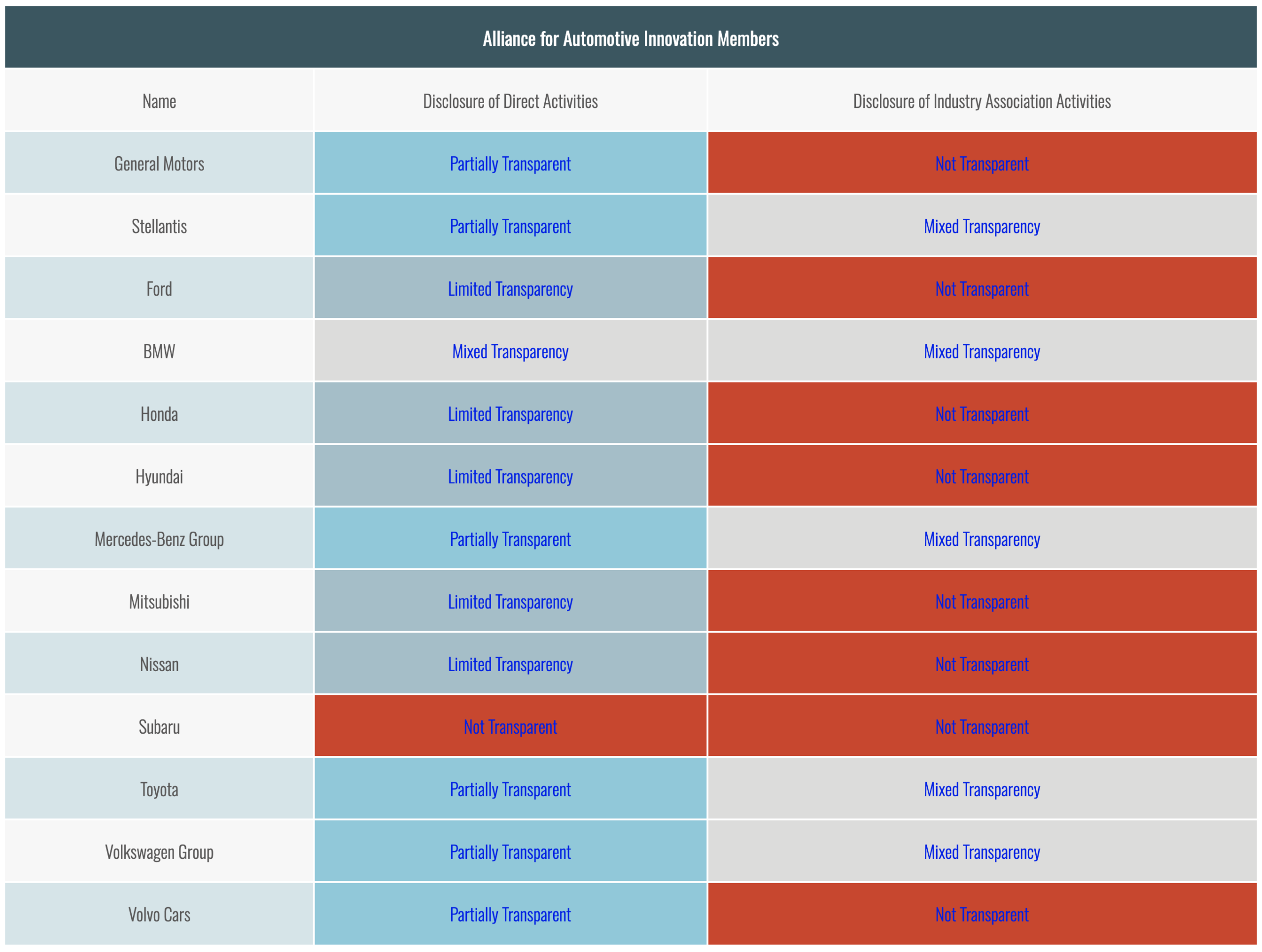
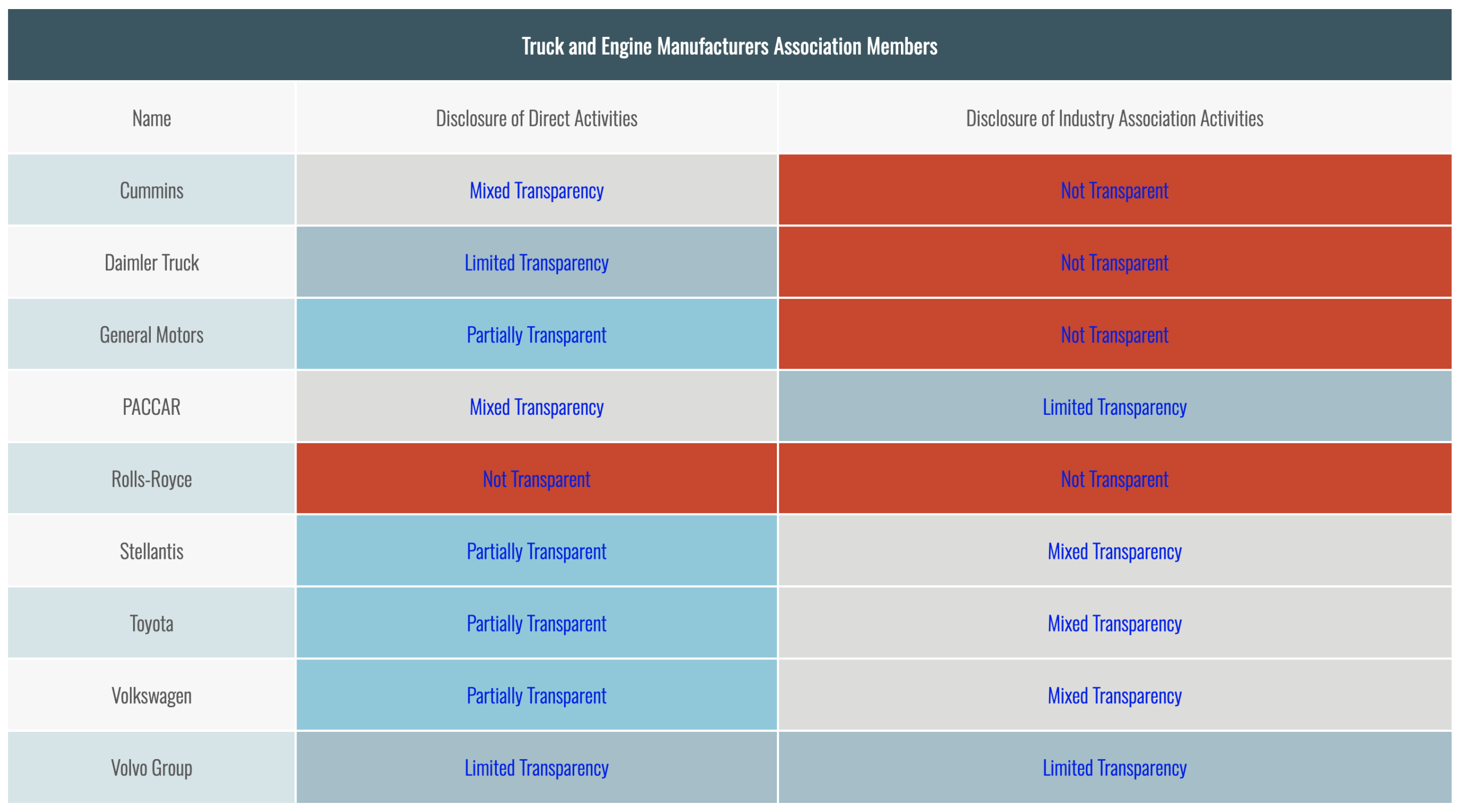
Influence Map analyzed the corporate lobbying disclosures of the members of the Alliance of Automotive Innovation and the Truck and Engine Manufacturers, covering most major light- and heavy-duty vehicle manufacturers in the US, and found that no major US manufacturer is fully transparent in disclosing its own direct policy engagement activities or the activities of its industry associations.
Honda has gone on record as saying, “Other major automotive markets around the world, including Europe and Asia, are continuing to tighten their emissions regulations…. If the US market were to become a ‘low-regulation’ outlier … such regression would not only harm American consumers but also risk global competitiveness — ceding leadership in automotive innovation to other countries.”
Influence Map says, “With improved disclosure of lobbying activities, investors can encourage companies to align their policy engagement with the IPCC’s recommendations and create a regulatory environment that keeps manufacturers competitive through the energy transition.” That, of course, would require looking beyond the end of next week and actually being responsible corporate citizens instead of greed heads.
Sign up for CleanTechnica's Weekly Substack for Zach and Scott's in-depth analyses and high level summaries, sign up for our daily newsletter, and follow us on Google News!
Have a tip for CleanTechnica? Want to advertise? Want to suggest a guest for our CleanTech Talk podcast? Contact us here.
Sign up for our daily newsletter for 15 new cleantech stories a day. Or sign up for our weekly one on top stories of the week if daily is too frequent.


CleanTechnica uses affiliate links. See our policy here.
CleanTechnica's Comment Policy

