
In Colombia, 57 Nations Chart A Path To A Future Without Fossil Fuels
Support CleanTechnica's work through a Substack subscription, on Patreon, or on Stripe. Help us produce all of the high-quality, original content we publish week after week despite the challenges of content-scraping AI, antisocial media, inflation, and other hurdles.
News that has the power to affect the course of history does not always get reported on the front page. For instance, the climate talks among nearly sixty nations gathering in Colombia for a climate summit this week got mentioned down near the bottom of the New York Times digital edition, right above an article about seven recipes for chicken that people rave about. And yet, when people look back in a few decades — or a few years — and wonder whatever happened to fossil fuels, those talks may figure prominently.
The Guardian, contrary to most of the mainstream press, did cover the talks in some detail and reported they resulted in the governments who participated being asked to develop national “road maps” that set forth how they will end the production and use of fossil fuels. Those voluntary plans will form the basis of a new initiative to wean the world off coal, oil, and methane.
The approach marks a departure from the annual UN climate negotiations, which have run for more than three decades even as greenhouse gas emissions have continued to rise. The world’s biggest carbon emitters ignored the talks in Colombia, including the US, which is firmly in the grip of oil and gas interests who are raking in obscene profits as a result of the war of choice against Iran.
Yesterday, King Charles addressed the US Congress. His remarks differed substantially from those of the so-called president. He asked the members of Congress to “reflect on our shared responsibility to safeguard Nature, our most precious and irreplaceable asset. Our generation must decide how to address the collapse of critical natural systems, which threatens far more than the harmony and essential diversity of Nature.” His words were a not so subtle slap in the face to his host.
Disaster At COP 30 Lit The Fuse
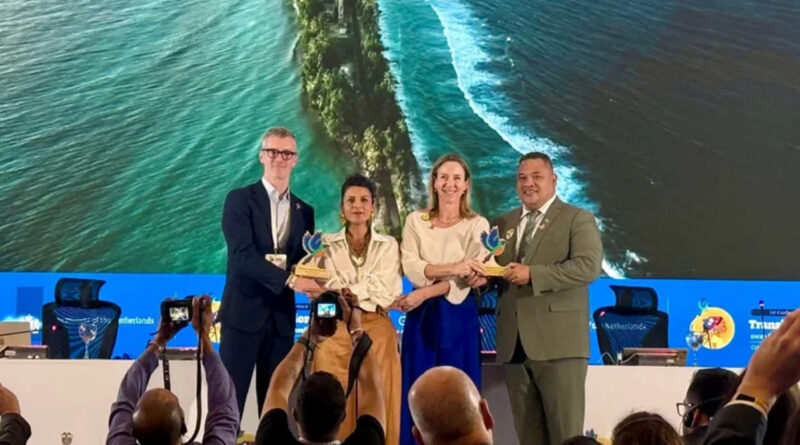
Carbon Brief today published a report by Daisy Dunne, who attended the talks in Colombia. She wrote, “The idea for a specific fossil-fuel transition conference hosted in Colombia first emerged during tense end-game negotiations at the COP 30 climate summit in Belém, Brazil.” A group of 80 nations pushed for a “road map” away from fossil fuels in the formal COP 30 outcome text. When that initiative failed, Colombia and the Netherlands jointly announced that they would co-host a summit in Santa Marta in April.
Colombian environment minister Irene Vélez Torres emphasized the importance of science, telling journalists, “We need to go back to science and base our decisions on science.” Sharp eyed readers will note that the US administration this week eviscerated the National Science Board and fired all its members.
Torres told the press that countries including China, Russia, and the US were not invited because they had not shown the necessary spirit to be part of the “coalition of the willing” and that Colombia wanted to avoid a rehashing of the lengthy debates at COP 30. Carbon Brief indicated that India also was not invited. Dutch climate minister Stientje van Veldhoven added that the two co-hosts had partially based their invitation criteria on who showed support for the fossil-fuel road map at COP 30. “It was a combination of what happened in Belém and all the existing initiatives that have been driving this agenda for a long time already.”
Many readers will remember the ministers from several middle eastern fossil fuel producing nations sitting stone-faced in Brazil and all the COP conferences since Paris in 2015, stubbornly refusing to consider any alteration to their business model.
A Place For Bonding, Not Negotiations
From the beginning of the meetings this week, the hosts stressed this was not a place for negotiations, but rather a forum for countries and other stakeholders to discuss practical steps to move away from fossil fuels. This format was widely praised by ministers and climate envoys, who described the conversational atmosphere in break-out sessions as “refreshing,” “highly successful,” and “groundbreaking.”
Covering Climate Now reported this week that climate scientist Johan Rockstrom, who is affiliated with the internationally recognized Potsdam Institute for Climate Impact Research (PIK), told those present in Colombia this week, “You are the light in a tunnel of darkness.” After years of UN climate summits rarely even mentioning the words “fossil fuels,” 57 countries representing a third of the world’s economy came to Santa Marta to discuss not whether, but how to leave behind the primary driver of climate change.
The gathering got an unexpected boost when the head of the International Energy Agency said in an interview with The Guardian that the war in Iran has broken fossil fuel markets beyond repair. The interruptions to oil and gas supplies and the resulting price spikes, said Fatih Birol, will forever turn countries away from fossil fuels and toward more secure renewable energy sources. “The damage is done,” Birol said.
Irene Vélez Torres, the environment minister of Colombia, welcomed Birol’s comments. “It seems that many of us are seeing at the same time that fossil fuels cannot provide energy security, because fossil fuels are subject to scarcity, and scarcity can be manipulated,” she said in an interview with Covering Climate Now. How delicious that all the breast beating and hyperventilating about energy dominance and national security by the current US administration has been exposed for the lie it is by its ill-conceived and impetuous assault on international norms when it unilaterally declared war on Iran,
A Suicidal Model For Capitalism
Colombia president Gustavo Petro told those in attendance at Santa Marta this week the world is threatened by a “suicidal” model of capitalism that is leading to war, fascism and the potential extinction of humanity. He blamed fossil fuel interests for taking ever more desperate measures to prevent a transition to green energy. “There is inertia in the power and the economy of this archaic form of energy — fossil fuels — that lead to death. Undoubtedly, that form of capital can commit suicide, taking with it humanity and [other] life,” he said. “The question that needs to be asked is whether capitalism can truly adapt to a non-fossil energy model.”
That is precisely the question those in attendance were wrestling with this week
Stepping Up To The Plate
There were tangible results at this week’s conference. France released what it called “the first national road map” by a developed country to phase out fossil fuels. The plan foresees removing coal from the national electricity grid by 2027 and ending oil consumption by 2045 , with methane to follow 2050.
The Santa Marta conference aimed to accelerate progress at COP 31 this coming November, but its larger impact may come from the economic heft of the conference’s “coalition of the willing.“ Joined in Santa Marta by California, the world’s fifth biggest economy, these countries account for 30% of global fossil fuel consumption. Withdrawing that buying power from oil, methane, and coal over the coming years could accelerate the retreat from fossil fuels, Covering Climate Now said.
CCN asks, “Will the stirring rhetoric that governments expressed in Santa Marta be matched by policies they implement back home? Will more countries and sub-national governments join their ranks? How will the big emitters that did not attend — the US, China, and other fossil fuel producing states and companies — react?” A follow-up conference will take place in February 2027, hosted by the Pacific island nation of Tuvalu and co-sponsored by Ireland. “This is not the end,” Velez declared in the conference’s closing moments. “It is the beginning of a new global climate democracy.” Amen to that and about time.
Sign up for CleanTechnica's Weekly Substack for Zach and Scott's in-depth analyses and high level summaries, sign up for our daily newsletter, and follow us on Google News!
Have a tip for CleanTechnica? Want to advertise? Want to suggest a guest for our CleanTech Talk podcast? Contact us here.
Sign up for our daily newsletter for 10–15 new cleantech stories a day. Or sign up for our weekly one on top stories of the week if daily is too frequent.


CleanTechnica uses affiliate links. See our policy here.
CleanTechnica's Comment Policy

