
Bisita Iglesia In The Age Of Energy Transition: Three Ways To Do It Cleanly
Support CleanTechnica's work through a Substack subscription or on Stripe.
Every Holy Week, millions of Filipinos (wherever they are in the world) take part in Bisita Iglesia (literally, visiting churches), moving across cities and provinces to visit seven churches in a single day. It is a tradition rooted in faith, but in 2026, it is also an unintentional stress test of the country’s transport systems, energy use, and urban design.
Bisita Iglesia became an excuse to become tourists. In an age before faster mobility, it was once a largely local, walking-based devotion. A pilgrimage that has evolved into a highly mobile phenomenon. Whole communities travel by the busload from one parish then visiting other parishes. Private vehicles dominate, traffic intensifies around heritage churches, and energy consumption spikes in short, concentrated windows. Catholics who practice this tradition, bring with them fellowship and also commerce.
In urban centers like Manila, Cebu, and even emerging corridors in Laguna and Cavite, Holy Week mobility patterns resemble micro-holidays. Families plot routes, fuel stations see increased demand, and short-distance trips multiply inefficiently. Internal combustion engine (ICE) vehicles still carry the bulk of this movement, reinforcing dependence on imported fuel—an issue made more acute by ongoing global oil volatility.
From a clean transport perspective, Bisita Iglesia is a snapshot of both the Philippines’ cultural resilience and its infrastructure gaps. The question is no longer whether people will travel—it is how.
CleanTechnica found three people who made their pilgrimage in more practical and cleaner ways.

A Toyota executive to be known only as Vss PH, (until he gives me authority to use his name and photos) walked 29,000 steps or about 20 kilometers to do his church pilgrimage. In a Facebook post he wrote: “Lakad Iglesia (walking to churches). A Maundy Thursday offering and a saving of 1 liter of gas for the nation…1,000 of us saves 1,000 liters and Pesos 100,000.” But if you convert the 20 kilometers in real economy figures, for example a Toyota Vios 1.5, guzzles fuel at about 15 kilometers per liter. So it’s about 1.5 liters at P98.00 per liter is P147 for the distance.
The Manila Times travel writer and vlogger, Joseph Bautista, did his church visits using the Manila Light Rail Transit System (LRT) as the backbone of his route, he mapped a seven-church pilgrimage beginning at Baclaran Church and moving through Pasay, Quiapo, Tayuman, and into Quezon City. Stops such as Sta. Clara de Montefalco Parish, Quiapo Church, and the Archdiocesan Shrine of Espiritu Santo were all accessible by a combination of rail and short walks, with only the final leg requiring a brief jeepney ride. As he noted, “Visita Iglesia doesn’t have to mean long drives and fuel stops,” emphasizing that what matters is “the intention behind the journey — not how you get there.”

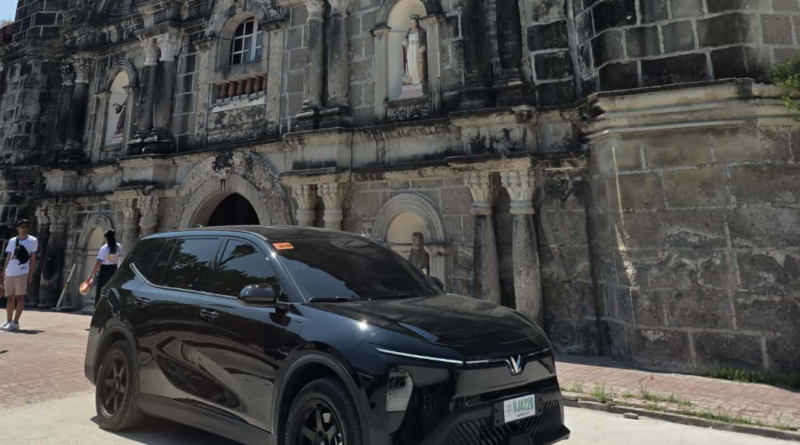
A parallel shift is emerging in private mobility. First-time EV driver James Don David undertook his pilgrimage in a newly acquired VinFast Limo Green vehicle, confronting a different kind of uncertainty. “Every kilometer felt more intentional,” he said, describing how he monitored range more closely than he ever did a fuel gauge, even joking that each Rosary bead might add “1% battery.” The anxiety, however, proved transitional.
“Driving the Limo Green made the journey quieter, more reflective—no engine noise, just you, your thoughts, and your prayers,” Santos observed. “Instead of rushing to the next stop like I used to with an ICE car, I became more mindful, more present.” By the end, the concern over battery life had inverted into something more aligned with the purpose of the pilgrimage itself: “From worrying about running out of power, I ended up being spiritually recharged.”
Electric vehicles (EVs), though still a minority, are uniquely suited to the Bisita Iglesia pattern. The typical route — short, stop-and-go, and often within a 50–100 kilometer radius — aligns almost perfectly with EV range capabilities. Charging can be distributed across destinations: malls near churches, parish parking lots, or even temporary mobile charging setups during Holy Week.
More importantly, EV adoption reframes the journey. A pilgrimage traditionally defined by sacrifice and reflection can now intersect with intentional choices around sustainability. Quiet drivetrains reduce noise pollution around heritage sites. Zero tailpipe emissions improve air quality in densely visited church districts. The act of moving becomes less extractive, more aligned with stewardship.
There is already a foundation to build on.
Several churches and dioceses in the Philippines have begun integrating solar panels into their facilities, reducing reliance on the grid while lowering operational costs. Expanding this to include EV charging infrastructure is a logical next step. A solar-powered parish that can support both worship and mobility becomes more than a spiritual center — it becomes a node in a decentralized clean energy network. Soon the bigger cathedrals will have charging stations in their lot, if our sources from Movem, a charging network builder, are reliable.
Local governments could also play a catalytic role. Temporary road closures, dedicated EV lanes, and incentives for electric public transport, such as e-jeepneys and e-tricycles, can reshape how pilgrims move between churches. Instead of congestion clusters, cities could create distributed, low-emission pilgrimage circuits.
The private sector, particularly retail and property developers, is already positioned to benefit. Many churches are located near commercial centers. Installing chargers in these areas during peak religious travel periods is not just a sustainability move — it is a business opportunity.
Yet the transition is not without friction.
Range anxiety, limited charging infrastructure, and higher upfront costs continue to slow EV adoption. More critically, cultural habits are deeply entrenched. For many families, Bisita Iglesia is as much about tradition as it is about faith, and tradition often resists change.
But traditions also evolve. A century ago, the journey was defined by proximity. Today, it is defined by access. The next phase may be defined by responsibility.
If the Philippines is serious about decarbonizing transport, it will need to address not just daily commutes, but also cultural mobility events like Holy Week. These moments concentrate behavior, amplify demand, and reveal system weaknesses. They are, in effect, live case studies.
Bisita Iglesia, viewed through this lens, is no longer just a religious practice. It is a moving map of how Filipinos travel, consume energy, and interact with infrastructure.
And like any pilgrimage, it invites reflection—not only on faith, but on the path forward.

Sign up for CleanTechnica's Weekly Substack for Zach and Scott's in-depth analyses and high level summaries, sign up for our daily newsletter, and follow us on Google News!
Have a tip for CleanTechnica? Want to advertise? Want to suggest a guest for our CleanTech Talk podcast? Contact us here.
Sign up for our daily newsletter for 15 new cleantech stories a day. Or sign up for our weekly one on top stories of the week if daily is too frequent.
CleanTechnica uses affiliate links. See our policy here.
CleanTechnica's Comment Policy

